The Fight for Pre-K: How Croton Joined a Statewide Push to Fund UPK
A local child care crisis packed Croton-Harmon board meetings and added the community's voice to years of statewide advocacy that helped push New York toward nearly doubling UPK funding to $10,000 per student.
When the Croton-Harmon school district held its lottery for Universal Pre-Kindergarten seats last spring, demand outstripped the available seats — and for the first time, the district couldn't place everyone. It was the beginning of a local crisis that would pack board meetings, generate a petition with more than 750 signatures, and add Croton's voice to a statewide push for adequate UPK funding.
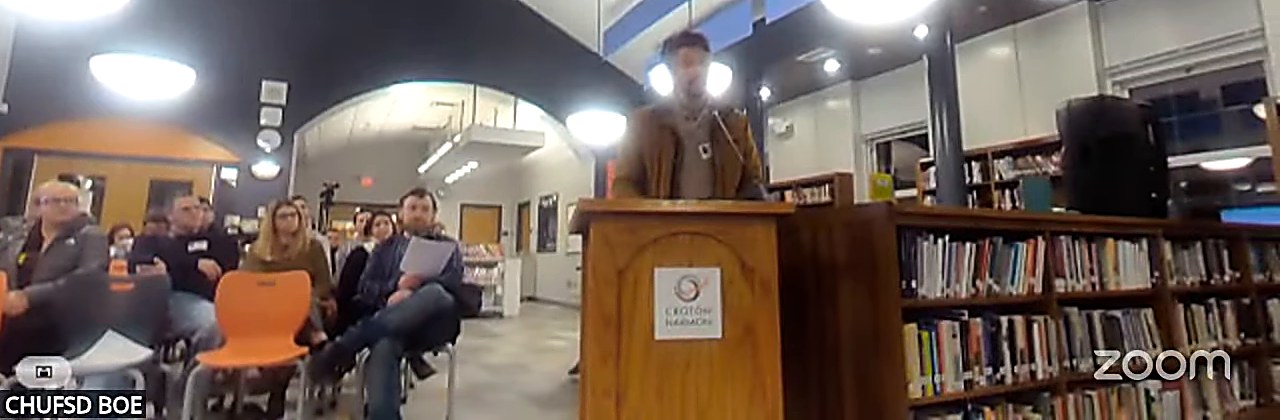
A resident addresses the board during discussion of state funding for universal pre-kindergarten.
The problem wasn't demand. It was money.
New York State funds UPK at roughly $5,400 per student — a figure that hasn't kept pace with the actual cost of providing quality early childhood education, according to district officials and providers statewide. For Children's Space North, the community-based provider that operates Croton's UPK classrooms, the gap had become unsustainable.
"As we heard last board meeting, they will not be able to continue because of the financial constraints," one parent told the board at the pivotal January 8, 2026 meeting, which drew massive turnout for the second consecutive month. "I asked last meeting that there be consideration made for a one-year commitment to bridge that gap." Read 244:07▶
The estimated shortfall was significant — a fraction of the district's overall budget, but one the board felt constrained from filling with local tax dollars without state support. Read 244:01▶
William Mac Shear, a parent and practicing attorney, put the human cost in perspective. "My projected child care costs for my three children, one of whom is in CET kindergarten, for this year, between aftercare, daycare, and summer care is about $72,000," he told the board. He had spoken with the state's Office of Early Learning, which told him directly: "A school district is expected to use local funds to supplement the UPK program. From my perspective, this is clearly an emergency." Read 243:59▶
Superintendent Stephen Walker made a clear pledge that night. "There is no intent from anyone who's seated at this table to allow UPK to flounder, to fail, or to be paused in the system," he said. "That simply will not happen. We will not allow it to happen." Read 244:01▶
But the board's frustration with Albany was palpable. "I wish Kathy Hochul was listening to our board meeting," one board member said. "We're trying to make something work and governmentally, in terms of how things are funded, they're not funded to make it easy for districts to do this, and the people who are left hanging are the people who are in the audience right now." Read 243:49▶
From Advocacy to Action
What followed was a determined local campaign that joined years of statewide advocacy by parents, educators, and early childhood organizations across New York. By January 22, the Croton-Harmon board adopted a formal resolution calling on New York State to fully fund UPK. Governor Hochul's budget proposal included an allocation of $10,000 per student for 2026-27 — nearly doubling the current rate — a figure advocates statewide had long pushed for. Read 140:31▶
Croton parents added their weight. By February, two parents had testified at the Westchester delegation's budget forum. Senator Pete Harkham toured Children's Space North.
At the February 26 work session, the board approved both providers for 2026-27. On March 2, a press conference with state legislators, parents, and Children's Space North owners cemented the effort.
"We were extremely pleased to hear our elected officials speak with such confidence that the governor's proposal of $10,000 per UPK student will be incorporated into the 2026-27 state budget," Walker reported. "The legislative focus has now shifted to advancing the timeline for truly universal access." Read 175:35▶
What's at Stake
One parent framed it in terms the entire community could understand: "Not having UPK essentially would make Croton a gated community — where we wouldn't have a physical gate obviously, but it sends a message that this community is only for people with the wealth and privilege to be able to function here. This is really an equity issue." Read 184:25▶
With the state budget expected in April, a key concern remains: the district has no clear backup plan if state funding falls through. The district removed the option of using classroom space at CET from its UPK request for proposals, citing space constraints — a point parents pressed at the February 12 board meeting. But with both legislative chambers proposing increases, the outlook is cautiously optimistic.
Correction (April 9, 2026): This article has been updated to correct the name of Mike Grubiak (previously misspelled), to remove an inaccurate characterization of the district's backup plan, and to better reflect that the proposed state funding increase resulted from years of statewide advocacy rather than any single community's efforts alone. The petition signature count has been updated to reflect current figures. Specific dollar figures and enrollment numbers cited in the original version without direct sourcing have been removed or attributed.
Share
Community Discussion
0 comments
One email per new comment on this story. You'll confirm by email first; unsubscribe any time. Your address is never shown publicly.
Be the first to comment on this story.
Sent to the editor for review
This is what you asked us to forward to the Village Board:
An editor reads it first. Once it goes, your comment here
will show a ✓ Forwarded to the Village Board mark —
that is your confirmation.
A croton.news explainer dated Apr 8, 2026, Village of Croton-on-Hudson, NY.
●Work session, 6 p.m.: discussion on the use of cameras by the Croton-on-Hudson Police Department; sole attachment is License Plate Reader Case Studies (January 2026)
●Neither the deck nor the packet contains a written camera policy, retention period, audit rule or list of agencies with query access
●Consent agenda, Resolution 187-2026: renew the RICI inter-municipal agreement with Westchester County
●The resolution authorizes a five-year renewal running November 1, 2026 to October 31, 2031; the agreement attached to it runs October 31, 2026 to July 31, 2029
●Westchester County's answer in the plate-reader class action is due August 31
Croton requires paper notice of street and sidewalk defects
●Local Law 7 of 2026 adopted 5-0 on June 17 (Resolution #118-2026); effective on state filing July 14
●The local law requires paper notice to the Village Clerk by hand delivery, certified mail or overnight service, with proof of delivery
●Email, the village website, report-an-issue apps, and village social media are expressly declared insufficient
●The public hearing drew no speakers; scheduling passed on the May 20 consent agenda without discussion
●The Calabrese ruling addressed Albany’s particular reporting system and notice statute; it did not establish that every electronic report in Croton previously qualified
Experimental project: croton.news uses AI to generate articles from public records. Content may contain errors. Please report any inaccuracies and check our corrections log.AI-assisted experimental site — may contain errors. Corrections
Community Discussion
Be the first to comment on this story.
Sent to the editor for review
This is what you asked us to forward to the Village Board:
An editor reads it first. Once it goes, your comment here will show a ✓ Forwarded to the Village Board mark — that is your confirmation.