Croton-on-Hudson, NY · Tuesday, November 17, 2026· Nov 17, 2026Independent, AI-assisted local reporting from public recordsSource-linked·Corrections welcomed
Presentation to Unveil the Croton100 Climate Quilt
▶
Responses To Questions Submitted by Email
▶
Public Comment - Agenda Items
▶
Report from the Village Manager
▶
Consent Agenda
•
Correspondence to the Board
•
Email from Nancy W. Perry, Ph.D., Executive Director of the New York Planning Federation, announcing Christine Wagner as the recipient of the 2025 David Allee Award for ZBA Chair.
Memo from Village Manager Bryan Healy requesting approval to accept a donation in the amount of $1,074.71 from Capriccio Pizzeria & Restaurant to place a bench at Black Rock Park.
Memo from Village Manager Bryan Healy requesting approval to accept a donation in the amount of $2,289.02 from the Holy Name of Mary Knights of Columbus Council for the purchase of new bleachers at Dobbs Park.
Letter from the New York State Justice Court Assistance Program (JCAP) awarding a grant to the Village of Croton-on-Hudson in the amount of $4,500 for security enhancements.
Consider accepting the donations from Capriccio Pizzeria & Restaurant & the Holy Name of Mary Knights of Columbus Council, approving the membership changes in the Croton-on-Hudson Fire Department and filing for the record the email from the New York Planning Federation and the grant award letter from the New York State Justice Court Assistance Program.
Consider scheduling a public hearing on the 2026-2027 Village Budget for March 25, 2026, at 7 p.m. in the Georgianna Grant Meeting Room of the Stanley H. Kellerhouse Municipal Building.
Consider scheduling a public hearing on Local Law Introductory No. 3 of 2026 to amend Chapter 230, Zoning, of the Village Code to address various inconsistencies, update definitions and amend the number of fowl permitted on residential properties for March 25, 2026, at 7 p.m. in the Georgianna Grant Meeting Room of the Stanley H. Kellerhouse Municipal Building.
Consider scheduling a public hearing on Local Law Introductory No. 5 of 2026 to amend Chapter 230, Zoning, of the Village Code to add certain occupational preferences for affordable housing units for April 8, 2026, at 7 p.m. in the Georgianna Grant Meeting Room of the Stanley H. Kellerhouse Municipal Building.
Consider scheduling a public hearing on Local Law Introductory No. 6 of 2026 to amend Chapter 204, Taxation, of the Village Code to add/update various real property tax exemptions for May 6, 2026, at 7 p.m. in the Georgianna Grant Meeting Room of the Stanley H. Kellerhouse Municipal Building.
Consider approving the Croton-on-Hudson Fire Department members in the Length of Service Award Program for 2025 and authorizing its posting for 30 days.
Consider authorizing the Village Manager to execute the 2026 Mount Airy/Quaker Bridge Fire Protection District contract for the period beginning January 1, 2026, through December 31, 2026.
Consider adopting a statement of consistency with the Village's Local Waterfront Revitalization Program for the Half Moon Bay Bridge Reconstruction Project.
Consider authorizing the Village Manager to execute a purchase contract with Seagrave Fire Apparatus LLC of Clintonville, Wisconsin, for the purchase of one Marauder Pumper to replace Engine 119 in the amount of $1,789,929.
Consider authorizing the Village Manager to accept the proposal from CivicPlus of Manhattan, Kansas, to upgrade the Village website in the amount of $8,000.
Consider authorizing the Village Manager to accept the proposal from CGR of Rochester, New York, to conduct an efficiency study of the Village Justice Court in the amount of $19,750.
Consider authorizing the hiring of Joel R. Dichter of Dichter Law LLC as Special Counsel to represent participating Westchester municipalities in monitoring the Con Edison rate settlement at a cost of $1,250 per year.
◆Approved vouchers totaling $266,135.16, using the warrant’s amounts rather than the posted minutes’ ten-cent capital-fund discrepancy.
◆Received Croton 100’s sustainability quilt for display in the Municipal Building.
◆Rejected the $19,750 court-study proposal with all five members voting nay.
The Croton-on-Hudson Board of Trustees meeting on March 11 opened with a celebration of local environmental stewardship, but the board unanimously rejected funding for a proposed review of the village’s justice court.
The meeting featured the unveiling of a collaborative quilt by the group Croton 100, which documents the village's grassroots climate action. However, the procedural highlight was the Board's decision to vote down a resolution that would have funded a study to explore the operations of the Village Justice Court.
A Fabric of Community Action
The board room was crowded with residents eager to see the unveiling of the third quilt created by Croton 100, a local climate action group. Mayor Brian Pugh invited the members to the front of the room to reveal the artwork.
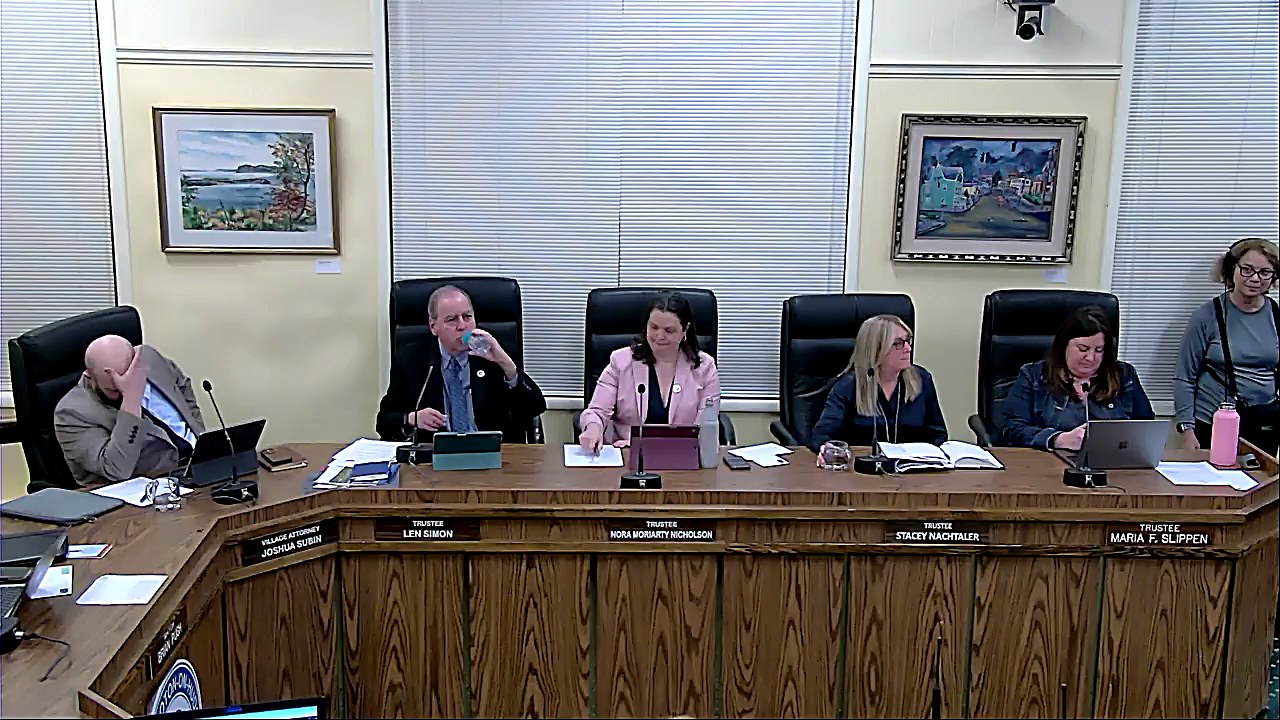
Officials at the dais during the March 11 Sustainability Quilt presentation. Watch this moment
Mayor Brian Pugh described the quilt as an artistic demonstration of grassroots climate action.
Patti Buchanan of Croton 100 explained that the quilt chronicles sustainability efforts across four "pillars" of the community: municipal government, businesses, public facilities, and households. Notably, the quilt highlights the school district's installation of solar panels and electric school buses.
Buchanan explained that the quilt’s four corners illustrate the district’s school buildings and their rooftop solar installations.
The quilt also features contributions from local businesses and specific squares representing 12 different household actions, such as composting and switching to electric heat pumps.
Buchanan said the legend explains the household actions represented on the quilt, including electric vehicles, heat pumps and clean electricity.
In an emotional moment, Buchanan revealed that the border fabric was made from silk saris that belonged to her late mother-in-law, repurposed to symbolize global connections.
Court Study Proposal Voted Down
Following the quilt presentation, the meeting shifted to a more divisive topic: the future of the Village Justice Court. The Board was set to consider a resolution to hire a consultant for $19,750 to review the court's operations, a move many residents viewed as a prelude to consolidation with the Town of Cortlandt.
In a unanimous rejection, all five members of the Board voted against the resolution. The vote was 5-0 against, with Trustee Simon, Trustee Nicholson, Trustee Nachtaler, Trustee Slippen, and Mayor Pugh all voting Nay. The written minutes record: “Trustee Simon Nay, Trustee Nicholson Nay, Trustee Nachtaler Nay, Trustee Slippen Nay, Mayor Pugh Nay. MOTION FAILED.”
Trustee Simon stated that the board intended to set the matter aside and that none of the proposals for studying court operations had the support of all five members at that time. He said all organizations should be subject to periodic review.
Trustee Nora Nicholson said she had not favored court consolidation but had a duty to examine whether village departments operate as efficiently as possible. She said she was proud that the board had listened to residents and one another. The recording transcript attributes these remarks to Nicholson; the written minutes attribute the passage to Nachtaler, the conflict described in the earlier correction above.
The minutes summarize Mayor Pugh’s position: “since the preference of the community is not for consolidation of our court, he does not foresee proposing any study in the future.”Residents Sound Off
During the public comment period, residents criticized the lack of transparency surrounding the study and the potential closure of the court.
Joel Gingold argued that a village cost study would not adequately account for residents’ travel and waiting time at the Town of Cortlandt court, and urged the board not to spend money on the study.
Casey Raskob, the Village Prosecutor, emphasized that state regulations dictate court operations regardless of location, questioning the validity of a study meant to find cost savings.
“No consultant is gonna be able to do something about this and fashion a different result,”Read 36:06▶ Raskob said. He argued that state requirements constrain how local courts operate and defended the Village Court’s work.
Village Justice Sam Watkins, who said he had served for almost twenty years, stated he does not believe moving the court to the Town of Cortlandt will save money and does not believe the Town court would show the same compassion as the local Village Court.
Resident Montana opposed moving the court and warned that it could be a slippery slope toward removing more of Croton's essential services.
Paul Doyle suggested that if the Board insists on moving forward, the study should be subject to a Permissive Referendum.
Financials
In other business, the Board approved the payment of bills: $216,684.13 from the general fund, $10,301.07 from the water fund, $5,437.69 from the sewer fund, and $33,712.27 from the capital fund.
The Board also authorized the purchase of a new Seagrave Marauder pumper to replace Engine 119 at a cost of $1,789,929, approved an $8,000 upgrade to the Village website through CivicPlus, and declared the proposed rehabilitation of the Half Moon Bay Bridge consistent with the Village's Local Waterfront Revitalization Program.
The quilt will be displayed in the Municipal Building for the public to view. The future of the court study remains uncertain, with Mayor Pugh indicating he does not foresee proposing any study in the future.
Meeting documents and agenda items, grouped by agenda item — each links to a searchable text page and its original source.
Full meeting record with summaries →
Consent Agenda — Correspondence to the Board — Email from Nancy W. Perry, Ph.D., Executive Director of the New York Planning Federation, announcing Christine Wagner as the recipient of the 2025 David Allee Award for ZBA Chair.
Consent Agenda — Correspondence to the Board — Letter from the New York State Justice Court Assistance Program (JCAP) awarding a grant to the Village of Croton-on-Hudson in the amount of $4,500 for security enhancements.
Consent Agenda — Correspondence to the Board — Memo from Village Manager Bryan Healy requesting approval to accept a donation in the amount of $1,074.71 from Capriccio Pizzeria & Restaurant to place a bench at Black Rock Park.
Consent Agenda — Correspondence to the Board — Memo from Village Manager Bryan Healy requesting approval to accept a donation in the amount of $2,289.02 from the Holy Name of Mary Knights of Columbus Council for the purchase of new bleachers at Dobbs Park.
Consent Agenda — Resolutions — Consider accepting the donations from Capriccio Pizzeria & Restaurant & the Holy Name of Mary Knights of Columbus Council, approving the membership changes in the Croton-on-Hudson Fire Department and filing for the record the email from the New York Planning Federation and the grant award letter from the New York State Justice Court Assistance Program.
Consent Agenda — Resolutions — Consider approving the Croton-on-Hudson Fire Department members in the Length of Service Award Program for 2025 and authorizing its posting for 30 days.
Consent Agenda — Resolutions — Consider authorizing the Village Manager to execute the 2026 Mount Airy/Quaker Bridge Fire Protection District contract for the period beginning January 1, 2026, through December 31, 2026.
Consent Agenda — Resolutions — Consider authorizing the Village Treasurer to amend the 2025-2026 General Fund Budget in the amount of $48,261.28 for snow removal costs.
Consent Agenda — Resolutions — Consider scheduling a public hearing on Local Law Introductory No. 3 of 2026 to amend Chapter 230, Zoning, of the Village Code to address various inconsistencies, update definitions and amend the number of fowl permitted on residential properties for March 25, 2026, at 7 p.m. in the Georgianna Grant Meeting Room of the Stanley H. Kellerhouse Municipal Building.
Consent Agenda — Resolutions — Consider scheduling a public hearing on Local Law Introductory No. 5 of 2026 to amend Chapter 230, Zoning, of the Village Code to add certain occupational preferences for affordable housing units for April 8, 2026, at 7 p.m. in the Georgianna Grant Meeting Room of the Stanley H. Kellerhouse Municipal Building.
Consent Agenda — Resolutions — Consider scheduling a public hearing on Local Law Introductory No. 6 of 2026 to amend Chapter 204, Taxation, of the Village Code to add/update various real property tax exemptions for May 6, 2026, at 7 p.m. in the Georgianna Grant Meeting Room of the Stanley H. Kellerhouse Municipal Building.
Consent Agenda — Resolutions — Consider scheduling a public hearing on the 2026-2027 Village Budget for March 25, 2026, at 7 p.m. in the Georgianna Grant Meeting Room of the Stanley H. Kellerhouse Municipal Building.
Proposed Resolutions — Consider adopting a statement of consistency with the Village's Local Waterfront Revitalization Program for the Half Moon Bay Bridge Reconstruction Project.
Proposed Resolutions — Consider authorizing the Village Manager to accept the proposal from CGR of Rochester, New York, to conduct an efficiency study of the Village Justice Court in the amount of $19,750.
Proposed Resolutions — Consider authorizing the Village Manager to accept the proposal from CivicPlus of Manhattan, Kansas, to upgrade the Village website in the amount of $8,000.
Proposed Resolutions — Consider authorizing the Village Manager to execute a purchase contract with Seagrave Fire Apparatus LLC of Clintonville, Wisconsin, for the purchase of one Marauder Pumper to replace Engine 119 in the amount of $1,789,929.
Proposed Resolutions — Consider authorizing the hiring of Joel R. Dichter of Dichter Law LLC as Special Counsel to represent participating Westchester municipalities in monitoring the Con Edison rate settlement at a cost of $1,250 per year.
Experimental project: croton.news uses AI to generate articles from public records. Content may contain errors. Please report any inaccuracies and check our corrections log.AI-assisted experimental site — may contain errors. Corrections