ZBA Grapples With 1931 Animal Code: Fowl Means Any Bird, Split Vote on Coop Setbacks
The Zoning Board of Appeals voted to define fowl as 'a bird of any kind' and split 3-2 on whether coops can stay within 50 feet of property lines, after parsing ambiguous language in a zoning provision dating to the village's founding.
●Adopted Merriam-Webster definition of domestic animal
●Defined fowl as 'a bird of any kind' (Merriam-Webster first definition)
●Voted 3-2 that fowl may be penned or housed within 50 feet of a lot line
●Approved draft minutes from May 19, 2026 (with spelling correction)
The Croton Zoning Board of Appeals spent its June 16 meeting parsing a single sentence of village code that dates to 1931, issuing interpretations on what qualifies as a domestic animal, what counts as fowl, and whether birds can be kept near property lines.
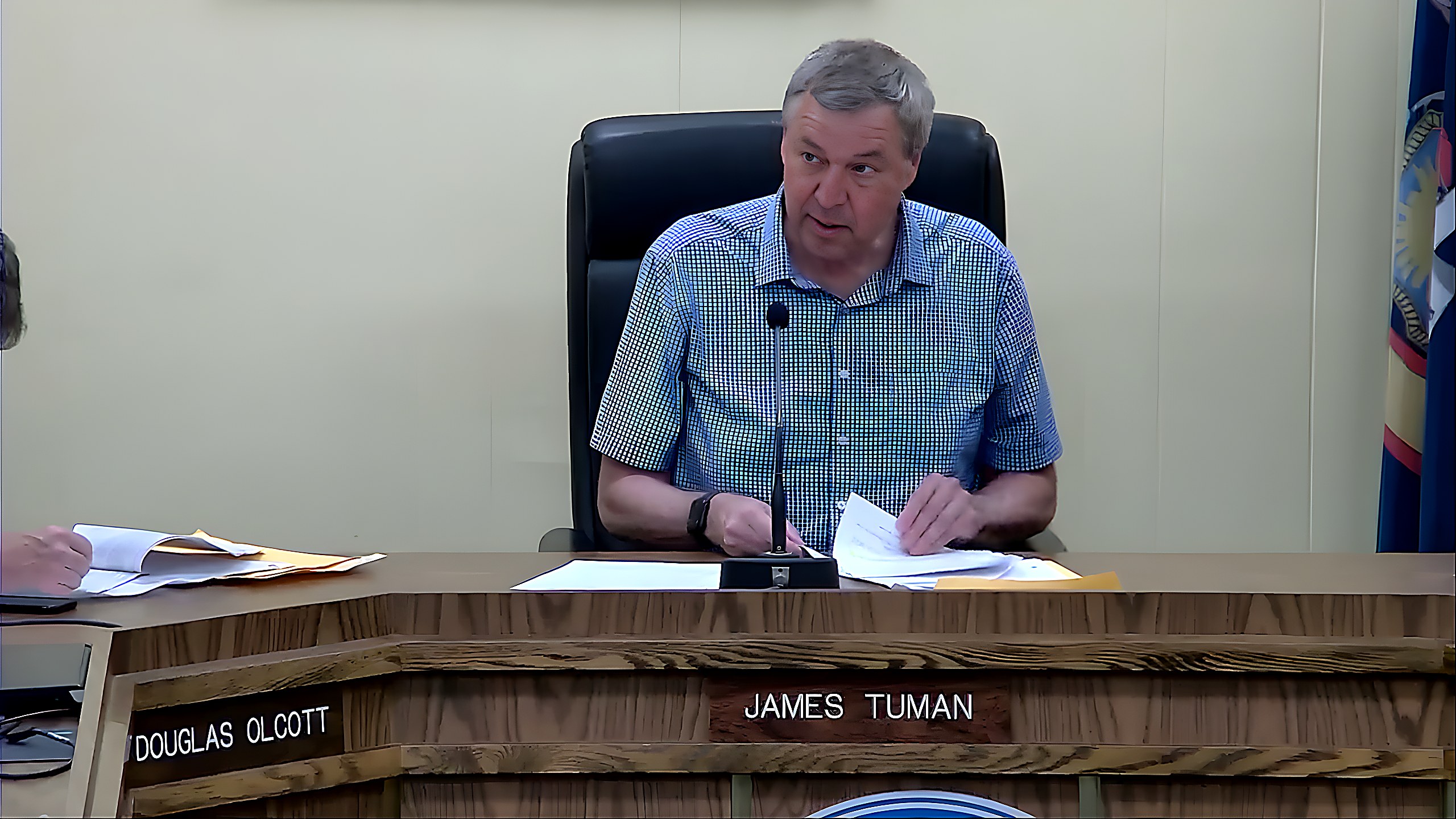
ZBA Chairman James Tuman and ZBA Board Member Doug Olcott during discussion of the interpretation of village zoning code Article 239.1 at the Zoning Board of Appeals meeting.
The interpretations were requested by Village Engineer Vincent Salanitro, who said the zoning provision on keeping animals has proven difficult to enforce because its language is ambiguous. "I'm basically just asking for an interpretation of this sentence," 0:52▶ Salanitro told the board.
The section in question, Village Zoning Code 230-9.1(A)(10)(f), reads: "Keeping domestic animals, except pigs, for individual domestic purposes or as pets, provided that not more than three dogs over six months old and not more than 25 fowl shall be permitted, and no animals, except dogs or cats, or fowl shall be penned or housed within 50 feet of any lot line."
Salanitro asked the board to interpret three questions: what is included in the definition of fowl, whether fowl are allowed to be penned or housed within 50 feet of a lot line, and what qualifies as a domestic animal.
Several residents spoke during the public hearing. Matthew Rubenstein of Truesdale Drive said he appreciated the effort to clarify the code, noting that the comma-separated sentence structure can read differently to a lawyer, an enforcement officer, or a resident.
Andy Simmons of 146 Old Post Road North said the pigeon coop next door did not concern his family.
A resident who identified himself only as Tony (sp) said he bought his home and built a coop specifically to keep pigeons after being told by village staff that he could. "I called you guys over here, and I, like, to find out if I could keep the pigeons, and I got the answer, yes." 7:55▶ He said he pulled a permit and had it signed off, and spent considerable money building the coop. "I'm not feeling very welcomed, honestly, right now," 8:21▶ he said. Chair James Tuman reminded him that the hearing was about code interpretation, not his specific situation, and that the board's ruling would apply village-wide.
Allison Rosen, an Old Post Road resident, urged the board to exclude pigeons from the definition of fowl, citing health concerns including avian flu, cryptococcus, and psittacosis. She said pigeons are carriers of diseases that are highly communicable and dangerous to humans, particularly children and immunocompromised residents, and asked the board to prohibit keeping them in densely populated neighborhoods.
After closing the public hearing, the board turned to deliberation.
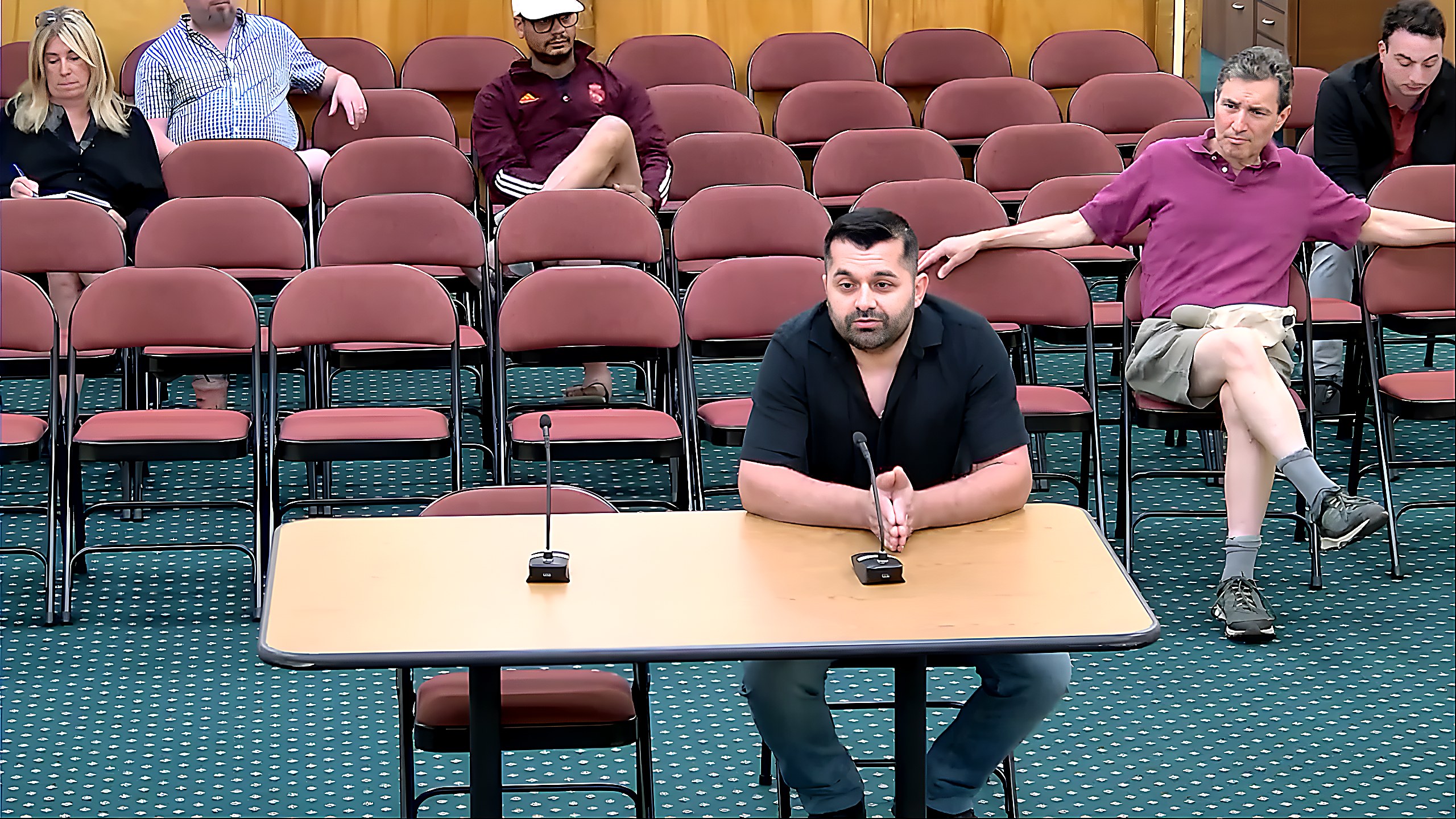
An applicant addresses the board during discussion of the 1931 animal code definition of fowl.
On domestic animals, the board quickly reached consensus. Doug Olcott offered the Merriam-Webster definition — an animal adapted over time by selective breeding from a wild or natural state to live in close association with and to the benefit of humans — and the board adopted it unanimously.
The definition of fowl proved more contentious. Olcott said he was inclined to interpret it by the first Merriam-Webster definition: a bird of any kind. He noted that the code uses lay terms like "dogs" and "cats," not scientific species names, and that fowl is commonly used to mean any bird.
Bill Goldsmith said he could not find a definition of fowl in New York state law, Westchester County code, or the village's own zoning code. "So at the moment I don't think that we have a definition," 20:12▶ he said, adding that without one, the board should interpret the term as broadly as possible.
Tuman initially leaned toward a narrower reading — poultry such as chickens, ducks, and geese — noting that the word derives from old English for bird. But he ultimately joined the majority, and the board voted to adopt the broad definition: fowl means a bird of any kind.
The 50-foot setback question produced the sharpest split. The code says "no animals, except dogs or cats, or fowl shall be penned or housed within 50 feet of any lot line." Goldsmith read the exception clause narrowly — only dogs and cats are exempt from the setback, meaning fowl must be kept at least 50 feet from property lines. Olcott and Matt Berger read it more broadly, arguing that dogs, cats, and fowl are all exempt.
Olcott raised a practical concern with the narrow reading. "We're effectively saying to have foul, you need to have a 100 foot wide lot," 30:21▶ he said — a lot wide enough for a 50-foot setback on each side. That, he noted, would exclude most properties in the village.
The board voted 3-2 in favor of the broader interpretation, allowing fowl to be penned or housed within 50 feet of a lot line. Goldsmith, who had pushed for the stricter reading, noted that the split itself was meaningful. "It sounds to me like we're probably three to two on both of these issues," 33:35▶ he said, adding that a non-unanimous vote would give the Village Board of Trustees useful information as it considers revising the code.
Tuman acknowledged the difficulty. He said the board itself could not agree on how the clause reads, and said the discussion had revealed gaps in the code that the Board of Trustees should address. The provision, he said, dates to the village's original 1931 incorporation, when circumstances were very different.
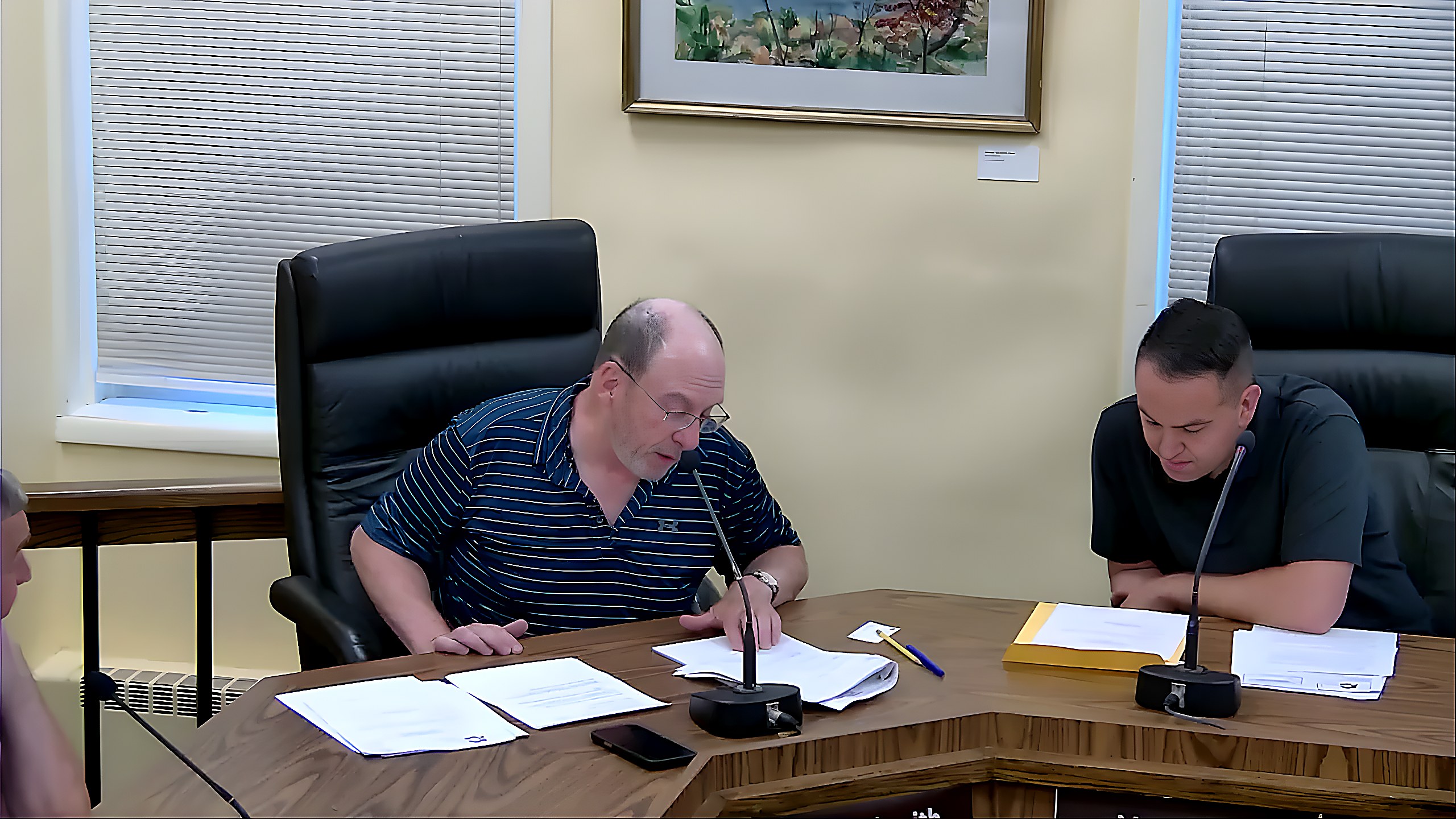
Board members review documents during discussion of the 1931 animal code's fowl and setback regulations.
Assistant Village Engineer Ron Wegner suggested the board could ask the village attorney to prepare a clean resolution incorporating the board's findings for a formal vote at the next meeting. Salanitro said he hoped for an interpretation from this meeting, calling it a pressing matter.
The board also approved draft minutes from its May 19 meeting, with a correction to the spelling of Olcott's name.
Share
Community Discussion
0 comments
One email per new comment on this story. You'll confirm by email first; unsubscribe any time. Your address is never shown publicly.
Be the first to comment on this story.
Sent to the editor for review
This is what you asked us to forward to the Village Board:
An editor reads it first. Once it goes, your comment here
will show a ✓ Forwarded to the Village Board mark —
that is your confirmation.
Coverage of the Zoning Board of Appeals meeting on 2026-06-16,
Village of Croton-on-Hudson, NY.
· Read full transcript
●Board required a steep-slope analysis, an updated survey, a cut-and-fill analysis, architectural renderings with heights and a final landscaping plan before deciding
●Applicant must flag every tree proposed for removal and mark the driveway and house locations before a site visit, which awaits snowmelt
●Public hearing remains open for further comment at a future meeting; no vote was taken
●Board member Doug Olcott recused himself citing a conflict of interest
Riverview Trail Cottage Keeps Its Street-Facing Door as Mount Airy Neighbors Wait Until February
●Resolution 1: Granted a 2.6-foot total side yard variance from Section 230-33A for a rear shed dormer addition at 21 Elmore Ave. Vote: 5-0.
●Resolution 2: Granted a front-yard setback variance of approximately 21 feet 2 inches from Section 230-40(B) and a height variance of 3 feet 5 inches from Section 230-40A(1)(a) for a prefabricated accessory dwelling unit at 43 Riverview Trail. Vote: 5-0.
●Resolution 3: Approved amended Zoning Board of Appeals Rules & Procedures, removing fixed meeting date/time language, clarifying scheduling flexibility and adjournment procedures, removing liaison references, and reorganizing the minutes documentation section. Vote: 5-0.
●Resolution 4: Approved the minutes of the October 28, 2025 meeting. Vote: 5-0.
●Resolutions Failed
●Applications Reviewed
●21 Elmore Ave (Section 79.9, Block 2, Lot 23; RA-5 District): Owners Noelle Sirico & John O'Brien, represented by architect Joseph Arnow, sought a side yard variance for a rear dormer to add headroom, enlarge a bedroom, and add a full bathroom. The board found the variance was not substantial and did not increase the degree of nonconformity of the 1950 home.
●43 Riverview Trail (Section 68.17, Block 2, Lot 11; RA-25 District): Owner Rosanne MacDonald, represented by Norm Jansa of Westchester Modular Homes Construction Corp., sought variances to replace a long-vacant, dilapidated accessory structure with an 800-square-foot prefabricated ADU for her daughter, Annette Forte. The board found the setback variance substantial but mitigated by steep topography and the dead-end street location.
●Public Comments
●Stacey Natchler, Village Board Liaison, asked questions regarding parking and site design (a proposed gravel area) for the 43 Riverview Trail application. No other public comments were heard.
●Reports
●Assistant Village Engineer Ron Wegner and board members thanked Chairperson Christine Wagner for her time and dedication to serving as Chair of the ZBA.
Experimental project: croton.news uses AI to generate articles from public records. Content may contain errors. Please report any inaccuracies and check our corrections log.AI-assisted experimental site — may contain errors. Corrections
Community Discussion
Be the first to comment on this story.
Sent to the editor for review
This is what you asked us to forward to the Village Board:
An editor reads it first. Once it goes, your comment here will show a ✓ Forwarded to the Village Board mark — that is your confirmation.