Croton-on-Hudson, NY · Friday, October 16, 2026· Oct 16, 2026Independent, AI-assisted local reporting from public recordsSource-linked·Corrections welcomed
From manor rents paid in hens to a Revolutionary spy selling eggs, Croton's historical record is full of poultry — and the village's relationship with backyard livestock is older than the nation.
Walk through any Croton neighborhood today and you will find lawns, gardens, and the occasional debate about whether residents ought to be allowed to keep a few hens. But for most of the village's recorded history, that question would have been incomprehensible. Chickens were everywhere. They appear in the manor rent rolls, in the census figures, in the reminiscences of Revolutionary War veterans, and on the menu of a Japanese inn that once stood in Harmon. The historical record is thick with poultry — and the story it tells is not really about birds. It is about who lived here, what they owed, what they ate, and how a farming landscape became something else.
Rent paid in hens
The earliest written references to chickens in the Croton area come not from farm ledgers but from landlord-tenant relations. When Robert Bolton Jr. compiled his history of Westchester County in 1848, he described the manor of Philipsborough — the vast estate that once encompassed much of what is now southern Westchester, including the land around Croton — and its rent-day customs. The lords of the manor feasted their tenantry at the Manor Hall on great rent days, maintaining, according to Bolton, an establishment of "thirty white and twenty colored servants." But most tenants were not grand. Many paid what they could. "In lieu of rent," Bolton wrote, "was frequently received a couple of fat hens, a day's work, or a trifling sum amounting to three or four pounds."
A couple of fat hens. That was the unit of value — not currency, not produce alone, but live birds kept in the yard. Hens were so standard a feature of the local farm economy that the lord of the manor accepted them as rent. The 1881 revised edition of Bolton's history repeats the same detail almost word for word, and the earlier 1848 volume records it as well, suggesting the practice persisted across decades of tenancy.
A spy with eggs and chickens
The Revolutionary War turned Westchester County into a contested corridor — the so-called Neutral Ground between British-held New York and the American lines to the north. Livestock, including poultry, became both currency and camouflage in the conflict.
Mrs. Palmer, interviewed by John Macdonald on November 1, 1844, recalled her husband's service in Wayne's assault on Stoney Point. Her account, preserved in the McDonald Interviews at the Westchester County Historical Society, includes a striking detail about reconnaissance. The day before the attack, she said, "a spy was sent in to scan the weak points of the fort &c. in the disguise of a country man selling eggs and chickens." A peddler of barnyard fowl was the perfect cover — ordinary enough to attract no suspicion in a landscape where every farmstead had a henhouse.
Prince Gedney of White Plains, interviewed by Macdonald in October 1850, described the same world from the other side of the lines. Gedney regularly crossed between the armies as a trader. "I used often to go below to sell chickens, butter and provisions for my master," he recalled — meaning he carried farm goods into British-occupied New York City, obtaining passes from Hessian officers to move through the lines. On one occasion he lost his pass and had to go back for another, provoking a scolding from General Horriman, who warned him: "Be careful. Suppose you lost this, I give you no more."
Jeremiah Anderson, born in 1778 and interviewed by Macdonald in December 1848, remembered a darker figure of the same economy. He described Caleb Green, a man from near the Byram River, who "traded with the enemy, and was often below at Morrisania where he took cattle and poultry and horses and became well acquainted with Colonel DeLancy." In the Neutral Ground, poultry were worth stealing — worth enough that a man could build a relationship with a Tory colonel by delivering them.
The census counts every bird
After independence, the agricultural census recorded what the manor rolls had implied. J. Thomas Scharf's 1886 *History of Westchester County* preserves the state census figures for the town of Cortlandt — the township that includes Croton — and they are remarkably specific. In 1865, the census recorded 557 persons, 61 of them landowners, farming 3,168 improved acres with 1,264 acres of pasture. Among the livestock: 142 horses, 322 neat cattle including 190 milch cows, 219 swine, and 214 sheep. And "the value of poultry and eggs sold was $1325."
A decade later, the 1875 census showed a shift. The population had dropped to 529, improved acreage had fallen, and the apple orchards had actually grown — but the poultry trade was climbing. "The value of poultry and eggs sold was $3358," more than two and a half times the 1865 figure. Even as the township's population contracted, its hens were producing more value than ever. The birds were not going away. They were becoming a business.
Chicken for breakfast, sukiyaki for dinner
The same records that document poultry as rent and commerce also document it as food. Scharf's history includes a vivid description of colonial kitchens in Westchester, where brick ovens were central to domestic life. At Christmas and holidays, Scharf wrote, the ovens "would be filled three times a day — first with generous loaves of wheat and rye, then with chicken and game pastries, and lastly with the succulent mince, apple and cranberry pies."
During the Revolution, chicken could also be a gesture of respect. Samuel Lyon, interviewed by Macdonald in December 1849, described the capture of Colonel Thomas, who was brought to New York City and handed to the notorious Provost Marshal Cunningham. After Cunningham's threats, two British officers intervened and arranged better treatment. "An excellent breakfast of coffee and chickens was then brought in," Lyon recalled, "after partaking of which his spirits were resorted, and he felt ready and anxious to be again confronted with his keeper." The historical spelling — resorted, where a modern reader might expect restored — is exactly as the manuscript reads, and the meaning is plain enough: a meal of chickens restored the colonel's courage.
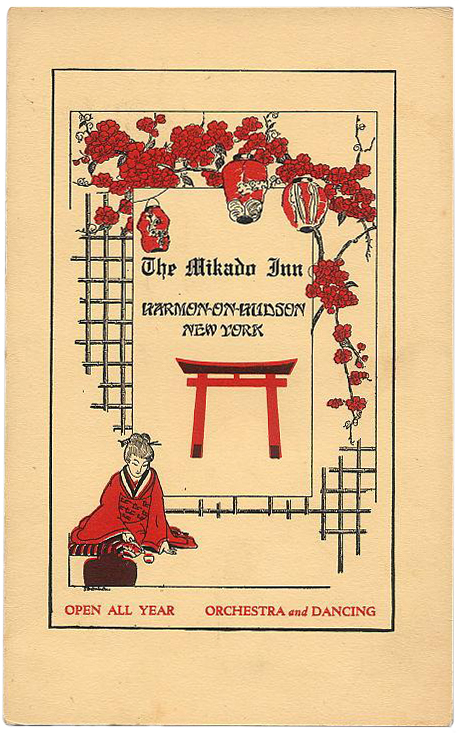
By the twentieth century, Croton's poultry had traveled an improbable distance from the manor rent roll to the dining room of the Mikado Inn in Harmon. A vintage menu preserved by crotonhistory.org shows the inn's offerings in the 1930s: Spring Lamb Chops for $1.50, Filet Mignon Mikado for $3.00, a Porterhouse Steak for two at $5.00. The house specialty was "Chicken or Beef Sukiyaki, seasoned with Soyu Sauce served in a chafing dish with rice." Roy Kojima, associated with the nearby Nikko Inn, told an interviewer that the traditional dish "with pheasant or wild boar meat was a great delicacy. Now we make with beef or chicken." The wild birds of the colonial landscape — the pheasants and turkeys that early chroniclers like John Romeyn Brodhead catalogued in his 1853 *History of the State of New York* — had given way to the domestic chicken, prepared in a Japanese style and served in the Hudson Valley.
A 1930s menu from the Mikado Inn in Harmon, featuring Chicken or Beef Sukiyaki as the house specialty. Courtesy of crotonhistory.org.
Where the record lives
The evidence for Croton's poultry past is scattered across archives that any reader can visit. The McDonald Interviews — eyewitness accounts collected between 1844 and 1851 — are held by the Westchester County Historical Society and have been digitized through Westchester County's digital collections. Scharf's and Bolton's county histories are available through the Internet Archive. The Mikado Inn menu resides at crotonhistory.org, the online archive of the Croton Historical Society. And the landscape itself still holds traces: the pasture land along the river, the old farm roads that connected henhouse to market, the sites where inns once stood. The next time someone debates whether a Croton yard should be allowed a few chickens, it may be worth remembering that for most of the last three hundred years, the question was not whether to keep them — but how many, and at what price.
Today's village board backyard-chicken debate is, in a sense, a return to a very old conversation.
Share
Community Discussion
0 comments
One email per new comment on this story. You'll confirm by email first; unsubscribe any time. Your address is never shown publicly.
Be the first to comment on this story.
Sent to the editor for review
This is what you asked us to forward to the Village Board:
An editor reads it first. Once it goes, your comment here
will show a ✓ Forwarded to the Village Board mark —
that is your confirmation.
A croton.news explainer dated Jul 15, 2026, Village of Croton-on-Hudson, NY.
●October 14, 2026 is the 184th anniversary of the formal Croton Water Celebration, held after water reached the city’s reservoirs.
●The new film pairs animated illustrations with a modern AI setting of George Pope Morris’s poem.
●Its soundtrack is not a verified performance of the historical Pearson arrangement; original poems and scores remain linked for readers.
Experimental project: croton.news uses AI to generate articles from public records. Content may contain errors. Please report any inaccuracies and check our corrections log.AI-assisted experimental site — may contain errors. Corrections
Community Discussion
Be the first to comment on this story.
Sent to the editor for review
This is what you asked us to forward to the Village Board:
An editor reads it first. Once it goes, your comment here will show a ✓ Forwarded to the Village Board mark — that is your confirmation.