Croton-on-Hudson, NY · Friday, October 16, 2026· Oct 16, 2026Independent, AI-assisted local reporting from public recordsSource-linked·Corrections welcomed
October 14 marks 184 years since the 1842 Croton Water Celebration. Watch our new Croton Ode lyric film and explore the poem, the aqueduct and the historical score behind the anniversary.
New York once threw a citywide party for water. On October 14, 1842, crowds gathered in City Hall Park to celebrate the Croton supply, and a poem turned its fountain into a singing, sparkling visitor from the hills. With the celebration’s 184th anniversary approaching on October 14, 2026, we’re bringing George Pope Morris’s Croton Ode to the screen in a new lyric film.
Watch the film below, then follow the words back to the occasion that inspired them. The animated journey is a modern interpretation of the poem and the aqueduct’s world; the historical celebration is the reason for revisiting it now.
A modern Croton Ode lyric film. Animated illustrations with an owner-generated modern AI musical setting of Morris’s poem. Historical composer credits shown in the film refer to the original score; this soundtrack is not a verified performance of Sidney Pearson’s arrangement or a historical recording. The imagery is an artistic interpretation, not archival footage.
The anniversary belongs to the celebration, rather than the first arrival of the water. Croton water had already reached New York’s reservoirs that summer. New York City’s Department of Environmental Protection dates its arrival in the city to July 4, 1842; New York State Parks identifies October 14 as the formal celebration. This is a look back at that day, rather than an announcement of a new festival.
For the city, a reliable supply meant something more substantial than a handsome fountain. DEP’s history describes polluted wells and waterways, fires that outran the available water, and the search for a cleaner, more abundant source. The Croton River offered water beyond Manhattan, carried through a masonry aqueduct largely by gravity. Its route led to a receiving reservoir in what is now Central Park, then to the distributing reservoir at what is now the main New York Public Library site.
Morris gave that engineering achievement a different sort of vocabulary. His ode begins with a fountain and music, then follows a goddess from the mountains, accompanied by woodland spirits. The river becomes a procession before the poem turns toward the human hopes riding along with it. Readers can follow the full poem in our archive or visit the Croton Ode page for lyrics and recording details.
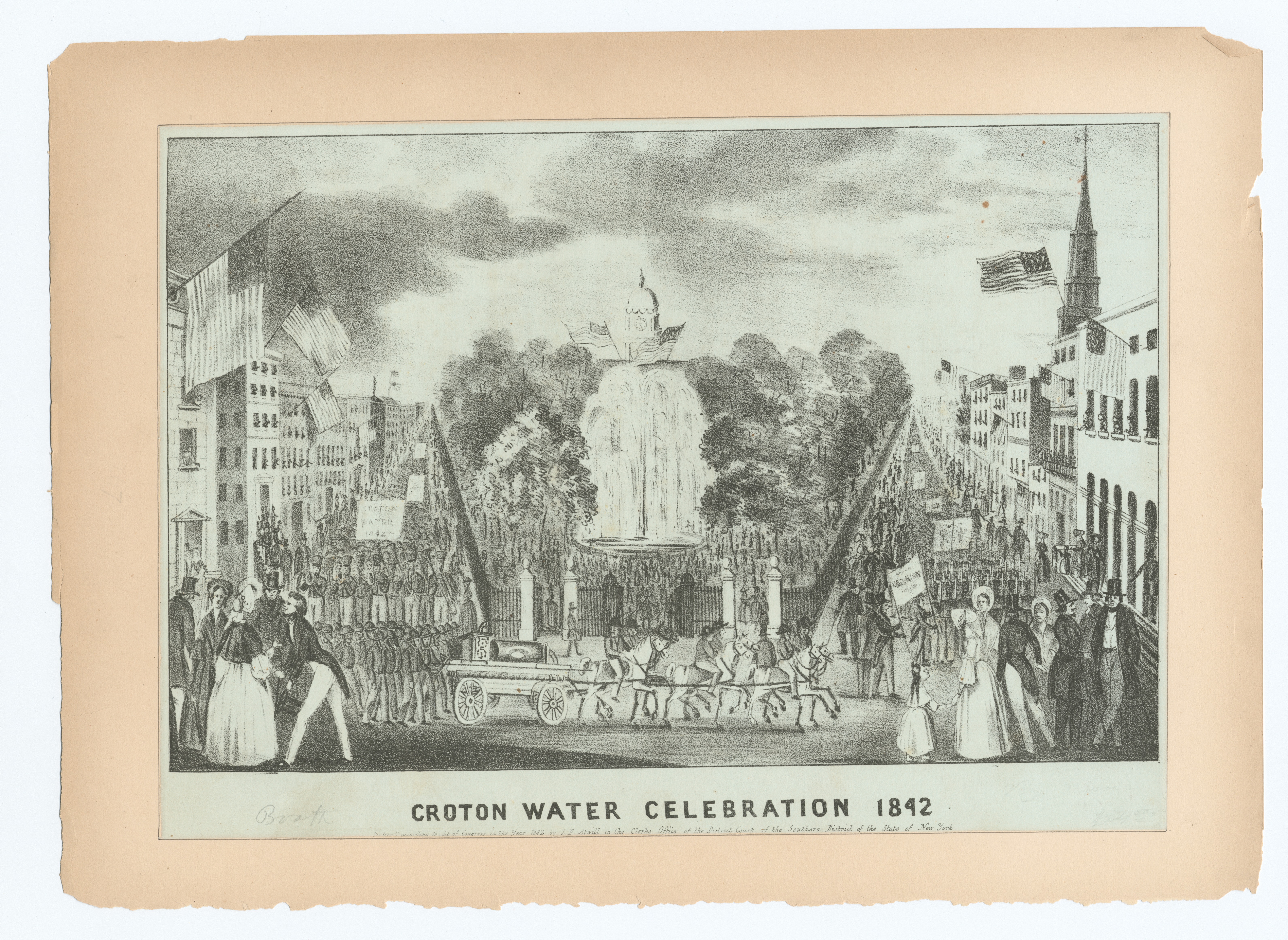
An 1842 view of the Croton Water Celebration. New York Public Library / Wikimedia Commons.
The poem was written at the request of the Corporation of the City of New York and sung near the Park Fountain by members of the New York Sacred Music Society on October 14, 1842. The surviving words let us hear how grandly an ordinary necessity could be imagined: water arriving as a gift, a spectacle and a promise to the city.
That promise becomes explicit when the poem sets water against disease and fire. Morris writes, “Pale Contagion flies affrighted / With the baffled demon Fire!” These are the poem’s triumphant images, not a claim that the new aqueduct instantly ended either danger. Read them alongside the practical history of the supply, and the celebration begins to make sense: this was infrastructure people could see, taste and gather around.
The music requires its own distinction. The contemporary score preserved by Baylor University credits Sidney Pearson with the vocal part and connects its piano accompaniment to Rossini’s Armida. Our film uses the existing modern AI setting of Morris’s text. It brings the poem into a new form without establishing how the original arrangement sounded.
There is more to explore in Listen to Croton: the ode sits beside other surviving songs, poems and piano scores inspired by the water. Each has its own date and provenance. For this anniversary, begin with the film, then take a closer look at the words and the original pages. A water supply that became part of daily life also left behind an unexpectedly exuberant soundtrack.
Share
Community Discussion
0 comments
One email per new comment on this story. You'll confirm by email first; unsubscribe any time. Your address is never shown publicly.
Be the first to comment on this story.
Sent to the editor for review
This is what you asked us to forward to the Village Board:
An editor reads it first. Once it goes, your comment here
will show a ✓ Forwarded to the Village Board mark —
that is your confirmation.
A croton.news explainer dated Oct 6, 2026, Village of Croton-on-Hudson, NY.
●Manor tenants on the Philipsborough patent commonly paid rent with 'a couple of fat hens,' per Bolton's 1848 history.
●Mrs. Palmer told John McDonald in 1844 that a spy scouted Stoney Point disguised as a man selling eggs and chickens.
●Prince Gedney, interviewed in 1850, recalled carrying chickens and butter past enemy lines during the Revolution.
●The 1865 state census valued Croton's poultry and egg sales at $1,325; by 1875 the figure reached $3,358.
●The Mikado Inn in Harmon featured 'Chicken or Beef Sukiyaki' as its house specialty in the 1930s.
Experimental project: croton.news uses AI to generate articles from public records. Content may contain errors. Please report any inaccuracies and check our corrections log.AI-assisted experimental site — may contain errors. Corrections
Community Discussion
Be the first to comment on this story.
Sent to the editor for review
This is what you asked us to forward to the Village Board:
An editor reads it first. Once it goes, your comment here will show a ✓ Forwarded to the Village Board mark — that is your confirmation.