Croton-on-Hudson, NY · Wednesday, November 18, 2026· Nov 18, 2026Independent, AI-assisted local reporting from public recordsSource-linked·Corrections welcomed
Black Rock dog park rules back before Croton board as permit counts slide
Croton trustees deferred action on Recreation Advisory Committee proposals to extend Black Rock dog park hours and admit school-district residents, asking for more usage data after hearing from residents on both sides. The board also approved eight committee appointments, weighed a possible switch of bond rating agencies, and prepared a February budget survey and a Village Auditor local law.
●Deferred action on Black Rock dog park hours and school-district access; a $4,144 defibrillator for Black Rock Park goes to the next meeting
●Approved eight volunteer committee appointments 5-0, naming Eva Thaddeus the next Conservation Advisory Council chair
●Heard municipal advisor Beth Ferguson suggest moving the village's Moody's Aa2 rating to S&P Global Ratings
●Budget priorities survey expected in February; Village Auditor local law set for the next meeting
The negotiated hours agreement for Croton's Black Rock dog park came back before trustees Wednesday night, as Recreation Advisory Committee members asked the Board of Trustees to extend weekend hours and admit a limited number of school-district residents — with neighbors and dog park users looking on, and no decision at the end.
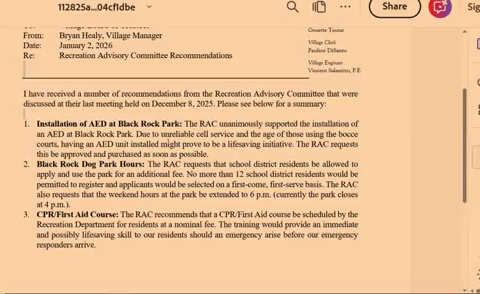
A committee memo dated January 2 carried three recommendations: install a defibrillator at Black Rock Park, revisit the dog park's rules, and schedule a public CPR course. The CPR class is settled — the recreation department will offer one this summer, Trustee Nora Nicholson confirmed. The defibrillator appears headed for approval: Village Manager Bryan Healy said Public Works Superintendent Frank Balbi put the installed cost at $4,144, covering the unit, a pediatric add-on, an outdoor enclosure, signage and electrical work, with the money to come from contingency funds at the board's next meeting. The village's ballfields already carry defibrillators donated by Little League and now maintained by the village.
The January 2 recreation recommendations memo displayed during the January 14 work session. Watch this moment
The dog park itself drew the evening's longest discussion. Recreation Advisory Committee representatives described two years of walking the park and asking users what worked and what didn't. One representative said the committee had a duty to pass along what park users told it. “We we couldn't ask the question about what it is you wanna see with the parks or what could we make it better and not bring it to the board.”Read 87:36▶ she said.
Committee member John Sasso, who said nobody spends more time at Black Rock — founding its bocce program, giving free lessons most of the year — said school-district residents who live just outside the village are turned away. Sasso said he had visited every day for two years and had never seen more than five cars at the dog park. Sasso also passed along secondhand complaints — reports attributed to dog park users, not personal experience — that a neighbor's hostile reception has kept some women away.
Healy had comparative numbers: the two nearest dog parks that admit nonresidents charge very different rates, with Bedford at $175 and capped at 60 permits, and Ossining at $25 with no cap. Croton issued permits to 52 families in 2025, down from 57 in 2024 and 87 in 2023, with permits issued per family. The village has 500 to 600 licensed dogs on its books, Healy added, and an estimated three times that number in all.
The park's current hours run 8 a.m. to 8 p.m. on summer weekdays, 8 to 6 in winter and 10 to 4 on weekends; the committee asked for a 10-to-6 weekend window. Healy traced the schedule to a pre-pandemic negotiation between park users and neighbors, restored to the same weekend hours when the park reopened after COVID closures. “I think and I said this previously that my opinion is that the hours were negotiated,”Read 79:19▶ Healy said, adding that the village heard nothing from Black Rock neighbors for years — until the item landed on the agenda and emails arrived. Trustee Stacey Nachtaler said several residents living adjacent to the park have raised concerns of their own. Trustee Maria Slippen pointed to the absence of usage data, suggesting a waiting list could show how many school-district residents actually want in. Nicholson said the board could live with a capped number of nonresident users given the drop in registrations. No action was taken: park hours sit under the village manager's authority, and Healy agreed to confirm whether village law actually bars school-district residents from the park.
Earlier in the evening, municipal advisor Beth Ferguson of Fiscal Advisors and Marketing walked the board through the village's Moody's credit rating — Aa2, with only two notches above it. Ferguson described Aa2 as a very high rating, citing the agency's findings of strong incomes, resident wealth and an improving fund balance. An upgrade could follow if leverage — debt plus retirement-benefit obligations — fell below 250% of revenues, or if fund balance held above 50%; rising retirement costs or a fund balance under 25% could push the other way. The village's debt policy, which caps new borrowing at roughly the debt it retires, and its fund balance policy were both viewed positively.
Ferguson suggested considering a shift to S&P Global Ratings, accomplished for one or two other Westchester municipalities with Croton's profile, each of which gained a notch. There is no downside, Ferguson said: investors accept either agency, Moody's would keep rating the village's outstanding bonds, and each notch is worth roughly five-hundredths of a percentage point in borrowing cost. Any switch would take effect at the next bond issue.
Healy said a refinancing about three years earlier had saved the village well over a million dollars over the long term. Reserves are a balancing act, Healy added: rating agencies want a large fund balance kept out of day-to-day operations, while, in Healy's account, the state comptroller's office can view excessive fund balance as a sign that residents have been overtaxed. Much of Croton's balance is already assigned to capital projects.
Village Attorney Joshua Subin praised the presentation as informative and educational for the public.
A budget priorities survey is headed to residents in February, likely after a February 4 board review. Healy's draft asks about satisfaction with village services, value for the tax dollar, spending priorities, preferred ways to fund them and long-term capital strategy. Trustees asked for forced rankings instead of single picks — Slippen argued a ranking would capture more nuance — plus 'other' options and an open comment field. Nachtaler asked that the survey make clear village services exclude schools, and floated separating maintenance from expansion when asking about infrastructure. Healy said the village can expect at least a couple hundred responses; the survey will be anonymous, with help available for residents who would rather not complete it online.
The board also previewed a local law, drafted by Healy and Subin, creating the office of Village Auditor to formalize the claims review that New York village law assigns to trustees. Croton's village managers have performed the duty for fifty years, Healy said — checking invoices for proper backup, sales tax charged in error and miscodings before the warrant reaches the board. Slippen questioned whether someone further from the manager's office should hold the post as a check and balance; Subin noted that Healy neither inputs nor signs checks, and that village managers hold the same duty in Port Chester and Briarcliff Manor. The law is due at the next meeting.
The board then approved eight committee appointments by a 5-0 vote, on Deputy Mayor Len Simon's motion and Trustee Nora Nicholson's second. Mayor Brian Pugh announced the Conservation Advisory Council's chair is stepping away from the post — a change Pugh said caps a chapter of civic service — but will stay on the council organizing cleanups, with member Eva Thaddeus elevated to chair through December 2026 and serving on the council through December 2027. Also appointed: Ellen Elchlepp (Arts & Humanities Advisory Council, December 2026); Lenore Edman (Arts & Humanities Advisory Council, December 2027); James Nadeau (Bicycle-Pedestrian Committee, December 2027); Dan Ozaruk (Bicycle-Pedestrian Committee, December 2028); Manuel Coronel Jr. (Police Advisory Committee, December 2026); and Jan Johnsen (Advisory Board for the Visual Environment, December 2027).
Balbi, opening the meeting with a follow-up to the trustees' recent tour of the DPW garage, said the fleet now runs on renewable diesel after a three-month pilot in selected vehicles turned up no issues. The discussion cited an estimated 12% cut in the village's carbon footprint; Balbi said part of the fuel cost could be offset by solar-panel revenue from the garage roof. Salt supplies and equipment are holding up for the rest of winter, Balbi said, though winter overtime will exceed its budget after the early storms.
Trash costs are climbing for a reason beyond the village's control. Nachtaler said trash-disposal fees appeared to have nearly doubled from 2025 to 2026. Healy blamed Westchester County tipping fees, long raised about a dollar a ton yearly before this year's jump: Healy estimated the latest increase at about $12 a ton. Recycling drop-off remains free, Healy noted — anything recyclable kept out of the trash is money the village does not spend.
Asked about growing the village's composting program, Balbi was blunt: municipalities with full curbside food-scrap collection have found the waste numbers do not fall as much as expected — Balbi said the reduction had not been a one-for-one match for the food scraps diverted. The same realism shapes Balbi's view of new technology: Croton is not New York City or Yonkers, and bigger governments should work the bugs out first — Balbi favored waiting for those larger cities to test new equipment before Croton committed its smaller fleet.
The defibrillator purchase and the Village Auditor law are due at the board's next meeting, with the budget survey to follow in February.
*Correction, October 19, 2026: An earlier version misspelled a Recreation Advisory Committee representative’s name. This article now identifies her by her committee role. Several short quotations have been replaced with faithful paraphrases, and the remaining quotation links have been corrected.*
Share
Community Discussion
0 comments
One email per new comment on this story. You'll confirm by email first; unsubscribe any time. Your address is never shown publicly.
Be the first to comment on this story.
Sent to the editor for review
This is what you asked us to forward to the Village Board:
An editor reads it first. Once it goes, your comment here
will show a ✓ Forwarded to the Village Board mark —
that is your confirmation.
●Received the FY2025 audit from Alan Kassay of PKF O'Connor Davies: an unmodified ("clean") opinion, revenues $1.1 million over budget, and a general fund balance of $11.05 million
●Reviewed AKRF's preliminary safety design for Old Post Road North at Lounsbury Road and Michaels Lane: new crosswalks, narrowed intersections, curb extensions and flashing beacons
●Discussed a Gouveia Park landscape master plan and $5,415 in asbestos testing at the park house, both headed to next week's board agenda
●Heard the police department's 2025 review: 1,368 traffic summonses (a ten-year high), replacement Glock 45 pistols, body-camera trials and a cadet program relaunching Feb. 9
●Previewed a zoning cleanup law that would scale fowl limits to lot size, repeal the three-dog rule and set a 300-square-foot threshold for site plan review
Croton trustees send $36,500 court study back for a rewrite after impartiality concerns
●Village manager directed to revise the $36,500 CGR court-study proposal: broaden it beyond consolidation, add police, district attorney, public defender and public input, and exclude COVID-era financial data
●No vote taken on the study; a revised proposal will come to a future board meeting
●America 250: Summerfest and the parade to carry the anniversary theme; three liberty tree sites and a Revolutionary War historic marker moving ahead
●National Police Week flag design referred to the VEB; $400 pin purchase questioned
●Five new property tax exemptions endorsed; adopted May 6 as Local Law No. 6 of 2026
●Committee guidelines revised with residency and one-committee rules; adopted April 22 as Resolution 89-2026
●$7,500 board training retreat proposed by a NYCOM-recommended facilitator; trustees urged a narrower scope
Croton moves toward red light cameras and a tax on short-term rentals
●Village Manager Bryan Healy said the village is authorized for red light cameras at up to three intersections; the board asked the Bicycle and Pedestrian Committee to rank the police chief's suggested locations before a local law is drafted.
●The board directed Healy to prepare a local law imposing the hotel and motel tax, which state law now extends to short-term rentals; Healy put the rate at 3 percent, with stays over 90 days exempt.
●Trustees gave consensus to draft affordable-housing preferences for veterans and for emergency-service and medical workers; Mayor Brian Pugh asked that school district employees be included in the referral to Westchester County.
●The board agreed that no resident may be appointed to more than one advisory committee after June 1, 2026, and set Jan. 7 as the target date to adopt the committee guidelines.
●Healy said a $100,000 CREST award from Sen. Pete Harckham would most likely go toward a roughly $150,000 replacement senior bus; the board gave consensus rather than a formal motion.
Croton parking would rise for the first time since 2010; trustees question a $37,500 court study
●Draft 2026-27 budget raises the tax levy 3.47% and the tax rate 3.59%; commuter parking goes from a dollar to a dollar fifty an hour, $12 to $15 a day and $7 to $9 on weekends; the budget is filed March 20
●Snow overtime has hit roughly $200,000 against $60,000 budgeted and the salt budget is spent; Healy will bring one budget amendment in late March or early April
●CGR proposed a four-month, $37,500 operational study of the village court; Nachtaler and Slippen questioned the spend, Healy said no November ballot deadline forces a decision, and Pugh will bring it back to a regular meeting
●A $1,789,929 Seagrave pumper would replace 2006 Engine 119 through the Houston-Galveston cooperative contract, paid on delivery roughly four years out; the contract is expected March 11
●Grant consultant Valerie Monastra outlined the 2026 grant year; Nicholson proposed a New York Forward work group and Nachtaler asked that a youth community center be considered for North Riverside
Croton's prosecutor asks for a way to reach violators who simply don't show up
●Raskob asked the board for enabling language allowing a money-only default judgment against a violator who never appears, collectible through a lien or tax relevy; Village Attorney Joshua Subin will check whether a criminal court can do it and said zoning violations almost certainly cannot.
●Village Manager Bryan Healy will have the village's attorneys test a Scarsdale-style tiered zoning penalty, with first offenses in the $500 to $1,000 range and higher tiers for corporate offenders; the general $250 catchall penalty would not change.
●More than 3,600 parking tickets dating to 2018 remain unpaid, worth over $400,000; Healy will confirm the court is running the state scofflaw procedure before pursuing default judgments, and an amnesty would be needed for older tickets.
●Local Law Introductory No. 7 of 2026, a content-neutral rewrite of the sign law, goes on next week's agenda for referral to the Planning Board, Waterfront Advisory Committee and Visual Environment Board.
●Deputy Mayor Len Simon reported Project MOVER's first season (1,374 Croton rides, 14.5 percent of the system) and is pursuing part of roughly $600,000 in bike-infrastructure funding; the system relaunches April 6.
Trustees demand Metro-North safety fixes at Harmon Yards
●*Resolution 1*: Authorized the Village Manager to send a formal letter to Metro-North Railroad regarding severe safety and access concerns at Harmon Yards. Passed 4-0 (Trustee Politi absent). No dollar amount attached.
●Resolutions Failed
●Applications Reviewed
●None (this was a Work Session, not a regular meeting with Planning Board/ZBA items).
●Public Comments
●None recorded during this Work Session.
●Reports
●Arts & Humanities Advisory Council: Provided an update on the village artist banner program.
●Village Manager (Bryan Healy):
●Delivered an update on the ongoing shoreline resiliency study.
●Reported on the Con Edison rate case settlement.
●Announced the conclusion of the Community Choice Aggregation (CCA) Program.
●Led a review of existing intermunicipal agreements for shared services, including a discussion on establishing a new agreement with the Croton-Harmon Union-Free School District.
●Board of Trustees: Continued reviewing guidelines and procedures for village advisory boards and committees, and reviewed drafts of the social media policy and Board of Trustees rules of procedure.
Experimental project: croton.news uses AI to generate articles from public records. Content may contain errors. Please report any inaccuracies and check our corrections log.AI-assisted experimental site — may contain errors. Corrections
Community Discussion
Be the first to comment on this story.
Sent to the editor for review
This is what you asked us to forward to the Village Board:
An editor reads it first. Once it goes, your comment here will show a ✓ Forwarded to the Village Board mark — that is your confirmation.