Trustees set cannabis-moratorium hearing, seek leaf-blower review
The May 27 work session set a June 17 hearing on a proposed cannabis pause, renewed a speed-camera home-rule request and referred resident leaf-blower comments for review. Trustees also discussed a possible Harmon grant application.
●Set a June 17 public hearing on a proposed six-month cannabis-dispensary moratorium.
●Renewed the school speed-zone camera home-rule request, 4-0.
●Referred about 40 residents’ leaf-blower comments to the Conservation Advisory Council, 4-0.
●Temporarily suspended a committee-membership restriction concerning HEART for 30 days.
Croton trustees scheduled a June 17 public hearing on a proposed six-month cannabis-dispensary moratorium at their May 27 work session, while also advancing a school speed-camera request and sending roughly 40 residents’ comments on gas-powered leaf blowers to the Conservation Advisory Council.
The cannabis proposal was a pause for a zoning review, not a moratorium enacted that night. The board’s unanimous vote set the hearing for 7 p.m. at the municipal building. Village Manager Bryan Healy explained that even adoption would be a separate step from the law taking effect.
“if the law is adopted, then the moratorium begins once it's filed with the state secretary of state's office,” Healy said. Read 150:11▶
The discussion reflected concern about changing state cannabis rules and how the village could regulate dispensary locations. The proposed law provided six months for that review. Trustees also discussed the implications for applications and the risk of granting one existing business a competitive advantage. Neither the hearing vote nor the work-session discussion established new zoning restrictions.
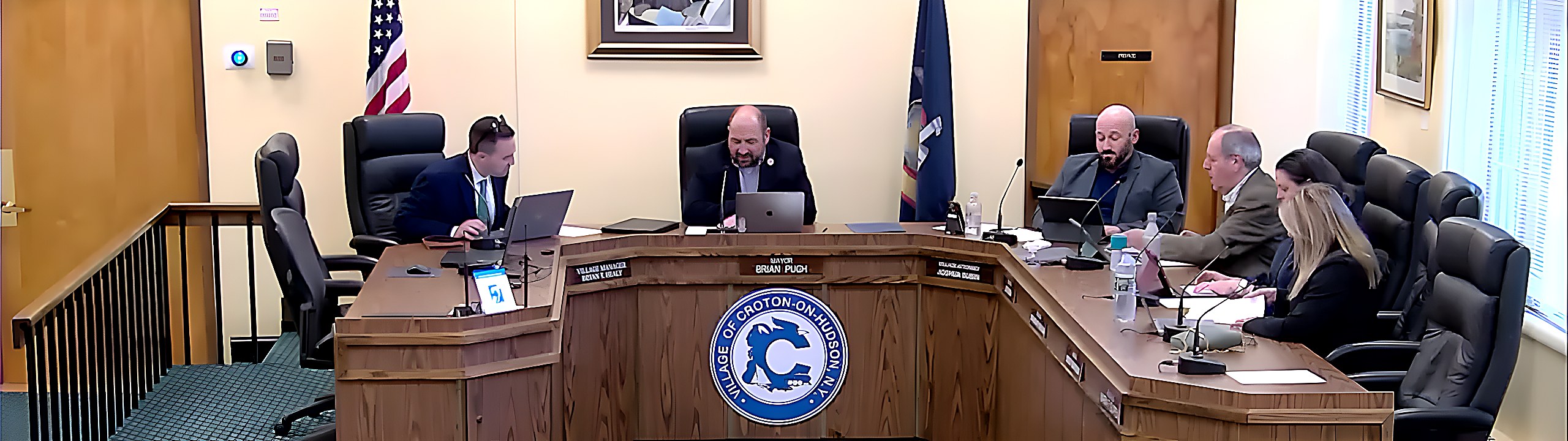
The Board of Trustees at the opening of its May 27 work session.
Earlier, the board voted 4-0 to renew its request for state authorization to establish a school speed-zone camera demonstration program. Trustee Maria Slippen had not yet arrived. The resolution identified Assembly bill A11322-A and Senate bill S10058-B.
Healy explained that the state bill needed corrections, including a reference that had called the village’s Parking Violations Bureau a traffic violations bureau. That required the trustees to act again.
“And so they've reintroduced the bill, which requires a separate a new resolution for the board to pass,” Healy said. Read 0:48▶
The action was a home-rule request to the Legislature. It did not install cameras or begin ticketing drivers.
On leaf blowers, trustees voted 4-0 to refer the resident correspondence to the Conservation Advisory Council. They also directed Healy to prepare a memo for the next board meeting outlining questions for the council to examine before recommending any change to the seasonal restriction.
Mayor Brian Pugh wanted the review to address practical questions such as phasing in a change and applying restrictions consistently. His starting question was “if we're to make some kind of change, what kind of phase in period we would want.” Read 3:01▶
The discussion also covered enforcement, exemptions and what other municipalities’ rules actually require. The referral did not extend Croton’s ban. The board was asking for research and recommendations before taking that next step.
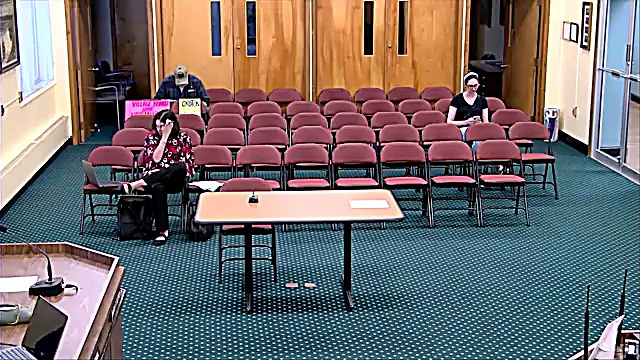
The audience at the May 27 Board of Trustees work session.
A possible NY Forward application focused on Harmon also came before the board. Planning consultant Valerie Monastra of Nelson Pope Voorhis described a proposed area along the South Riverside commercial corridor, from Oneida Avenue toward Van Cortlandt Manor, including the Croton-Harmon station.
Her May 22 memo listed possible projects including station parking-lot upgrades, streetscape improvements along Riverside Avenue and Benedict Boulevard, bike lanes, building development and a small-project fund. The discussion concerned an application for a program that could award $4.5 million; it was not an announcement that Croton had won funding.
“So not all projects that the village would put forth would be awarded. The state ultimately ends up picking that,” Monastra explained. Read 25:20▶
The board also reviewed comments on proposed signage regulations and continued its discussion of rules for farm animals and fowl. The animal discussion ranged from definitions and lot sizes to setbacks, enclosure conditions and the effects on neighbors. No new animal or sign law was adopted at this work session.
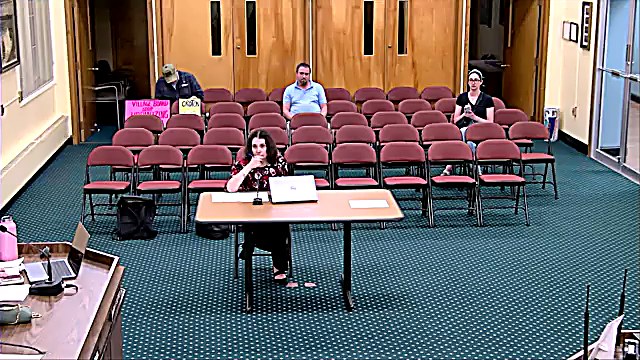
Pugh urged the board to think through what enforcement would mean for someone told an animal could no longer be kept. He said “the point of doing this is also to communicate that we plan on enforcing this, and once that happens, we're gonna start running into some of these issues.” Read 147:28▶The meeting room during the board’s discussion of animal and fowl regulations.
Finally, the board unanimously suspended its committee-guideline restriction on serving on more than one committee for 30 days as it related to the HEART Committee. Slippen moved the measure and Trustee Len Simon seconded it. The minutes record an agreement to return to the issue at the next work session.
Slippen had asked to slow the decision after discussion by email earlier that day. She said she “would like to pump the brakes on this because all of that happened in email.” Read 160:46▶ The temporary suspension gave the board time for further discussion; it was not a permanent change to committee membership rules.
Share
Community Discussion
0 comments
One email per new comment on this story. You'll confirm by email first; unsubscribe any time. Your address is never shown publicly.
Be the first to comment on this story.
Sent to the editor for review
This is what you asked us to forward to the Village Board:
An editor reads it first. Once it goes, your comment here
will show a ✓ Forwarded to the Village Board mark —
that is your confirmation.
●Authorized the village manager to reject all bids under Bid No. 22-2025 for HVAC trade labor so the changed scope of work can be re-bid
●Reached consensus to raise the income limit for senior citizen and disability rent increase exemptions in the village's five ETPA buildings, with a public hearing expected to be called Aug. 19
●Reviewed code amendments preserving local environmental review after state SEQR exemptions; referrals to the Planning Board, WAC and county planning expected at the Aug. 19 meeting
●Village manager to meet with the planner and village attorney on a zone-based approach to cannabis dispensary locations
●Agreed to add an "animal-related uses, general" category to commercial zoning districts while leaving kennels unlisted, and therefore prohibited without a zoning amendment
●Appointed Carolyn Whiting chair of the reconstituted ad hoc HEART Committee, reappointed its members, and reappointed Whiting to the Police Advisory Committee
A Water Main From 1908 Breaks as Croton Opens Budget Season; Board Clears $414,301 Police Body-Camera Deal
●Authorized the village manager to accept a $414,301.36 Axon Enterprise body-worn camera proposal (NYS contract #PM69698), first year funded by a state Law Enforcement Technology Grant; public comment planned before a June 15 deadline
●Began line-by-line review of the proposed 2026-27 DPW budget: water distribution up $102,757, street maintenance up $64,691, snow removal up $20,000 after a $286,000 overtime winter
●Repaired a 1908-era water main break on Olcott Avenue that left one block without water the afternoon of March 26
Experimental project: croton.news uses AI to generate articles from public records. Content may contain errors. Please report any inaccuracies and check our corrections log.AI-assisted experimental site — may contain errors. Corrections
Community Discussion
Be the first to comment on this story.
Sent to the editor for review
This is what you asked us to forward to the Village Board:
An editor reads it first. Once it goes, your comment here will show a ✓ Forwarded to the Village Board mark — that is your confirmation.