Old Post Road North Traffic Study Draws Resident Pushback on Beacons, Calls for Stop Signs
Village officials presented a traffic study proposing crosswalks, curb extensions, and flashing beacons for Old Post Road North, but residents at a June 11 public information session overwhelmingly opposed the flashing beacons and urged the village to reconsider stop signs at Michaels Lane.
●Village to bring resident feedback back to traffic consultant AKRF for potential plan revisions
●Proposed improvements include two new crosswalks, curb extensions, and a rectangular rapid flashing beacon at Michaels Lane
●Trustee Maria Slippen called for residents to have another opportunity to weigh in before any final decision
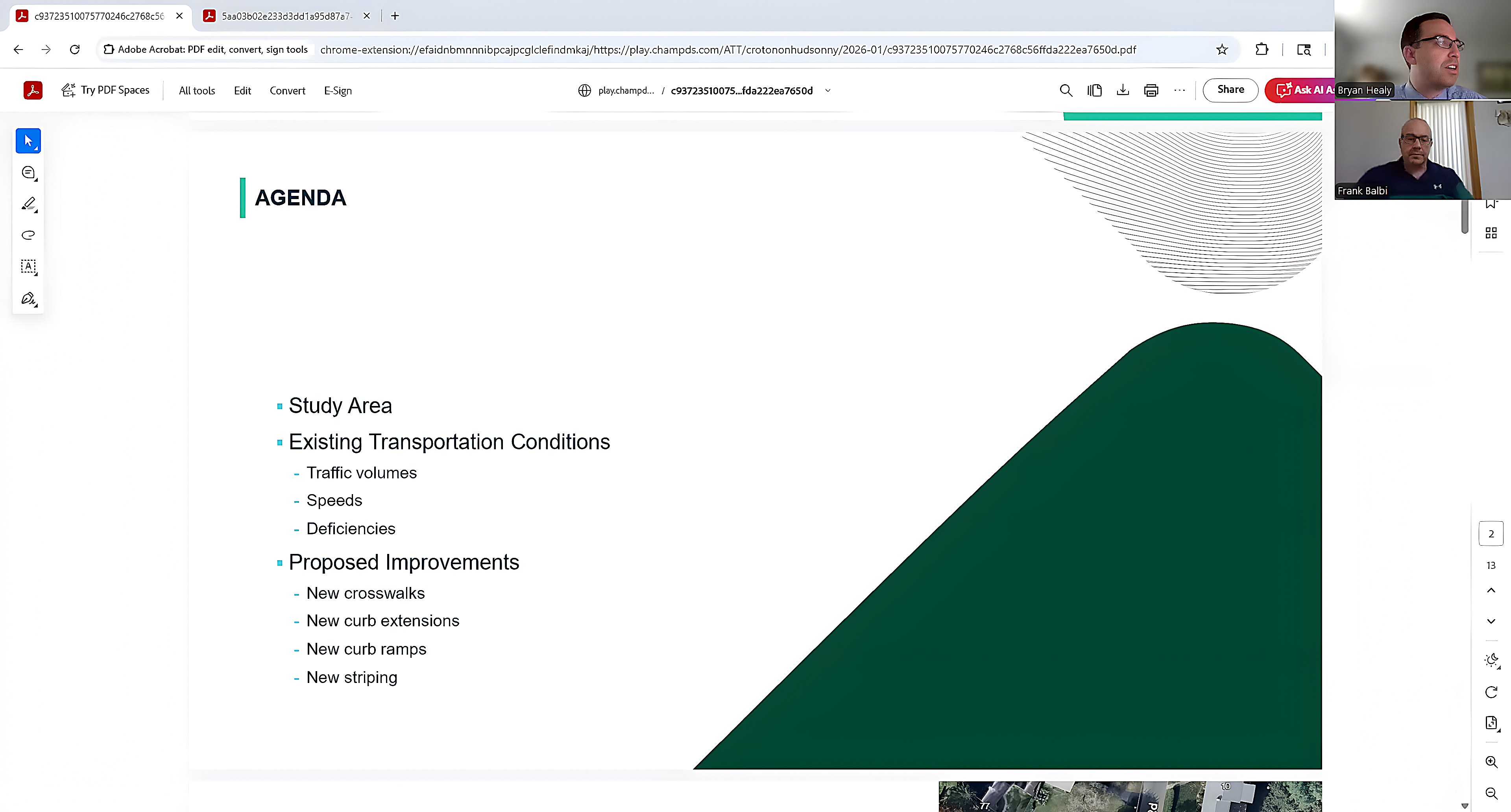
Village Manager Bryan Healy and Superintendent of Public Works Frank Balbi presented findings from a traffic study of Old Post Road North to about 10 residents at a June 11 public information session, proposing crosswalks, curb extensions, and a rectangular rapid flashing beacon to improve pedestrian safety between Hunter Place and Michaels Lane.
The Old Post Road Traffic Study Webinar meeting in session.
"The board authorized this study last year to look at the area of Old Post Road North between Hunter Place and Michaels Lane", 0:50▶ Healy said. The village hired consulting firm AKRF to conduct traffic counts and field observations. Data collected over seven days in September showed most vehicles traveling at or below the 25 mph speed limit, with no traffic accidents reported in the corridor over the past 15 years, according to state DOT records. 5:00▶
The study identified several deficiencies: no crosswalks in the corridor, an excessively long pedestrian crossing distance at Loudounsbury (58 feet despite a 22-foot roadway, according to the presentation slides), and poor sight distance for vehicles exiting side streets. AKRF proposed two new crosswalks, curb extensions known as "bump outs" to narrow turning radii, and a rectangular rapid flashing beacon at Michaels Lane similar to those installed on Maple Street near the middle school.
But residents who tuned into the virtual session pushed back, particularly on the flashing beacon.
Liza, a resident of 71 Old Post Road, said the area already suffers from sign clutter. "My concern is that for such a low volume road and few people who are crossing the street, right, that we're adding light to our already ugly front", 10:50▶ she said, noting existing signs, telephone poles, and wiring. She and her neighbor James both described the proliferation of posted signs as visual pollution affecting property values.
James, who lives adjacent to one of the proposed crosswalks, raised concerns about snow removal on the new sidewalk extensions and questioned the scale of the project. "we're building all this for nine people to cross the road. How efficient is that?" 18:00▶ he asked, echoing frustration shared by several residents that the study counted relatively few pedestrian crossings.
David, a Michaels Lane resident, was the lone voice supporting the flashing beacons. "every time I cross Michael's Lane, like, I get that there haven't been accidents, but I always feel like I'm kinda taking my life into my own hands", 20:00▶ he said. He also raised a separate concern about limited visibility turning left from Michaels Lane due to a retaining wall, asking whether a traffic mirror could help. Balbi said the village is not allowed to use mirrors as traffic control devices.
Alicia Ann Feritero, who described herself as the longest-tenured resident of Michaels Lane with more than 50 years on the street, said her primary concern was snow removal. "where is all this snow gonna go", 26:30▶ she asked, noting that DPW trucks currently pile snow at the very corners where curb extensions are proposed. She recalled that the Hunter Place stop sign was originally installed after a crash during a school morning when children were waiting for a bus.
The most pointed exchange came from Michaels Lane residents Michael and Jamie, who said they helped initiate the call for the study. Michael noted that roughly 17 children live on the street and argued that even the study's favorable statistics were cold comfort. "1,900 vehicles going on a daily basis and 99% of them are going 30 or under, that still means that 20 cars are going above 30 miles an hour on Michael's Lane, which all it takes is one", 31:40▶ he said.
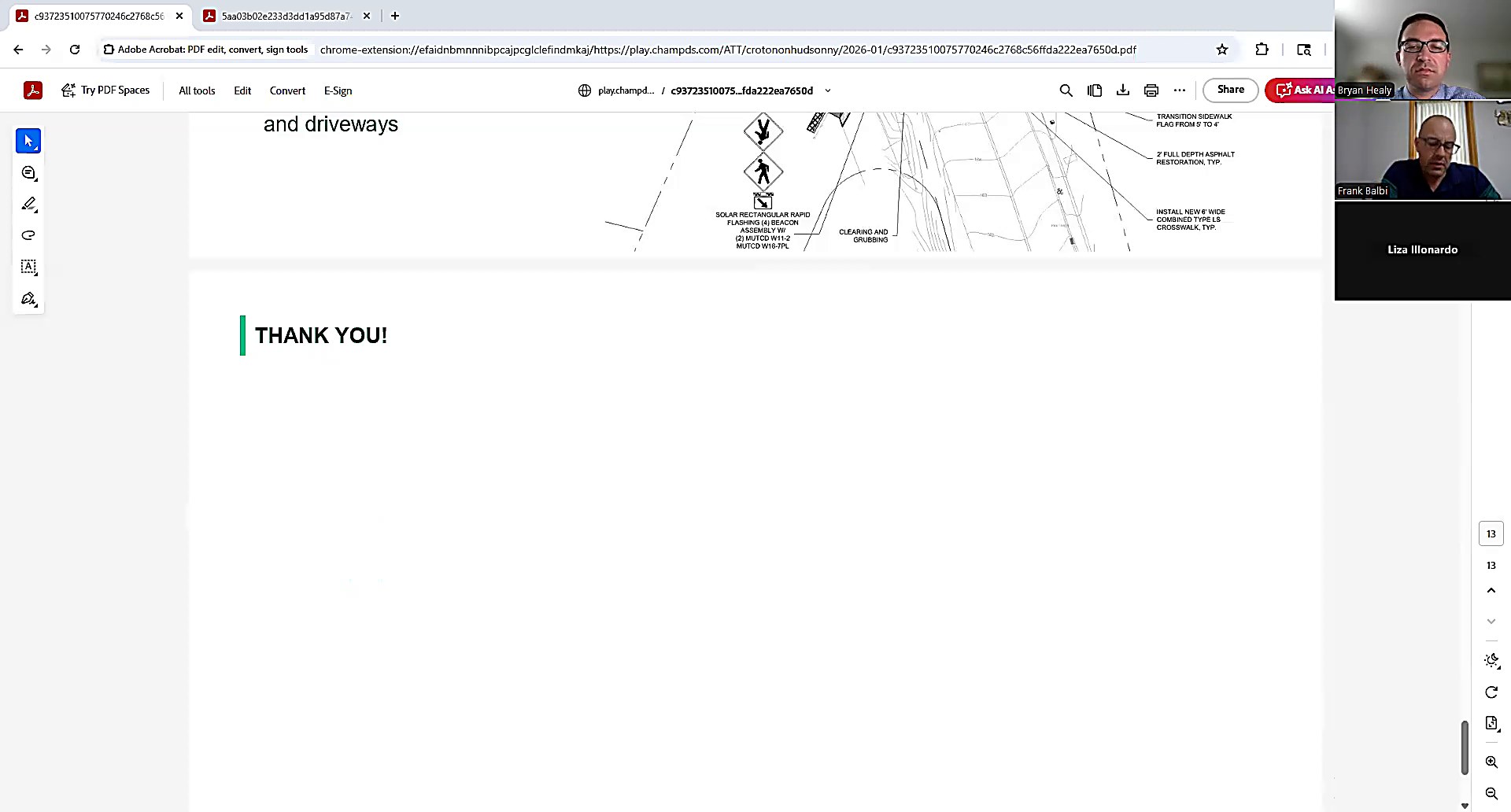
The Old Post Road Traffic Study Webinar meeting in session.
He questioned why the village would not install a stop sign at Michaels Lane, which he said would simultaneously address pedestrian safety, left-turn visibility, and residents' objections to additional signs and lights.
Balbi explained that the traffic engineer found a Michaels Lane stop sign would be too close to the Hunter Place intersection and could backfire. "when you add stop signs, people actually go faster because they have that makeup speed", 32:40▶ he said.
Jamie said she crosses the intersection roughly 10 times daily and called the visibility problem more dangerous than speeding. "I have crossed this intersection probably 10 times daily, winter, summer, spring, fall", 34:40▶ she said, adding that drivers — including police vehicles — frequently stop short when they finally spot her mid-crossing with a stroller.
Trustee Maria Slippen, who lives in the neighborhood and has represented it for 22 years, credited the family for raising the issue. "I appreciate the Schwartz's you know, bringing this to everybody's attention", 45:00▶ she said before pressing village staff on whether a stop sign could be reconsidered. She argued that residents' concern is not primarily about speed but about visibility. "it feels like we don't have the right solution", 46:40▶ Slippen said.
Healy held firm that the village relies on professional engineering guidance. "the village is not gonna go against the advice of the professional traffic engineers and the state of New York in not using stop signs for traffic, to slow down traffic", 48:00▶ he said. He noted that the village had evaluated removing the Hunter Place stop sign entirely, relocating it to Michaels Lane, and adding a second stop sign, ultimately concluding the current configuration was best.
A resident suggested speed bumps as an alternative. Lisa, who has lived at the corner of Old Coast Road and Loudounsbury since 2001, proposed installing speed bumps to slow drivers regardless of the study's speeding data. Healy acknowledged the idea but said the data identifies visibility, not speed, as the core problem.
Slippen asked whether temporary stop signs could be tested before a permanent installation. Healy was skeptical. "I don't really know what putting stop signs there temporarily would do", 50:10▶ he said.
As the session wound down, Michael returned to the question of whether the right problem was being solved. "can we stop traffic at Michael's Lane if for a moment so that everyone can see everyone before making their next move", 52:30▶ he said.
Jamie urged the village to keep an open mind when revisiting the consultant. "I'm almost getting nervous the fact that there could be no answer", 54:10▶ she said.
The Old Post Road Traffic Study Webinar meeting in session.
Healy said staff would bring the feedback to AKRF and discuss potential adjustments before presenting a revised plan. Slippen asked for residents to have another opportunity to weigh in. "I feel like we're about halfway through this process, not closer to the end", 51:50▶ she said.
Healy said the matter would return to a board work session for further discussion.
Share
Community Discussion
0 comments
One email per new comment on this story. You'll confirm by email first; unsubscribe any time. Your address is never shown publicly.
Be the first to comment on this story.
Sent to the editor for review
This is what you asked us to forward to the Village Board:
An editor reads it first. Once it goes, your comment here
will show a ✓ Forwarded to the Village Board mark —
that is your confirmation.
Coverage of the Old Post Road Traffic Study Webinar meeting on 2026-06-11,
Village of Croton-on-Hudson, NY.
· Read full transcript
Experimental project: croton.news uses AI to generate articles from public records. Content may contain errors. Please report any inaccuracies and check our corrections log.AI-assisted experimental site — may contain errors. Corrections

Community Discussion
Be the first to comment on this story.
Sent to the editor for review
This is what you asked us to forward to the Village Board:
An editor reads it first. Once it goes, your comment here will show a ✓ Forwarded to the Village Board mark — that is your confirmation.