Croton-on-Hudson, NY · Friday, October 16, 2026· Oct 16, 2026Independent, AI-assisted local reporting from public recordsSource-linked·Corrections welcomed
Croton narrows where cannabis shops could open, creates assistant village manager post
Croton-on-Hudson trustees told the village attorney on Sept. 16 to draft cannabis zoning that would allow dispensaries by special permit in a handful of commercial and industrial pockets, and adopted a local law re-creating the position of assistant village manager, a post the village has not had since 2015.
●Adopted Local Law Introductory No. 15 of 2026, which becomes Local Law No. 12 of 2026, amending Chapter 31 of the Village Code to create the position of assistant village manager
●Directed the village attorney to draft cannabis zoning allowing dispensaries as a special permit use in C-2 outside the gateway overlays, C-1RA, the light industrial district and the North End Gateway
●Directed that the local draft include a 1,000-foot minimum separation between dispensaries and a 500-foot buffer around public youth facilities
●Deferred extending the same siting rules to direct-to-customer alcohol and tobacco sales pending a legal review of state preemption
●Approved a warrant of $270,866.03 across the general, water, sewer, capital and trust funds
Croton-on-Hudson's Board of Trustees decided at a Sept. 16 work session where adult-use cannabis dispensaries should be allowed to open in the village, and directed the village attorney to turn those choices into a draft zoning law.
Dispensaries would be allowed only by special permit, and only in a short list of commercial and industrial pockets: the C-2 commercial district outside the village's gateway overlay zones, the C-1RA stretch of North Riverside Avenue, the light industrial district, and the North End Gateway along Albany Post Road north of Warren Road, including one vacant C-1 parcel inside that gateway.
A village moratorium on dispensaries is still in effect while the board works out permanent rules, Village Attorney Lori Lee Dickson said. The draft in the packet, listed on the agenda as Local Law Introductory No. 16 of 2026, was written to conform with the state's Marijuana Regulation and Taxation Act, Village Manager Bryan Healy said, and what he needed from the board was the map. The draft pulls adult-use cannabis dispensaries out of general retail and defines them as a use of their own, so they can be slotted into the village's schedule of uses. As written now, Dickson said, the use "doesn't exist in the use tables. So it's up to you to determine where, if, when, etcetera." Read 26:37▶
"You want it to be a special permit use," Read 27:51▶ Healy said, and the board agreed that would hold wherever dispensaries are allowed. Mayor Brian Pugh set out his own test. "The big concern for most people is proximity to schools," Read 30:25▶ Pugh said, "or proximity to places where children congregate, which is to say the upper Village during lunchtime." Read 30:28▶ Pugh said he would rule out the C-1 district and the Municipal Place Gateway, which between them take in the Upper Village and Maple Street near the middle school, and was comfortable with the rest.
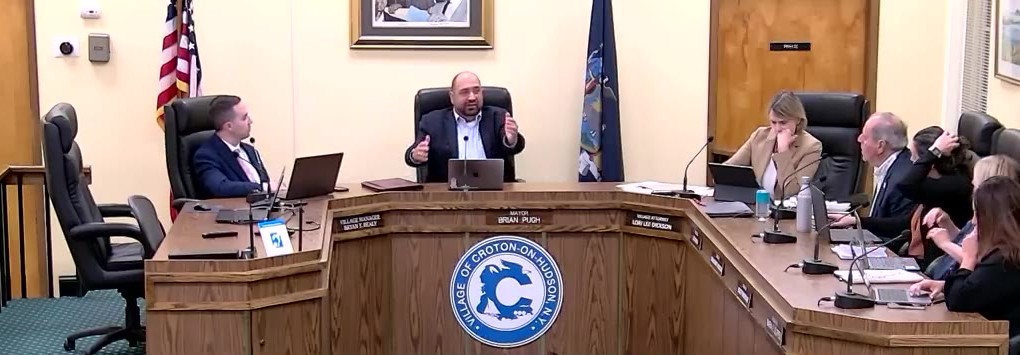
Village trustees discuss proposed cannabis zoning at their September 16 work session. Watch this moment
State law sets distinct distance rules. Cannabis Law § 72 bars a retail dispensary on the same street and within 500 feet of a building containing a school, or within 200 feet of a building used exclusively as a house of worship. The statute measures between the centers of the nearest qualifying entrances, with specific rules for buildings set back from the street. State law
For dispensary-to-dispensary spacing, the usual state requirement is 2,000 feet in municipalities with fewer than 20,000 residents. The Cannabis Control Board may approve a Public Convenience and Advantage exception, but its rules do not permit that exception below 1,000 feet. An exception also depends on other conditions, including how long a nearby dispensary has been open. The 1,000-foot figure discussed by trustees is the exception's floor, not the ordinary separation requirement. OCM guidance, pages 1–2 Deputy Mayor Len Simon said the village already has a dispensary under construction at the corner of Riverside and Benedict, and asked how far away a second one would have to be. Healy said he measured 983 feet from the front door of 370 South Riverside to a realtor's office at 2 Croton Point Avenue, below the 1,000-foot figure under discussion, though he had drawn the line "as the crow flies" Read 50:46▶ and did not know for certain how the state defines the measurement.
Trustee Stacey Nachtaler pushed back on allowing dispensaries in the light industrial parcels near the Metro-North station, which she said she regards as a gateway into the village for drivers coming off Route 9. "I would hate to see another shop open up there. We already have one around the corner," Read 49:06▶ Nachtaler said. Healy said the light industrial district amounts to only about four parcels, among them the Metro-North station property and the old Croton North station.
Residents have asked why the village does not simply ban dispensaries outright, Nachtaler said. It cannot: Croton had its chance to opt out in 2021 and opted out only of on-site consumption, not retail. "Under the current state law, once you've opted in, you cannot opt out," Read 41:07▶ Healy said.
The board also directed that the local draft include a 1,000-foot minimum separation between dispensaries and a 500-foot buffer around public youth facilities. Healy said nothing in Croton currently qualifies as a public youth facility, but the board decided to spell the buffer out anyway. Writing the state numbers into local code, Dickson said, leaves Croton better placed to argue its own rule still applies if the state later changes a standard.
Pugh floated going further and applying the same districts and distances to direct-to-customer sales of alcohol and tobacco, meaning package stores and smoke shops rather than restaurants or bars. "That is my personal suggestion. I don't know if that's the consensus of the board," Read 31:57▶ Pugh said. Dickson urged the board to let her research it first: the state occupies the field on alcohol licensing far more completely than the cannabis law does. "I would like not to just add it willy nilly and then jeopardize this," Read 62:16▶ Dickson said.
Croton adopted its own distance rules in 2021 and had to amend them once the state set its own, Healy said. "The code is a living document," Read 54:56▶ Healy said.
A deputy for the village manager
Earlier in the evening the board adopted a local law creating the position of assistant village manager, a job the village has not had since 2015. Local Law Introductory No. 15 of 2026 amends Chapter 31 of the Village Code and becomes Local Law No. 12 of 2026 on adoption. Simon moved the resolution and Nachtaler seconded it, and the board voted to adopt after a public hearing.
Healy said the position existed from 2008 to 2015, was replaced by a secretary to the manager, and that the workload in his office has outgrown that arrangement. It adds no headcount: the office has two positions now and will still have two. Westchester County told the village the position had to be on the books before it could be created, Healy said. It is a deputy rather than an assistant: "This is a true deputy position, so it requires a certain level of confidentiality as well," Read 4:04▶ Dickson said.
Simon said he had drawn up his own list of ten reasons for the job. Among them: the growth of federal and state regulations, project delivery, oversight of a planner and a grant writer the village did not used to have, intergovernmental relations, and the need for a number two who can step in. "We have issues that no one even thought of ten or fifteen years ago, like cyber security," Read 5:37▶ Simon said.
Nachtaler said she supported the position but wanted to know whether the board should have a role in filling it. "I personally feel it would be great if it had, you know, board of trustee approval," Read 10:09▶ Nachtaler said. "That's basically an attack on the cornerstone of the council manager form of government," Read 10:40▶ Healy said, though he prefaced it by telling Nachtaler he knew she did not mean it that way. Under that structure, he said, the board hires the manager and the manager hires everyone else.
"This position will be acting as the manager's subordinate, not as the manager's replacement," Read 13:53▶ Pugh said, 99.9-something percent of the time by his estimate. Making the assistant a board appointee, he said, would complicate the chain of command, and he doubted the manager could then discipline or remove the person. "Ultimately, what we're talking about is the office of the village manager," Read 16:02▶ Simon said, and he was comfortable leaving the choice to the manager.
"I personally wasn't involved at all in the recruitment or, you know, the job description or anything like that," Read 16:29▶ Nachtaler said. Another trustee asked for a fuller public account of how the search had run. Healy said the village received close to 30 applications through reliable channels after a recruitment pamphlet went up on the village website, LinkedIn and other recruitment sites. Nine went into a first tier and 13 into a second, and Healy said he picked five to interview. The interview panel was Healy, Simon, the village clerk and a senior office assistant from the clerk's office. Five were interviewed over Zoom, then a second round was held in person; of three finalists, one withdrew and the village met with the other two. Healy said the search took a little more than three months from start to finish and that he hoped to bring one of the finalists on soon.
Healy said the law now goes to New York State to be filed with the secretary of state, which he said takes seven to ten days, after which the village gives the county the documentation it needs to approve creating the position. Asked about two vacancies in the manager's office, Healy said the secretarial position will not be filled for now and the part-time communications job is a "wait and see" Read 22:40▶ until the new assistant has weighed in. Healy said the board had already set the money aside in contingency, and that a budget resolution moving it into the manager's office salary line will come before the board. "So the funds are accounted for," Read 24:18▶ Healy said.
The board also approved the night's warrant, $270,866.03 across the general, water, sewer, capital and trust funds. The general fund accounted for $169,168.81 of that total and the capital fund $66,299.69.
What comes next: an updated cannabis draft carrying the districts, the 1,000-foot floor and the youth-facility buffer, with the moratorium holding until a permanent law is adopted. The assistant manager law heads to Albany for filing, and the county's sign-off is the last step before Croton's new second-in-command can start.
Documents and meetings behind this story
Every one of these is a
public record. Links go to original public records or our meeting pages.
●Completed a second review of Local Law Introductory No. 7 of 2026, the sign code rewrite, with one change requested: striking the word "harmonious" from the design standards.
●Directed the village manager to bring the sign law back on Sept. 30 to set a public hearing, which he expects to be held Oct. 21.
●Voted to move the public hearing on Local Law Introductory No. 14 of 2026, the waterfront revitalization consistency amendment, from Sept. 23 to Sept. 30 at 7 p.m.
●Agreed to have a local law drafted adopting the state's now-optional property tax exemption for veterans with 100% service-connected disabilities.
●Agreed the proposal at 425 South Riverside should come out of the village's New York Forward materials because it is not zoning compliant.
Board approves $790,900 paving contract and updates rent-relief limits
●Approved a $57,750 police staffing and operations study, without approving staffing changes.
●Approved a Route 129 resolution urging state tree work and pavement rehabilitation; no state construction date was announced.
●Authorized a 2025–26 budget amendment using $500,000 in water-fund balance for Lounsbury Road relining while county plan approval remains pending.
●Closed the Local Law 14 waterfront hearing without voting on the law; voted to accept 21 Cook Lane and authorized the manager to execute transfer documents.
●Set October 21 hearings on sign and site-plan proposals and referred a proposed cannabis-dispensary law for review; none was adopted.
Mayor appoints Matthew Berger as trustees approve waterfront law, bridge resolutions
●Scheduled Sept. 2 public hearings on Local Law Introductory No. 10 of 2026 (domestic and farm animals), No. 11 of 2026 (senior and disabled rent-exemption income limits) and No. 12 of 2026 (sidewalk snow-removal exemptions, expanded to add 24 and 26 Palmer)
●Referred Metro-North's Hudson Line signal and resiliency project to the Waterfront Advisory Committee, after a unanimous vote; Trustee Stacey Nachtaler later sought to change her vote
●Awarded the plumbing trade-labor bid to Joe Lombardo Plumbing ($42,557.60 estimated annual figure), a police Chevrolet Tahoe to Emergency Vehicle Specialists ($51,900) and a loader-mounted snow blower to FDR Hitches ($62,599)
●Accepted a $9,500 Nelson & Pope Engineering, Architecture and Land Surveying proposal for South Riverside Avenue traffic-signal bid documents and a $32,230 Tectonic Engineering scope increase for the Half Moon Bay Bridge
●Approved a $2,619 transfer for a new Sparky the Fire Dog costume ahead of the Oct. 4 Fire Fair
Village Wins $353,744 Sidewalk Grant; Trustees Address Committee Minutes Controversy Over the Chronicle
●Adopted revised Debt Policy: fund-balance range corrected to 17%–25%, dollar figures updated, and the clause barring the village from issuing more debt than it retires each year removed
●Authorized Consolidated Funding Application, tree-inventory, water-quality and water-infrastructure grant submissions, including the Harrison Street project with a $370,000 local match
●Accepted Princeton Hydro Engineering's $8,500 proposal for an independent water-health and berm assessment of Kaplan's Pond
●Re-established the HEART Committee as an ad-hoc body honoring at least one recipient annually
●Approved the October 18 Harry Chapin Memorial Run Against Hunger and a $75,036.55 change order, plus vouchers led by $953,055.70 in the general fund
●Manager announced a $353,744 Westchester County complete-streets grant for Municipal Place and South Riverside Avenue sidewalks, plus $100,000 from Assemblymember Dana Levenberg
Experimental project: croton.news uses AI to generate articles from public records. Content may contain errors. Please report any inaccuracies and check our corrections log.AI-assisted experimental site — may contain errors. Corrections
Community Discussion
Be the first to comment on this story.
Sent to the editor for review
This is what you asked us to forward to the Village Board:
An editor reads it first. Once it goes, your comment here will show a ✓ Forwarded to the Village Board mark — that is your confirmation.