Croton-on-Hudson, NY · Saturday, November 28, 2026· Nov 28, 2026Independent, AI-assisted local reporting from public recordsSource-linked·Corrections welcomed
Croton-Harmon accepts audit as student data sharpens curriculum plans
Expanded eighth-grade algebra access and plans for aligned K–5 math materials shaped the October 15 work session. Trustees also accepted the annual audit and corrective-action plan, 5–0.
●Accepted the 2025–26 external audit and corrective-action plan, 5–0.
●Reviewed eighth-grade algebra access and future curriculum and intervention priorities.
●Discussed identifying aligned K–5 math materials by December 2026 for 2027–28 implementation; no curriculum purchase was approved.
●Approved the consent agenda, including medical-director, STAC and Xerox agreements.
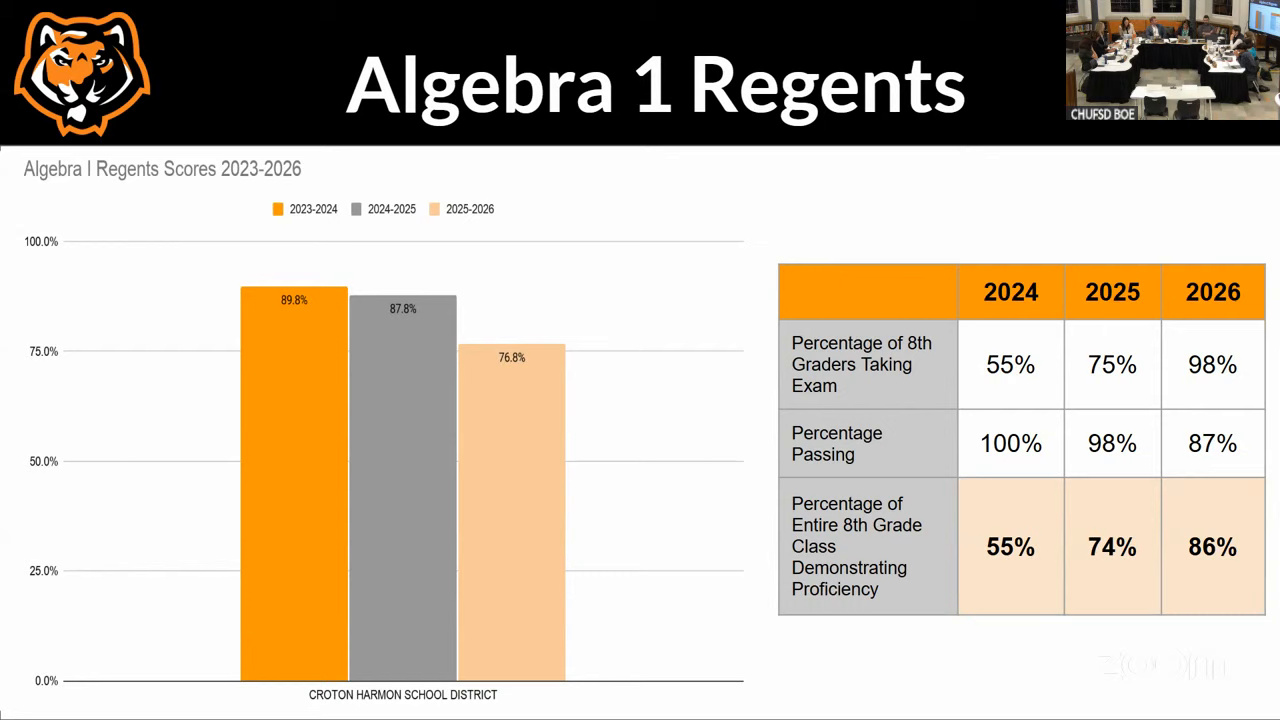
Croton-Harmon’s first year of Algebra for All brought 98% of eighth graders to the Algebra I Regents exam, while district leaders used the October 15 work session to outline curriculum changes aimed at more consistent reading and math performance. The school board also accepted the 2025–26 external audit and corrective-action plan, 5–0.
Watch the explainer on YouTube.
The algebra results illustrate why the percentage passing an exam does not tell the whole story about access. In 2024, 55% of eighth graders took the exam and all of those students passed. In 2026, 98% took it and 87% of those test takers passed. That meant 86% of the entire eighth-grade class demonstrated proficiency, compared with 55% two years earlier, according to the district’s presentation, page 18.
Assistant Superintendent Laura Dubak explained that the slide’s eighth-grade table and its broader Algebra I graph describe different groups: the graph also includes high-school students. Describing the purpose of expanding access, she said, “We want more kids to access the more rigorous curriculum.” Read 89:57▶ The district plans to follow those students through subsequent high-school math courses, including geometry, to see how the change carries forward.
The October 15 presentation distinguishes the full eighth-grade cohort from the broader group taking Algebra I Regents exams. Watch this moment
The discussion also identified work still to do in elementary and middle-school math. Dubak said the district aims to identify updated, aligned K–5 math materials by December 2026 for implementation in 2027–28. She described an updated Eureka math program with physical materials students can handle, with online tools serving as supplementary resources rather than replacing those materials in class. These were plans discussed by administrators, not a curriculum purchase approved that evening.
Superintendent Stephen Walker connected the data to upcoming budget choices. He said most of the additional intervention staffing supported over recent budget cycles had gone toward English language arts, with less directed to math. “So as we get into the budget cycle, I think that's something that we'll wanna take a look at.” Read 99:57▶ He also identified scheduling as a priority: allowing more students to receive math intervention from the teacher who provides their regular classroom instruction. No new staffing allocation was adopted during that discussion.
Reading results prompted a similar emphasis on consistent classroom experiences and curriculum resources. Walker described looking beyond an individual year’s results to “whether we can create upward movement in the overall proficiency percentage that lasts more than a single year.” Read 64:51▶ He linked promising classroom practices to work selecting and piloting consistent curriculum resources. Dubak described attention to spelling and word study, common texts and reading stamina; she said PVC had adjusted lab time to provide silent reading.
The high-school discussion turned to what Advanced Placement results can and cannot show. Dubak said the district wants to examine whether adding AP courses brings more distinct students into the program or leads existing AP students to take more exams. Trustees also sought a clearer view of exam results and the relationship between course grades and test performance. Those were requests for further analysis, not findings that every new offering had broadened participation.
Separately, the board accepted the external audit prepared by PKF O’Connor Davies and the district’s corrective-action plan for the year ended June 30, 2026. The recorded BoardDocs action lists five yes votes; the recording shows the acceptance vote after the audit presentation and questions.
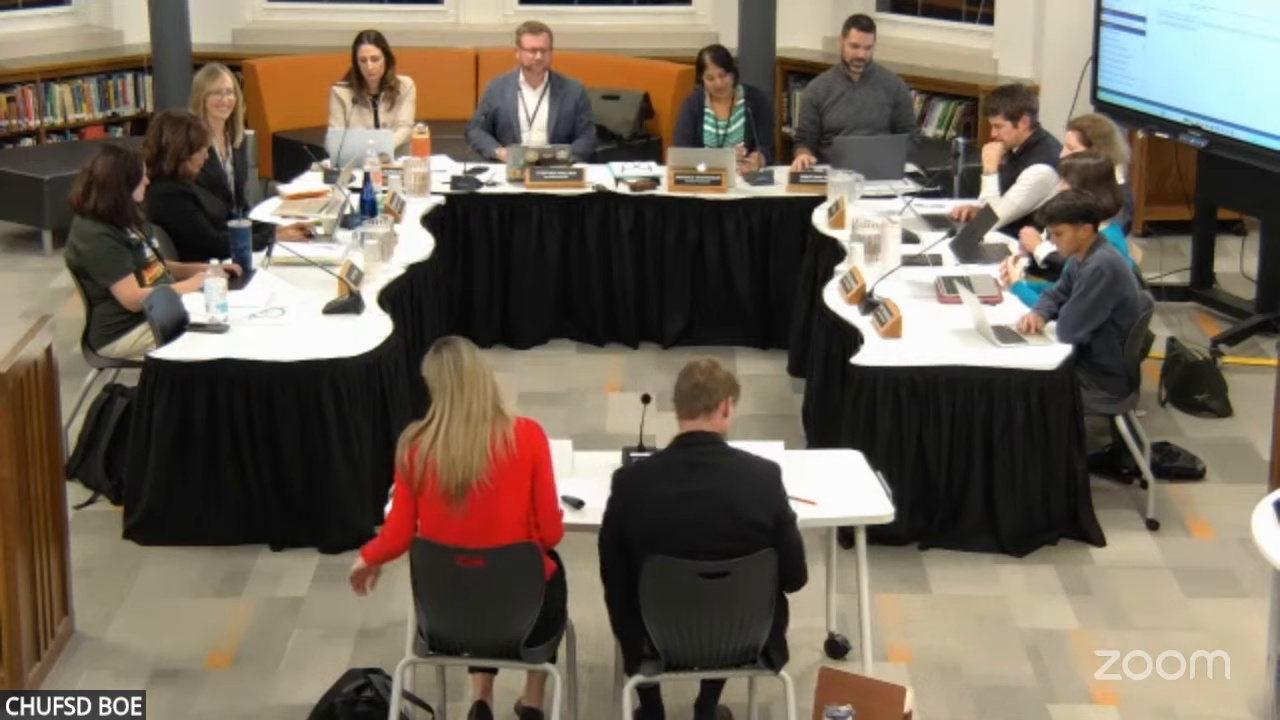
The board and district administrators during the October 15 audit discussion, before the audit-acceptance vote. Watch this moment
The district’s main financial statements received an unmodified opinion. Auditor Jeff Shaver cautioned against treating the difference between budgeted and actual spending and revenue as an equivalent amount of new savings: “budgetary variance does not equal actual surplus or actual increase in fund balance.” Read 14:52▶ The financial report, page 16, reports a roughly $1.9 million increase in the General Fund balance to $27.3 million, including $20.6 million restricted for particular purposes. That total is not an unrestricted spending pot.
The separate student activity-fund audit carried a qualified opinion. Its original report, page 2, says controls before students’ cash receipts reached district personnel did not allow the auditors to determine whether all receipts had been recorded. That qualification should not be confused with the unmodified opinion on the district’s main statements.
Assistant Superintendent for Business Denise Harrington-Cohen described the response to activity-fund handling concerns: “So we've developed a training program for the staff and for our student representatives.” Read 31:07▶ The written corrective-action plan sets November 30 for the timely-deposit training work and December 31 for reviewing inactive scholarship accounts. It says claims-related access responsibilities had already been reassigned, with a September 30 completion date.
The board also approved its consent agenda, including the medical-director, STAC administrative-services and Xerox agreements. The next regular meeting was announced for November 5 at 6:30 p.m. in the high-school library, followed by a November 19 work session at the same time and place. Trustees plan to be available for informal conversation at 6 p.m. before both meetings.
Documents and meetings behind this story
Every one of these is a
public record. Links go to original public records or our meeting pages.
Why it's hereThe June 29 special meeting explained designated reserves and year-end allocations before final audit figures were available.
▶
Key Actions & Decisions
●Expanded the PVC air-conditioning contract to $805,800 and awarded $285,777 for CET tennis-court lighting.
●Authorized a $200,000 General Fund transfer to reduce the School Lunch Fund deficit.
●Authorized a PVC boiler repair from the Repair Reserve and year-end reserve allocations subject to final audit figures.
●Approved four probationary teaching appointments and two leave replacements.
Experimental project: croton.news uses AI to generate articles from public records. Content may contain errors. Please report any inaccuracies and check our corrections log.AI-assisted experimental site — may contain errors. Corrections
Community Discussion
Be the first to comment on this story.
Sent to the editor for review
This is what you asked us to forward to the Village Board:
An editor reads it first. Once it goes, your comment here will show a ✓ Forwarded to the Village Board mark — that is your confirmation.