Croton's license plate readers feed a county database that is now being sued
In January, Croton's Police Advisory Committee was assured that plate data is not available to ICE without a judicial warrant. In June, a class-action lawsuit alleged the county database holding Croton's scans is shared with more than 50 outside agencies — including ICE. Separately, the company whose software reads the plates is warning investors it may not survive the year intact.
By Matthew Broudy · July 22, 2026 · drawn from the village meeting record and cited public sources
Update — September 8, 2026: Westchester plans to seek dismissal on September 11 under a new court schedule. Our latest report also compares the January and August police statements on outside access and examines Rekor's proposed privacy standard.
The cameras Croton actually has
Croton-on-Hudson's fixed public cameras are easy to miss in the village's records, because they arrived quietly. The Village Board authorized a contract with Rekor for a license plate reader system in the summer of 2022 — $9,716, disclosed in the Mayor's Newsletter of August 3, 2022 — and the program has run ever since with no dedicated public webpage, no posted signage, and, until this year, almost no board discussion. [EFF Atlas of Surveillance, listing Croton PD's ALPRs as Rekor-vendored, in use since at least 2022]
The clearest public description the village has produced came at the Police Advisory Committee's January 15, 2026 meeting, in a briefing by Detective Fielding recorded in the committee's minutes: "The License Plate Reader cameras are Mobotix brand and data is stored by Rekor. License Plate Reader information is stored at the County Real Time Crime Center." Mobotix is a German camera manufacturer; Rekor is the Maryland software company whose artificial intelligence reads the plates; the Real Time Crime Center is the Westchester County Police Department facility, established in 2017, that pools camera data for the county's roughly 40 police agencies. [PAC minutes, 1/15/2026; Mobotix Westchester case study, 2021]
Membership has terms. Croton PD cannot pull images itself — it "must go through the RTC to access the cameras images," per the minutes — and participation requires staffing: Detective Fielding works at the county center one day per week. The committee was told the county keeps plate numbers "approximately 3 years" and the wider overview photos for 10 days, that the data is incident-specific rather than a tool for analyzing patterns of movement, and — in an assurance that would look different five months later — that "data is not available to ICE or other agencies without a judicial warrant." [PAC minutes, 1/15/2026]
The village's adopted FY2026-27 budget shows what the system costs to keep running: $4,800 for LPR internet service, $4,268 for LPR site maintenance, $1,800 for radar and LPR unit repairs, and a line for seven wireless cameras at $3,192 — plus, in a separate fund, an $8,190 "LPR Service Agreement" for the plate readers that enforce permits in the village's commuter parking lots. Roughly $22,000 a year, all in. [Adopted Budget FY2026-27, Detail of Expense Appropriations]
Everything else is still on paper. A Croton-specific state law signed October 27, 2025 (Chapter 486) authorizes red-light cameras at up to three intersections — the police chief's recommended sites are the two Route 9 ramps at Croton Point Avenue and Municipal Place/South Riverside — but the board has not begun implementation, and the village has no vendor. A school speed-zone camera program exists only as a home-rule request to Albany, re-adopted three times this spring as the state bill was revised. Security cameras for Croton Landing and Senasqua parks are budgeted in this year's capital plan after a one-year deferral. [A8360-A / Ch. 486 of 2025; work session 12/4/2025; BoT 6/2/2026; capital plan session 4/16/2026]
Residents have noticed the cameras even if the record barely does. The PAC's minutes acknowledge "a vocal group of residents are opposed to any government cameras within the village"; Trustee Nora Nicholson said in May that "the rumoring is pretty intense" and proposed a public camera Q&A; the committee has been planning an education campaign since January and a community survey runs September 15 to October 15. At the May 20 board meeting, Mayor Brian Pugh offered the village's most direct public defense of its choices: Croton's camera data "is hosted by the Westchester County Police Department and is not cloud based," per the minutes — and, of vendors, "I won't name names, but there's one that's been in the news lately. You can look it up if you're curious. We don't use that one." The reference lands on Flock Safety, the ALPR giant whose cameras dozens of American towns have canceled since 2025 over revelations that its national lookup network was used for immigration enforcement. [PAC minutes 1/15/2026; transcript 5/20/2026; BoT minutes 5/20/2026; 404 Media, 5/2025; NPR, 2/17/2026]
The village's two official descriptions of its own system — the mayor's "not cloud based" and the PAC minutes' "data is stored by Rekor" — sound contradictory but turn out to be reconcilable. Rekor sells its Scout software two ways: hosted in Rekor's own AWS cloud, or self-hosted on servers the customer runs, with plate data in a local database. Rekor's official documentation describes both options. Westchester runs the self-hosted kind: the county operates a Rekor/OpenALPR login portal at a westchestergov.com address on network space publicly registered to the County of Westchester — not on Rekor's cloud — and the Umemoto complaint describes the county paying Rekor roughly $30,000–44,000 a year for "access to Rekor Scout" and maintenance, with the county running the system out of its Real Time Crime Center. "Stored by Rekor," in other words, means stored in Rekor's software, licensed and administered for the county — on the county's infrastructure. The mayor's description holds up. [Rekor Scout self-hosted documentation; deployment options; Umemoto complaint ¶¶33, 61, 72; DNS/ARIN registration checks, 7/22/2026]
But county-hosted is not the same as county-confined — and here the record gets uncomfortable. The Umemoto complaint states the county "has chosen to enroll in Rekor's Public Safety Network," which "shares real-time and historical vehicle surveillance data with every other law enforcement agency that uses Rekor software and enrolls in the network" — and Rekor "does not provide a public list" of members. Rekor's own current terms of service go further: "By using law enforcement products in the Services, you agree to share your Data with other law enforcement agencies, unless you affirmatively opt-out" — sharing is the default, and opting out requires written notice. Whether the county — or Croton, for its own contract — ever filed that opt-out is not in any public record found. croton.news has filed a Freedom of Information Law request with the village for its Rekor agreement and any opt-out or data-sharing election, and will report what comes back. [Umemoto complaint ¶58; Rekor Privacy and Terms, updated 2/10/2025]
Every time Croton's plate readers appear in the village's own police blotter (10 entries)
Westchester County refused to disclose where its plate readers are, telling the plaintiffs' lawyers in August 2025 that releasing locations "would provide roadmaps to individuals planning high-risk or violent crimes." Croton's own police blotter, published weekly by the village, has meanwhile been recording the readers at work for years — including, in the April 6, 2024 entry, the location of one of them. Every entry below is the village's own text, verbatim.
Included: entries where a reader actually registered something. Excluded: the much larger number of blotter items about lost or stolen license plates, which have nothing to do with the cameras. The village deletes blotter posts after a month or two, so this is our archive rather than a complete record — the absence of 2023 entries reflects gaps in what was captured, not a pause in use.
Real Time Crime Center alerted authorities of a vehicle wanted in connection with menacing with a firearm by the New York State Police (NYSP), which triggered the License Plate Reader (LPR) on South Riverside Ave at Croton Point Avenue. Patrols were promptly informed. Subsequently, patrols located the vehicle in the ShopRite parking lot. RTC was updated accordingly. NYSP and MTA Police responded to the scene. Patrol confirmed the scene secure and reported being present with NYSP to conduct an investigation. No firearm was displayed; instead, they were utilizing a long lens camera to photograph vehicles.
Patrol reports stopping a vehicle on Route 9 South after a license plate reader notification. Subsequent to the stop, the operator, a 46-year-old female from Garrison, NY was arrested for operating with a suspended registration.
Patrol stopped a vehicle on North Riverside Avenue after a license plate reader notification. Subsequent to the stop, the operator, a 47-year-old male from Verplanck, NY was arrested for operating with a suspended registration and Aggravated Unlicensed Operation in the 1st Degree.
Patrol utilizing a license plate reader, stopped vehicle for suspended registration. Driver also the registered owner who was shown to have a suspended license. The license plates were confiscated and vehicle towed. The driver, 27 years of age of Yonkers, New York was issued two uniform traffic tickets for violating NYS Vehicle & Traffic Laws section 512 & 511-1a, Suspended Registration and Aggravated Unlicensed Operation 3rd . The driver was released on scene with a return date of 02/26/2022.
NYSP requesting patrols be on look out for a white chevy cargo van, A LPR hit on Route 9 South at bay street in Peekskill was received ten minutes in the past. The vehicle operator, a 43 year old white male, is wanted for menacing with a knife during a road rage incident and aggravated unlicensed operation. Croton patrols dispatched to bolo.
MTA Bridge & Tunnel Authority requests a welfare check on local female resident. MTA Bridge & Tunnel Authority report locating an abandoned vehicle on the Bronx bound span of the RFK bridge yesterday morning. Local female sought is known to this department and has a history of mental illness. NYPD 13th precinct refused to take missing person's report from her and asks to have report filed here. Information taken from sister of missing person. A missing person report was sent via eJustice portal, message sent on slack. Real Time Crime reports a LPR hit on missing persons Toyota on 1/7/2022. eJustice shows sister contacted Croton Police and reported that she had spoken to her sister who was reported missing. Patrols conducted a welfare check upon the local resident reported missing. Patrols located her at her residence and she indicated she was okay and did not need any further assistance. She was on the phone with her sister while patrols spoke with her.
Patrols report stopping a gray Jeep for a VTL violation (license plate reader hit). eJUSTICE portal shows the vehicle registration to be suspended and expired. The owner/operator, age 27 of the Bronx NY had a suspended license. The operator was placed under arrest and processed roadside. The vehicle was impounded and towed from the scene. The defendant was charged with Aggravated Unlicensed Operation 3 rd /VTL 511-1A. The defendant was given a village court return date of January 5th, 2022.
Patrol reports stopping a 2019 Hyundai for an LPR hit of a suspended/revoked registration. Vehicle registration was suspended two times for having no insurance. The operator, a 48 year old female resident of Shrub Oak NY held a valid NYS license. Operator was booked and processed roadside. She was issued summons for VTL 512 Suspended Registration, and VTL 319-1 Uninsured Vehicle. She was released on her own recognizance with a return date of December 15, 2021. The operator and passenger were provided a courtesy transport to the Croton Diner. The vehicle was impounded.
Patrol reported stopping a black 2019 Toyota for a license plate reader hit of a suspended registration, on Route 9 South and Croton Point Avenue. Patrols confirmed the operator had a suspended license and the registration was suspended for insurance lapse. The operator was taken into custody without incident and issued summonses for Aggravated Unlicensed Operator in the 3rd Degree, Suspended Registration and Uninsured Vehicle.
Patrol unit reported stopping a vehicle on Route 9 North after receiving an LPR hit revealing the vehicle registration was suspended. After further investigation, it was determined that the operator, a 25-year-old resident of Staten Island, was also driving the vehicle with a suspended driver's license and an expired inspection certificate. Defendant is due back in Village Justice Court on 11/18/20. The vehicle was impounded from the highway.
The lawsuit — and what it reaches in Croton
On June 9, 2026, four Westchester drivers filed a class-action complaint, Umemoto v. Westchester, with the Westchester County Clerk (Index No. 65935/2026, State Supreme Court), naming the county, its Department of Public Safety, and its commissioner and chief; the suit was announced publicly two days later. Brought by the New York Civil Liberties Union, the Policing Project at NYU Law, the Knight First Amendment Institute at Columbia, and the firm Freshfields, it alleges the county built a network of roughly 600 cameras holding 1.6 billion accumulated scans, retained for two years and searchable without a warrant or individualized suspicion — and that the system was never authorized by the county Board of Legislators, violating the state constitution's separation of powers. One named plaintiff's car was scanned more than 2,400 times. Of the 264 million plate recordings collected in 2024, the NYCLU says, over 99 percent were unrelated to any suspected crime. [Complaint, filed stamp 6/9/2026; Policing Project case page; NYCLU, 6/2026; Fortune/AP, 6/11/2026]
The county has said the complaint contains "legal and factual errors." [The Examiner News]
For Croton's deployments, the suit matters in at least four concrete ways — and the first is the largest.
First, the ICE question: the suit directly contradicts what Croton was told. This is the collision at the center of the story. In January, the village's Police Advisory Committee received a specific, recorded assurance about its plate readers:
"Data is not available to ICE or other agencies without a judicial warrant and only information requested with that warrant can be shared." — PAC minutes, Jan. 15, 2026
Five months later, the Umemoto complaint and the NYCLU's accompanying research allege the opposite about the county system where Croton's data lives: that access is shared with more than 50 outside agencies, including ICE — not through judicial warrants, but as participants in the system. [NYCLU commentary, 6/17/2026; Fortune/AP, 6/11/2026]
Both statements cannot fully describe the same database. The village's briefing may faithfully reflect what Croton was told by the county — the contradiction is not evidence that anyone in Croton misled anyone. But the stakes are concrete: a village that has publicly distanced itself from the vendor at the center of the national ICE-lookup scandal ("we don't use that one") is feeding its scans into a county system now accused, in court, of the same category of sharing. Every Croton-on-Hudson plate scan since 2022 is potentially within reach of whatever access the county actually grants. "Does Croton's plate data reach ICE?" now has two conflicting public answers, and only the village and county can resolve which one is true. [PAC minutes 1/15/2026; transcript 5/20/2026]
Second, Croton's data is inside the case. The village's own minutes say its LPR data "is stored at the County Real Time Crime Center." Whatever the court decides about that database — up to and including the plaintiffs' request that the system be declared unlawful — decides the fate of the back end Croton's cameras depend on. The village owns cameras; the county owns the system that makes them useful.
Third, the numbers don't line up. Croton's committee was told plates are kept about three years; the NYCLU describes a two-year county retention policy (and alleges some data is held longer). Which schedule governs a scan made by a Croton camera is not answered anywhere in the public record. [PAC minutes; NYCLU]
Fourth, the legislature may move first. Bills drafted with the NYCLU (A.10808/S.9890) would restrict license plate reader use statewide to felony investigations, stolen vehicles, and missing persons. If enacted, that would rewrite the rules for Croton's readers regardless of how the lawsuit ends. [NYCLU]
There is also precedent one county over from the lawsuit's theory. Westchester's system has already produced the best-known example of ALPR pattern policing in the country: the 2023 case of David Zayas, flagged by the county's Rekor-powered AI because his driving patterns resembled a drug courier's — reporting that led a defense attorney to call the system "dragnet surveillance." Croton's committee was told its data "is not compiled to allow officers to analyze large groups of people to narrow down behavior." At the county level, Forbes' reporting suggests the capability exists. [Forbes, 7/17/2023; PAC minutes]
Separately: the company reading the plates is in trouble
Rekor Systems — the vendor on Croton's 2022 contract and the AI supplier for the county system — is a publicly traded company in visible financial distress.
Its annual report, filed March 31, 2026, shows revenue of $48.45 million for 2025 against a net loss of $31.46 million — an improvement on 2024's $61.4 million loss, but the filing goes further. In management's own words: "the existing cash is insufficient to fund its current level of operations for the next twelve months following the issuance of these consolidated financial statements. These factors raise substantial doubt regarding the Company's ability to continue as a going concern." The company's auditor attached a going-concern explanatory paragraph to its opinion. Rekor raised about $13.9 million in a December 2025 stock offering; as of March 31, 2026 it reported $12.6 million in cash (including restricted cash) against roughly $15 million in long-term debt, including notes that come due in December 2026. [Rekor Systems Form 10-K, filed 3/31/2026; figures confirmed via SEC EDGAR company facts; Q1 2026 10-Q]
On April 27, 2026, Nasdaq notified Rekor that its stock had traded below the $1.00 minimum bid price; the company has until October 26 to regain compliance, with a reverse stock split among its options. [SEC Form 8-K, 5/2026]
Rekor has responded to the industry's broader crisis by positioning itself as the responsible alternative: on July 8, 2026 it published a "Privacy and Evidence Architecture" white paper explicitly framed against "the Flock backlash," conceding that "legitimate issues are being raised around privacy... data retention and sharing, auditability, and evidentiary trust." That is marketing, not policy — but it is notable that Croton's own vendor now publicly concedes the premise of the criticism. [GlobeNewswire, 7/8/2026]
For a village whose entire program rides on a $9,716 contract and $22,000 a year in maintenance lines, the practical question is continuity: what happens to Croton's readers, and to the scan data they have generated since 2022, if the vendor is acquired, restructures, or fails? Nothing in the village record addresses it.
What to watch
The county's formal answer in Umemoto; the village's response to croton.news's FOIL request for the Rekor contract and any written opt-out from Rekor's default law-enforcement data sharing (acknowledgment is due within five business days) — and which retention schedule governs Croton-originated scans; whether the Board of Trustees takes up the dormant red-light authorization (which sunsets in 2030 and carries mandatory annual crash-and-revenue reporting if used); the fate of the speed-camera bill in Albany; the PAC's community survey (September 15–October 15), which may produce the first structured measure of what Croton residents actually think about the cameras; Rekor's October 26 Nasdaq deadline and December debt maturity; and the promised village education campaign — proposed in January, not yet delivered.
Sources
- Croton Police Advisory Committee minutes, Jan. 15, 2026 — Mobotix/Rekor/RTC description, retention, ICE assurance, "vocal group of residents"
- PAC minutes, Mar. 12, 2026 and Jun. 18, 2026 — all-cameras discussion, education campaign, survey dates
- Board of Trustees work session, Dec. 4, 2025 — red-light locations, no vendor
- BoT May 20, 2026 and Jun. 2, 2026 (transcripts: 5/20, 6/2) — speed-camera home rule; Pugh on hosting and vendors
- BoT work session, Apr. 16, 2026 — park cameras, signage practice
- Adopted Budget FY2026-27 · Mayor's Newsletter, Aug. 3, 2022
- A8360-A / Chapter 486 of 2025 · A11322 (2026)
- Umemoto v. Westchester case page · complaint (filed 6/9/2026, Index No. 65935/2026) · NYCLU press release · NYCLU commentary
- Fortune/AP, 6/11/2026 · Washington Post/AP, 6/9/2026 · The Examiner News
- Forbes, 7/17/2023 — the Zayas case
- Rekor Form 10-K (3/31/2026) · Form 8-K, Nasdaq notice · Q1 2026 10-Q digest
- Rekor Scout self-hosted documentation · data-destination options · Rekor Privacy and Terms (2/10/2025)
- GlobeNewswire, 7/8/2026 — Rekor white paper
- Mobotix Westchester case study (2021) · EFF Atlas of Surveillance
- 404 Media, 5/2025 · NPR, 2/17/2026 — the Flock backlash
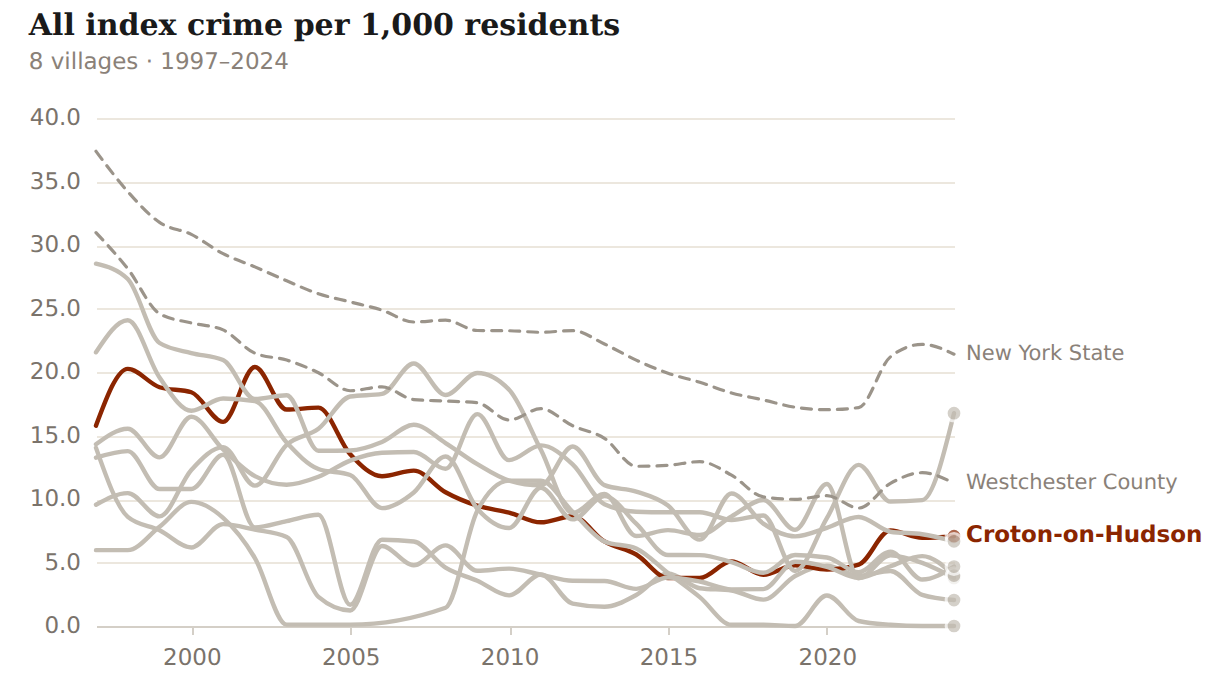
- croton.news chart engine: index crime per 1,000 residents (NYS DCJS)
Community Discussion
Be the first to comment on this story.
Sent to the editor for review
This is what you asked us to forward to the Village Board:
An editor reads it first. Once it goes, your comment here will show a ✓ Forwarded to the Village Board mark — that is your confirmation.