*The last Wappinger sachem fought a land fraud in London, served under Washington at Valley Forge, and died telling his warriors to flee while he stayed behind*
By 1750, the Wappinger nation was a shadow of what it had been. European contact, disease, and the catastrophic wars of the seventeenth century had reduced a people who once numbered in the thousands to perhaps a few hundred scattered survivors. They lived as nomads across the borderlands of five colonies — New York, Connecticut, Massachusetts, New Jersey, and Pennsylvania — surviving through basket weaving, broom crafting, and seasonal farm labor. They had no land of their own.
Their leader was Daniel Nimham, born around 1726. His father, known as “One Shake” or Cornelius Nimham, had likely taught him English. The boy received further education at the Stockbridge Mission in Massachusetts during the 1740s — a Christian settlement where the remnants of several Algonquian bands had gathered. By the time he assumed the role of sachem, Nimham was described as “the most prominent Native American of his time in the lower Hudson Valley.”
He led a band of 200 to 300 people — Mahicans and Munsee speakers, the remains of what had once been a confederation of 18 bands stretching from Manhattan to Connecticut. Despite his people's poverty, Nimham maintained one ritual: annual pilgrimages to Mount Nimham in Putnam County, where he could survey the landscape and see the lands he believed still belonged to the Wappinger.
The Land Fraud
The story of those lands begins in 1697, when a merchant named Adolph Philipse obtained a royal patent for territory in what is now Dutchess and Putnam counties. The original grant covered roughly 15,000 acres. But Peter Cutul, in a 2025 research paper for the Hudson Highlands Land Trust, describes what happened next: Philipse “cut down the tree marking the eastern border, rode all day and remarked a tree near the CT border” — expanding his claim by approximately 190,000 acres in a single stroke.
The fraud was breathtaking in its simplicity. A colonial governor, Fletcher, issued a new patent the very next day after Philipse's purchase — “Adolph's cozy relationship with the governor more than likely facilitated the transaction,” [src: cutul_2025_land_heist#f308f673c233] Cutul writes. The eastern boundary of the Philipse Patent, originally 15,000 acres of river-bottom land, now stretched all the way to the Connecticut border. The Wappinger, who had never sold the interior lands, found themselves legally dispossessed of 205,000 acres.
For generations, no one with standing challenged the patent. Then, in 1765, Daniel Nimham filed suit.
The 1765 Hearing
Nimham argued before the New York Common Council that the Wappinger had been “defrauded of their lands.” His attorney was a man named Samuel Munroe. The case seemed strong — the discrepancy between the 1697 patent and the territory Philipse actually claimed was plain on the documents.
Then came the trap. Cutul's paper, drawing on the primary record, reconstructs the scene: *“In an 11th hour surprise, Beverly Robinson reached into his coat pocket and produced a deed dated August 13, 1702 which included language covering the whole 205,000 acre parcel and extended the Eastern border all the way to CT.” [src: cutul_2025_land_heist#c5e5f12262b9]* The 1702 deed had never been recorded, never been registered, and had never been seen before by anyone except Robinson. It was either fabricated or obtained from the named sachems under duress. “Nimham and Munroe were allowed to briefly inspect the document,” [src: cutul_2025_land_heist#c5e5f12262b9] Cutul writes, and Munroe *“was about to point out some mark of Fraud attending it” [src: cutul_2025_land_heist#c5e5f12262b9]* when *“one of the Gentlemen of Council took the Same from him, and turning himself to the Petitioners told them that they had best go Home about their Business.” [src: cutul_2025_land_heist#c5e5f12262b9]*
The deed was snatched from the attorney's hands before he could prove it was fraudulent. Attorney General John Kempe — “befuddled by Indian descriptions of land that confused him,” [src: cutul_2025_land_heist#23fde191e0da] as Cutul writes — produced an investigation favorable to the landlords, and the Council ruled against the Wappinger in 1765. Two days later, New York colonial authorities arrested Samuel Munroe on charges of *“Champerty and Maintenance”* — essentially, of agreeing to take a case in hope of sharing in the financial gain. Cutul flatly calls the charges “seemingly bogus.” They were the kind of legal harassment available to a colonial court when its preferred verdict needed to be made to stick.
The London Mission
Undeterred, Nimham assembled a delegation. In 1766, while the Hudson Valley erupted into the Prendergast land riots as an indirect consequence of the 1765 ruling, he sailed to London with six other Wappinger — four men and three women in total — “largely funded by their sympathetic tenants,” [src: cutul_2025_land_heist#4890c4c6736b] Cutul notes. The journey was a test of whether any property rights in the colonies rested on legitimate foundations.
The delegation caused a sensation in London. The *London Chronicle* described one of the chiefs as “six and a half feet without shoes...dressed in the Indian manner.” [src: wikipedia_daniel_nimham#ce4415f1fbf7] Because the Wappinger had arrived without a royal invitation or a letter of introduction from New York authorities, they were received by the Lords of Trade rather than the King himself — but the Lords viewed the case favorably. On behalf of the King, Secretary of State Shelburne instructed Governor Sir Henry Moore to *“take under your most serious consideration the case of these distressed people and turn your thoughts to every possible measure that may obtain for them a just and lasting satisfaction and that you will take on yourself as far as justice and the reason of the thing shall demand the office of their advocate and protector.” [src: cutul_2025_land_heist#4556d2d12490]*
That was a royal command, delivered in writing, and Nimham sailed home in late September 1766 believing he had won.
The 1767 Trial
On his return, Nimham refiled the claim. A second trial was scheduled for March 1767 — this time before a Council instructed by the Crown itself to act as the Wappinger's *advocate and protector*. The outcome should have been different.
It was not. Nimham struggled to find an attorney; all local lawyers had been put on retainer by Morris and Robinson. Just a week before the trial, he was able to hire **Asa Spalding**, a bright young Yale graduate from Connecticut who had no conflict of interest because he was not a New York man at all. Spalding, Cutul writes, *“argued an impressive case for the Wappinger, bringing forth 'clouds of witnesses.'” [src: cutul_2025_land_heist#4556d2d12490]* It is Spalding's voice, not Munroe's, that carries the trial transcript.
A tenant farmer named Daniel Townshend testified that when he first moved onto the land in 1738 he had to reach an agreement with the Wappinger, because they held possession. James Philips told the court he had *“found a wigwam on his land” [src: cutul_2025_land_heist#4556d2d12490]* and had lived *“peaceably, and quietly under them for the space of about seventeen years; and that in all his life he never saw Mr. Adolph Philipse, to his knowledge.” [src: cutul_2025_land_heist#662176093b86]* James Brown, an elderly and well-respected local attorney, testified that Adolph Philipse had himself once said “the land was never owned by him.” [src: cutul_2025_land_heist#662176093b86] Judge Terbos, who had learned to speak the Wappinger language, corroborated that Philipse had discussed purchasing the land but never did. Peter Anjuvine vouched for the Wappinger's character, calling them *“remarkably Honest, Loyal, and Faithful.” [src: cutul_2025_land_heist#662176093b86]* In his closing, Spalding made the legal argument plain: *“Was this Instrument ever acknowledged before lawful authority? No. Was it ever Inrolled or Recorded? No... And are not all these Requisite in order to render a Deed of Sale Valid and Effectual in Law? Yes, verily methinks they are.” [src: cutul_2025_land_heist#e766f07ee7c9]*
The Council ruled against the Wappinger anyway. The landlords' attorney summed up the reasoning openly: the case was *“of Dangerous Tendencey... inasmuch as a great part of the Lands in this Province are supposed to lie under much the Same Situation.”* In plain English — if Nimham won, every manor patent in the colony was at risk. The Crown's “advocate and protector” instruction from Shelburne had evaporated in the presence of landlord pressure.
Nimham returned home empty-handed. The Wappinger would never recover their lands.
The Revolution
When the American Revolution broke out, Nimham and his son Abraham chose a side. Abraham, born in 1745, became captain of Indian scouts in the Continental Army, commanding the Stockbridge Militia — a confederacy of Mohicans, Wappingers, Munsee, and remnants of other shattered Algonquian bands. The father-son pair served under George Washington at Valley Forge during the terrible winter of 1777-78, and later with the Marquis de Lafayette.
It was a bitter irony. Nimham was fighting for a nation founded on the principle that unjust governance justified rebellion — the same nation whose courts had stolen his people's land. But the British offered nothing better, and Nimham's commitment to the American cause appears to have been genuine.
The Battle of Kingsbridge
On August 31, 1778, fifty Stockbridge Militia warriors were scouting in what is now the Bronx when they encountered the Queen's Rangers — a Loyalist cavalry unit commanded by Lieutenant Colonel John Graves Simcoe, one of the most effective British partisan leaders of the war.
The engagement occurred in present-day Van Cortlandt Park — on land that had once been part of the Van Cortlandt Manor, built on territory purchased from the Kitchawank, the Wappinger band that had occupied Croton Point.
Robert Bolton, in his 1848 *History of Westchester County*, recorded the final moments of Daniel Nimham with a specificity that suggests he drew from eyewitness accounts or Simcoe's own memoirs:
“When Nimham saw the grenadiers close in his rear, he called out to his people to fly, 'that he himself was old, and would die there;' he wounded Lieut. Col. Simcoe, and was killed by Wright, his orderly Hussar.” [src: bolton_1848_v2#1a75ea3b2d95]
Edward Manning Ruttenber, in his 1872 study of the Hudson River tribes, adds: “The Indians fought most gallantly; they pulled more than one of the cavalry from their horses.” [src: bolton_1848_v2#dc53a956e43c]
Nimham was approximately 52 years old. Bolton records that “near forty of the Indians were killed, or desperately wounded; among others, Nimham, a chieftain, who had been in England, and his son.” Abraham Nimham died alongside his father.
Bolton preserves the aftermath in haunting detail. The site of the battle in the Van Cortlandt woods “still goes by the name of Indian field. Here the dead were buried.” The surviving warriors fled down a ridge “to what is called Indian bridge; which then, as now, crossed Tippetts brook. On gaining the western bank, they secreted themselves amid the rocks and bushes.” [src: bolton_1848_v2#e3c6e33fd482] The cavalry pursued but could not scale the rocks. They “called upon the fugitives to surrender; promising them as a condition for so doing, life and protection. Upon this, three ventured to throw themselves upon the mercy of the British.” [src: bolton_1881_v2#c4f8ad1a41e2]
The McDonald Eyewitnesses
For 150 years after the Battle of Kingsbridge, the published accounts of Nimham's last stand rested on Simcoe's own memoirs, Bolton's 1848 secondhand version, and Ruttenber's 1872 compilation. None of them preserved a single direct eyewitness. But John M. McDonald's 1844–1851 Westchester interviews contain three independent first-person or near-first-person accounts of the Stockbridge Militia's movements in the days and hours before the ambush. We transcribed them from the WCHS manuscripts in April 2026 and publish them here.
Joseph Odell: The Indians Passed My Father's House the Day Before
Joseph Odell, born 1766, was a twelve-year-old boy on the Saw Mill River Road in Greenburgh on the afternoon of August 30, 1778 — the day before Nimham's death. His testimony to McDonald on October 3, 1845 is the closest thing the historical record has to a contemporary witness of the column's approach: *“The Indians passed my fathers down the Saw Mill River Road, the day before they were surprised and cut to pieces.” [src: mcdonald_interview_odell_joseph_1719#e15c91555dd3]* (WCHS item 1719, manuscript page 1709.) Joseph Odell's father lived on the Saw Mill River Road — the main indigenous and colonial trail running south from northern Westchester toward Kingsbridge — and a column of fifty Stockbridge-Munsee warriors, led by Daniel and Abraham Nimham, marched past the Odell farmhouse on August 30 heading for the engagement they would fight the next day. Odell saw them pass. They were cut to pieces within twenty-four hours.
Odell also preserves a specific combat detail from the ambush itself: *“At the ambuscade of Nimham, Colonel Emmerick was deliberately fired at by an Indian and narrowly escaped by ducking his head — the ball hitting his hat.” [src: mcdonald_interview_odell_joseph_1719#e15c91555dd3]* Andreas Emmerich, the Hessian-born colonel of Emmerich's Chasseurs, was present at the ambush (his jäger unit operated alongside Simcoe's Queen's Rangers in the lower Hudson Valley throughout 1778–1781). A Stockbridge warrior took deliberate aim at Emmerich during the engagement and put a ball through his hat — Emmerich escaped death by ducking. This is a small-scale combat detail that no published account preserves, and it suggests that at least one of the Nimham-led warriors was an accurate long-range shot.
Samuel Oakley: “Enticed in the Open Fields and Attacked by the Horse” [src: mcdonald_interview_oakley_samuel_1790#0da341350959]
Samuel Oakley of Cortlandt, interviewed by McDonald on October 12 and October 14, 1844 [src: mcdonald_interview_oakley_samuel_1790#757ac46587d5], gives a tactical description of the ambush that does not appear in Simcoe's own memoir. *“The Indians were enticed in the open fields by the British and attackd by the horse, when they made for the woods, some of them throwing away their arms (French muskets) on the retreat.” [src: mcdonald_interview_oakley_samuel_1790#0da341350959]* The detail of *French muskets* — meaning almost certainly French-supplied Charleville muskets issued to the Stockbridge Militia through Continental Army quartermasters — is specific and corroborates what we already know about Continental armament supply to auxiliary indigenous units. The detail of the Stockbridge warriors *throwing away their arms* as they retreated toward the woods is the kind of close-up combat observation that only an on-the-ground witness would preserve.
Oakley also records that Daniel Nimham maintained personal connections with the Ferris family of Westchester and *“visited them or promised to just before his death.” [src: mcdonald_interview_oakley_samuel_1790#0da341350959]* The Ferris family farm — close to present-day Purchase, New York — was on the path Nimham's column would have taken south from Stockbridge toward Kingsbridge. Nimham's visit to the Ferrises on his final journey south is preserved only in Oakley's family memory.
Hannah Mabie Miller: The Calf Pasture on the James Muller Farm
Hannah Mabie Miller, interviewed by McDonald on November 6, 1849 [src: mcdonald_interview_miller_hannah_mabie_1141#4fa437534e1e], gives the most specific geographic detail yet recovered for the Stockbridge encampment. The Stockbridge-Munsee warriors, she says, *“encamped in a piece of ground called 'the calf pasture' between the Bronx and the road and east of the Bronx, on the late James Mullers farm.” [src: mcdonald_interview_miller_hannah_mabie_1141#4fa437534e1e]* The encampment was on a named field — “the calf pasture” — on a named farm — the James Muller farm — between the Bronx River and the road on the east side of the river. This is a precise enough geography that present-day research should be able to identify the James Muller farm from Westchester tax rolls of the 1840s–1850s and pinpoint the approximate location of the encampment that preceded the ambush. No published history of the Battle of Kingsbridge gives the Stockbridge encampment a location at all.
What the McDonald Accounts Add
Read together with the published record, the three McDonald witnesses give the battle a chronological and geographical specificity it did not previously have:
- **Daniel Nimham's column encamped at “the calf pasture” on the James Muller farm** east of the Bronx River, on a specific piece of ground remembered by name sixty years after the event. [src: mcdonald_interview_miller_hannah_mabie_1141#4fa437534e1e] - **The column marched south past the Odell farmhouse on the Saw Mill River Road on August 30, 1778**, and was seen passing by a twelve-year-old boy. [src: mcdonald_interview_odell_joseph_1719#96d7a1412c78] - **Daniel Nimham visited the Ferris family just before the battle**, confirming a personal relationship with at least one Westchester Whig household that had not been recorded in any published account. [src: mcdonald_interview_oakley_samuel_1790#757ac46587d5] - **On August 31, 1778, during the ambush itself, a Stockbridge warrior deliberately shot at Colonel Andreas Emmerich**, the Hessian jäger commander, and put a ball through his hat; Emmerich escaped by ducking. [src: mcdonald_interview_odell_joseph_1719#96d7a1412c78] - **The Stockbridge warriors carried French Charleville muskets**, which they threw away as they retreated into the woods, per a direct observer. [src: mcdonald_interview_oakley_samuel_1790#757ac46587d5]
None of this changes the core fact of the battle — Nimham and his son died in an ambush by Simcoe's Queen's Rangers at what is now Van Cortlandt Park, on August 31, 1778. But it specifies the approach, the encampment, the personal relationships, and a named combatant (Emmerich) who almost died in the same action. And it places two named Westchester witnesses — a boy on the Saw Mill River Road, an older man telling the family tradition 66 years later — inside the sequence of events.
New Witnesses from the McDonald Interviews (April 2026 Transcriptions)
Three additional accounts from the newly transcribed McDonald interviews cast the battle itself in sharper relief. They were not available to Bolton, Ruttenber, or any subsequent historian of the engagement, and they introduce details that do not appear in any published source.
**Augustus Cregier [src: mcdonald_interview_cregier_augustus_b_c_1769_1764#6fc860127b03]: A Stockbridge warrior nearly killed Banastre Tarleton.**
Of all the findings from the April 2026 transcription batch, none is more startling than this. Cregier's account, preserved in the McDonald manuscripts, describes a moment during the fighting at Deveau's farm:
“Tarleton charged an Indian at Deveau's who fell flat down on the ground and tripped his horse, and then seized and was about to kill Tarleton when a Legion soldier (named Murphy) came up and rescued him.”
Banastre Tarleton -- at this moment in the war already acquiring the reputation that would make him the most feared and hated British cavalry officer in America -- was nearly killed by a Stockbridge warrior who used a deliberate counter-technique against a mounted charge: dropping flat to trip the horse, then grappling with the rider before Tarleton could recover. A Legion soldier named Murphy intervened and saved him.
This incident appears in no published history of the Battle of Kingsbridge. Its significance is considerable. The standard narrative of August 31, 1778 is essentially a rout -- fifty indigenous fighters caught in open ground by superior British cavalry. The Cregier account does not change the outcome, but it substantially changes the character of what happened. The Stockbridge fighters were not passive victims of a mounted charge; at least one warrior improvised a ground-level counter to cavalry tactics that came within seconds of eliminating the Legion's most famous officer. The guerrilla instinct -- use the horse's momentum against its rider -- is the kind of improvised close-quarters response that neither Simcoe's memoirs nor Bolton's secondhand account had any reason to record.
**Susan Valentine Vredenburgh [src: mcdonald_interview_vredenburgh_susan_valentine_1756_1854_1453#77f9ced7c3d9]: Eyewitness corroboration of the pursuit.**
Vredenburgh provides a direct eyewitness account of the aftermath of the cavalry charge:
“Cavalry pursued the Stockbridge Indians west and south of Deveaus. They were almost cut to pieces by the British dragoons. Those who escaped had been cut about the head and shoulders. Old Nimham and young Nimham were both killed.”
The geographical detail -- “west and south of Deveaus” -- is consistent with the topography of the Van Cortlandt area and with Bolton's account of the retreat toward Indian Bridge and Tippetts Brook. The physical description of survivors (“cut about the head and shoulders”) is the hallmark of cavalry saber wounds from a mounted pursuit, and it is the kind of detail a person relaying eyewitness memory -- rather than a published account -- would preserve. The naming of both Daniel and Abraham Nimham confirms what Bolton recorded, and the brevity of her phrasing (“Old Nimham and young Nimham were both killed”) suggests a community where these names were known and the loss was personal.
**Daniel Deveau and Andrew Corsa [src: mcdonald_interview_deveau_daniel_1787_1857_323#cb1aaa6c2ec1]: The refusal to cry “Long live King George!”**
A third account, from Daniel Deveau and Andrew Corsa, preserves two details of the pursuit that have no parallel in published sources. The warriors were chased down a recognizable landscape:
When the Indians were ambushed, “they were chased by the Light Horse down the Ridge and across the fields covered with yellow weed (Johnswort)... many threw away their muskets which were French guns, for convenience of running. One Indian was offered his life if he would say 'Long live King George!' but he shook his head and was killed.”
The botanical detail -- fields of St. John's Wort in late August bloom -- is the sort of sensory particularity that marks genuine memory over literary convention. The French muskets corroborate Oakley's account [src: mcdonald_interview_oakley_samuel_1790#757ac46587d5] of Charleville-pattern weapons issued through Continental supply lines. And the final detail -- an unnamed warrior offered his life in exchange for a loyalty cry, who refused and was killed -- is a fragment of the kind of individual moral courage that collective memory preserves long after tactical details have blurred. He is not named. No monument bears his name. He shook his head.
What the New Witnesses Add
Together with the three accounts published above in “The McDonald Eyewitnesses,” these additional testimonies complete a picture of the Battle of Kingsbridge that no previous historian had access to:
- **The Stockbridge fighters were not passive victims.** At least one warrior used a ground-level counter-technique against Tarleton's horse charge and nearly killed him. [src: mcdonald_interview_cregier_augustus_b_c_1769_1764#6fc860127b03] - **The pursuit ran “west and south of Deveaus,”** confirming the retreat route toward Indian Bridge, and survivors bore saber wounds to the head and shoulders consistent with mounted pursuit. [src: mcdonald_interview_vredenburgh_susan_valentine_1756_1854_1453#77f9ced7c3d9] - **The fields around Deveau's farm were in late-August bloom** -- St. John's Wort, noted by name -- giving the landscape a specificity no published account preserves. [src: mcdonald_interview_deveau_daniel_1787_1857_323#cb1aaa6c2ec1] - **An unnamed warrior refused to cry “Long live King George!” and was killed for it.** [src: mcdonald_interview_deveau_daniel_1787_1857_323#cb1aaa6c2ec1]
The Legacy
After Nimham's death, Hendrick Aupaumut and surviving tribal members petitioned Massachusetts for aid, noting that widows and children now lacked hunters to “provide for their families” and struggled to obtain “coarse cloathing particularly Blankets.”
The surviving Wappinger eventually merged with the Mohicans and Munsee in Stockbridge, Massachusetts. In the nineteenth century, they were relocated to New York's Oneida County, then again to Wisconsin. Today the Stockbridge-Munsee Nation holds a reservation in Shawano County, Wisconsin — 800 miles from the Croton River that the Kitchawank had called Kitchewan, “the rushing water.”
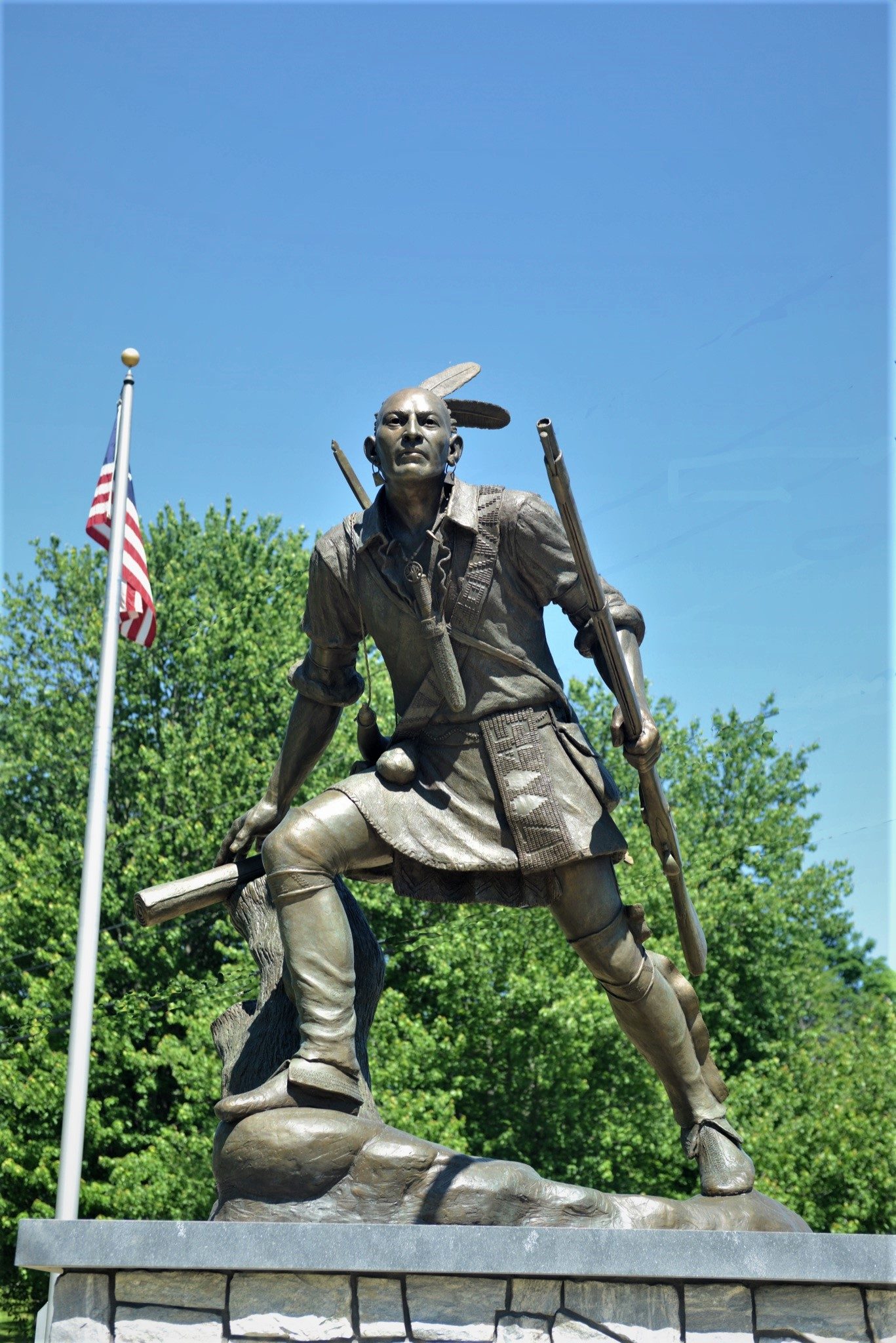
Memorials to Nimham have multiplied over the centuries. In 1906, the Daughters of the American Revolution dedicated a monument at Van Cortlandt Park. New York State erected historical markers in Kent and Fishkill. Nimham Mountain (1,260 feet) and Lake Nimham in Putnam County bear his name. An annual Daniel Nimham Intertribal Pow Wow is held in Putnam County. In 2022, an eight-foot bronze statue by sculptor Michael Keropian was dedicated in Fishkill — depicting the sachem who had traveled to London to argue for justice, fought at Valley Forge for a nation that had wronged his people, and died on a field in the Bronx telling his warriors to save themselves while he made his last stand.
Sources Consulted
- Cutul, Peter. "Land Heist in the Highlands" [src: cutul_2025_land_heist#890cf6a8491d] (2025) [src: cutul_2025_land_heist#890cf6a8491d]
- Bolton, Robert Jr. *History of the County of Westchester*, Vol. II (1848)
- Ruttenber, E.M. *History of the Indian Tribes of Hudson's River* (1872) [src: ruttenber_1872_p0001_title.jpg#265aab4c628f]
- Wikipedia, "Daniel Nimham" [src: photo_ruttenber_1872_p0001_title.txt#3f902e6edcd9]
- McDonald, John M. *Westchester Interviews*, 1844-1851 (WCHS manuscripts, transcribed April 2026):
All direct quotes are verbatim from the cited sources. Each factual claim was verified against the Croton Historical Archive database.