*A 1626 robbery near Manhattan's Collect Pond set in motion a chain of violence that would culminate in the Pavonia Massacre, shatter the Wappinger Confederacy, and reshape the Hudson Valley forever*
In 1626, a Weckquaesgeek elder was walking south toward Fort Amsterdam with his nephew — a small boy — and a companion. They carried beaver pelts to trade at the Dutch settlement on the tip of Manhattan Island. It should have been routine. The Weckquaesgeek, whose territory stretched from Dobbs Ferry north to the Croton River, had been trading with the Dutch for nearly two decades.
Near the Collect Pond — a natural body of water in lower Manhattan that would later be drained to make room for the Five Points slum — they were intercepted.
The Robbery
Frederic Shonnard, in his 1900 *History of Westchester County*, gives the most vivid account of what happened. The elder was “stopped by three laborers belonging to the farm of Director Minnit” — Peter Minuit, the director of New Netherland, the man who had purchased Manhattan itself from the Lenape just months earlier. The laborers, “coveting the valuable property which he bore, slew him and made off with the goods.” [src: shonnard_1900#1d5bb4bf82de]
The nephew escaped. The Dutch authorities apparently never investigated. Shonnard specifies the laborers were “said to have been negroes” [src: shonnard_1900#1d5bb4bf82de] — enslaved Africans working on the director's own farm, which adds a bitter layer to the story: enslaved men robbing and killing an indigenous man on land recently purchased from his people.
Edward Manning Ruttenber's 1872 *History of the Indian Tribes of Hudson's River* — the most detailed nineteenth-century study of the region's indigenous peoples — records the aftermath in a single devastating sentence: “The act was unknown to the Dutch at the time, but the boy treasured a revenge which he forgot not to exact in manhood.” [src: ruttenber_1872#dd61829ab359]
For fifteen years, the boy waited.
The Killing of Claes Smit
In 1641, the nephew — now a grown man — appeared at the workshop of **Claes Cornelisz Smits**, identified in the Westchester record by Robert Bolton (1848) as *“the raadmaker”* — Dutch for *wheelwright* — *“an aged settler resident on the west side of the river.”* The visitor brought pretense along with his beaver skins: Bolton writes that the man *“called at the house of one Claes Cornelisz Smits… under pretence of making some purchases. The old man suspecting no harm, (for the Indian had been in the habit of working for his son,) set some food before him, and proceeded to get from a chest, in which it lay, the cloth which the other wished to purchase.”* The killing came as the old wheelwright stooped:
*“The moment he stooped, the savage seized an axe, struck him dead, and then withdrew, having rifled the house of all its contents.” [src: bolton_1881_v1#7831b72de508]* (Bolton 1848, Vol. I, transcribing from the Dutch colonial record via O'Callaghan's *History of New Netherland*.)
Ruttenber's 1872 version is tighter but matches Bolton: *“Taking with him some beaver skins to barter, he stopped at the house of one Claes Smit, 'a harmless Dutchman,' and while he was stooping over a chest in which he kept his goods, the savage seized an axe and killed him by a blow on the neck; then quickly plundering his abode, escaped to the woods.” [src: ruttenber_1872#e37b5633caa0]*
What matters is that this is not a road-rage killing. The Weckquaesgeek man had carried the memory of his uncle's death for fifteen years, knew the Smits family personally (*“the Indian had been in the habit of working for his son”*), and chose the moment Smits turned his back and bent over the chest. Fifteen years of patience and then a single stroke.
Kieft's Demand
Director Willem Kieft demanded that the Weckquaesgeek surrender the killer. The chief's reply is preserved in Bolton 1848, Vol. I, and it is one of the most chilling single sentences in the Dutch colonial record:
*“He was sorry that twenty Christians had not been immolated; the Indian had but avenged, after the manner of his race, the murder of a relative whom the Dutch had slain nearly twenty years before.” [src: bolton_1881_v1#7831b72de508]* Kieft wanted war. But he needed political cover. He summoned the Council of Twelve Men — the first popularly elected body in New Netherland, created specifically to advise on the crisis. The Twelve Men urged caution. They advised Kieft to send a shallop to the Weckquaesgeek and demand the surrender of the killer “once, twice, yea for a third time” in a “friendly manner,” as Ruttenber records.
Kieft refused, dissolved the Council, and declared their meetings *“of dangerous tendency.”* A brief peace was negotiated in the spring of 1642 by Kieft's secretary Cornelius Van Tienhoven at the Bronx River house of the Scandinavian settler **Jonas Bronck** — whose farm gave the borough its name. One of the peace conditions was that the killer of Claes Smits would be surrendered. Bolton notes matter-of-factly that this was “a condition which however was never fulfilled, owing either to unwillingness or inability on the part of the Indians.” [src: bolton_1848_v1#0efc1b102b59]
The peace collapsed almost immediately. In the winter of 1642–43, a party of Mohawk from the north raided the Weckquaesgeek and Tappan settlements, driving some eighty refugees down into Pavonia (present-day Jersey City) and into camps around Manhattan itself. They had come to the Dutch for protection. Kieft saw an opportunity.
The Pavonia Massacre
On the night of February 25, 1643, the Wappinger refugees sheltering at Pavonia believed the Dutch would protect them. Kieft had other plans. The Dutch West India Company's own government record, preserved in Volume IV of O'Callaghan's *Documents Relative to the Colonial History of New York* (1851), contains the Commonalty's internal deposition on what led up to the attack:
*“The Commonalty seriously distrusting the Director, suspecting him of conniving with the Indians, and that an attempt was making to sell Christian blood… in as much as he would not avenge blood they should do it, be the consequences what they may.” [src: brodhead_1853_colonial_v1#df8e9244ffb1]* Pressure to attack came not just from Kieft but from a faction of the Twelve Men who had not yet been dissolved. Kieft directed them to put their request in writing:
*“[They] received for answer that they should put their request in writing which was done by three in the name of them all, by a petition to be allowed to attack those of Hackingsack in two divisions — on the Manhatens and on Pavonia. This was granted after a protracted discussion too long to be reported here.” [src: ocallaghan_1851_v4#f90a85f3be73]* The Dutch deposition notes that **two ships of war and a privateer** were anchored off Pavonia at the time of the attack, indicating that the operation had naval cover. The contemporary eyewitness **David Pietersz. de Vries**, a Dutch colonist who had opposed the war from the beginning, described what he saw: *“Infants were torn from their mother's breasts and hacked to pieces in the presence of their parents, and the pieces thrown into the fire and in the water.” [src: wikipedia_kiefts_war#d5919b28a8e2]*
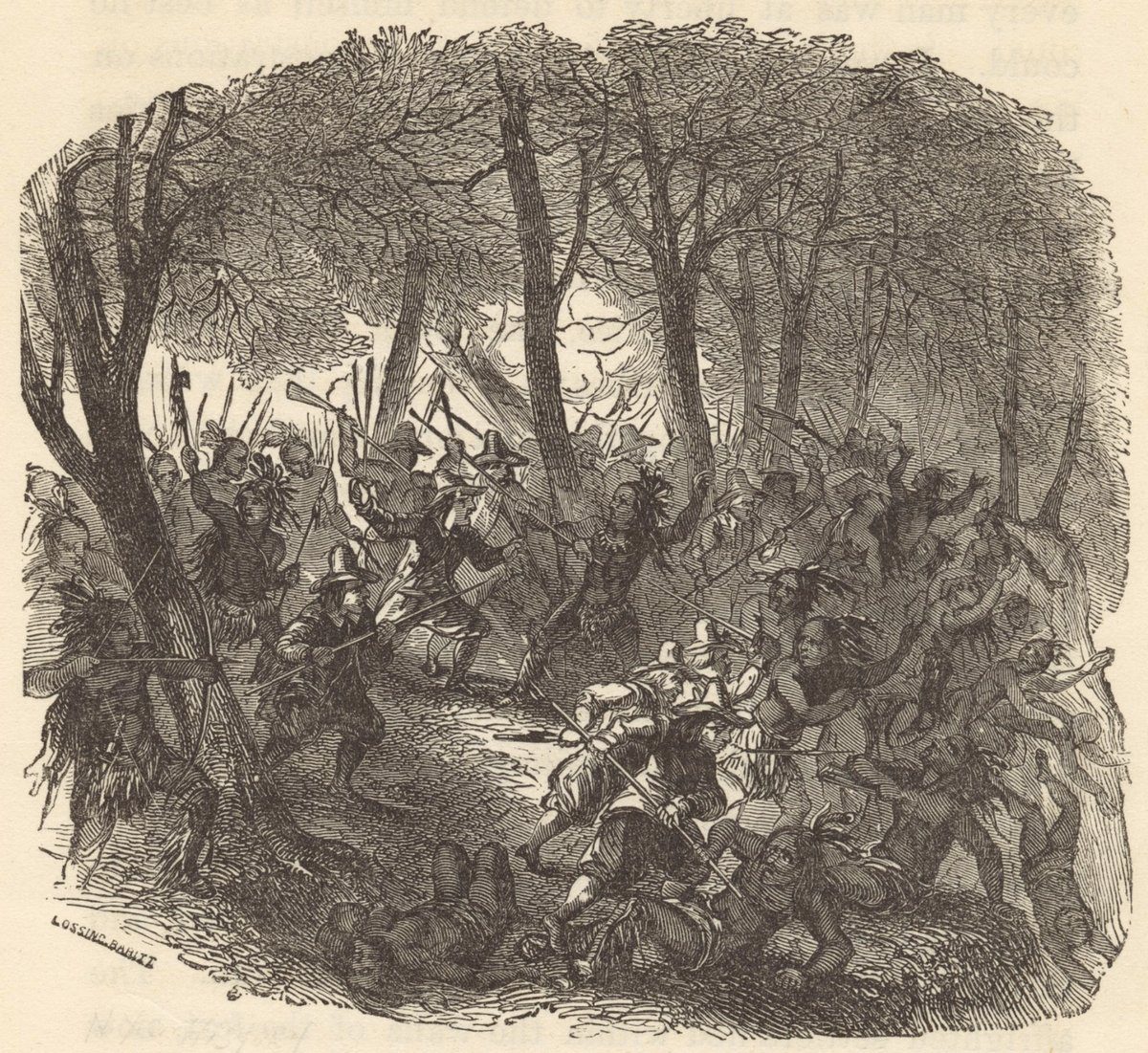
Approximately 120 men, women, and children were killed at Pavonia that night. That same night, soldiers attacked another refugee camp at Corlears Hook on Manhattan's east side, killing roughly 40 more. But the most devastating single passage in the Dutch government record is not about the numbers. It is about what happened the morning after, preserved verbatim in O'Callaghan 1851 Volume IV:
*“Some children of from 5 to 6 years of age, as also some old infirm persons, who had managed to hide themselves in the bushes and reeds, came out in the morning to beg for a piece of bread and for permission to warm themselves, but were all murdered in cold blood and thrown into the fire or the water. A few escaped to our settlers, some with the loss of a hand, others of a leg, others again holding in their bowels with their hands, and all so cut, hacked and maimed, that worse could not be.” [src: ocallaghan_1851_v4#25148b95475c]* That passage is not Shonnard editorializing in 1900. It is the Dutch West India Company's own clerks writing down what their own soldiers had done, inside the government's own archive, while the events were still recent. The children had waited through the night in the marsh, come out at dawn to ask for bread, and been killed by the same men whose officers had summoned them to Pavonia for protection.
The War
The Pavonia Massacre unified every Algonquian band in the region. The Weckquaesgeek, the Kitchawank at Croton Point, the Siwanoy, the Hackensack, the Tappan — tribes that had previously acted independently — now joined together against the Dutch. Ruttenber records that the united tribes conducted “sustained attacks throughout the colony.” New Amsterdam filled with refugees. Colonists petitioned the Dutch West India Company for Kieft's removal, writing that they “sit here among thousands of wild and barbarian people, in whom neither consolation nor mercy can be found.” [src: wikipedia_kiefts_war#52ee668455ad]
Kieft hired Captain John Underhill, a veteran of the Pequot War, to lead militia operations. In March 1644, Underhill's forces attacked a Weckquaesgeek village at Pound Ridge, killing between 500 and 700 people. Many were burned alive in their dwellings. The Pound Ridge Massacre was among the deadliest single events in the colonial Indian wars.
The conflict ground on for two years. By August 1645, the last of 69 united tribes agreed to a peace. The Kitchawank were among the signatory tribes. A commemorative plaque at Croton Point Park marks the treaty site — the same ground where, thousands of years earlier, the Kitchawank had built shell middens that archaeologists would eventually date to 5000 BC.
The Toll
The war that began with a 1626 robbery and a boy's vow cost over 1,500 indigenous lives. Dutch casualties were far fewer in raw numbers but devastating to the tiny colony: farms destroyed, two decades of settlement work undone. Kieft was recalled to answer for his actions. He died in a shipwreck off the coast of Wales on the voyage home. Peter Stuyvesant succeeded him and governed New Netherland until the English takeover in 1664.
The Wappinger Confederacy — the loose alliance of Algonquian bands that had controlled the east bank of the Hudson from Manhattan to Poughkeepsie — never recovered. The Kitchawank remained at Croton Point for another generation, but their numbers were shattered. Within forty years, Cornelius Van Bursum would purchase the point from them, and the 1682 deed would record the place-names Navish and Senasqua — the last indigenous words officially attached to the land.
Four Historians, One Story
What makes this story remarkable is not just its drama but the way it emerges from the convergence of multiple independent sources — and particularly from the direct Dutch government deposition preserved in O'Callaghan's 1851 *Documents Relative to the Colonial History of New York, Volume IV*, which is the primary-source ground truth behind every later narrative. **Ruttenber (1872)** provides the most detailed indigenous perspective, drawing on Moravian missionary notes and oral tradition. **Shonnard (1900)** gives the most vivid narrative prose for general readers. **Bolton (1848)** preserves the Claes Cornelisz Smits killing in the oldest Westchester-focused source and records the “sorry that twenty Christians had not been immolated” [src: bolton_1881_v1#7831b72de508] quote as it reached the county's own chroniclers. **O'Callaghan (1851 Volume IV)** is the Dutch West India Company's own internal deposition — the Commonalty's distrust of Kieft, the three petitioners asking for permission to attack, the two ships of war at Pavonia, the children coming out in the morning to beg for bread.
Only by reading them together does the full fifteen-year arc become visible: from a roadside robbery near the Collect Pond, to a boy's silent vow, to an axe murder in a wheelwright's shop, to a political crisis in Fort Amsterdam, to a night attack on a refugee camp across the Hudson, to children murdered at dawn while they asked for a piece of bread, to a two-year war that shattered a confederation, to a peace treaty signed on the ancient shell middens at Croton Point.
The chain of causation stretches across those fifteen years with a terrible logic. Each act of violence provoked the next. The Dutch laborers' greed in 1626 created a debt that the Weckquaesgeek boy collected in 1641. Kieft's refusal to negotiate — his dissolution of the council that urged restraint — turned a murder into a war. And the war's legacy shaped the Hudson Valley for centuries, emptying the land of its indigenous inhabitants and opening it to the colonial manors that would dominate Westchester until the Revolution.
Sources Consulted
- **Bolton, Robert Jr.** *A History of the County of Westchester*, Vol. I (1848), transcribing the Claes Cornelisz Smits killing from the Dutch colonial record. Source for the *"raadmaker"* identification, the *"the Indian had been in the habit of working for his son"* context, the *"sorry that twenty Christians had not been immolated" [src: bolton_1881_v1#7831b72de508]* reply from the Weckquaesgeek chief, and the Jonas Bronck peace negotiation that briefly held in 1642.
- **O'Callaghan, Edmund Bailey.** *Documents Relative to the Colonial History of the State of New-York*, Vol. IV (1851). Internet Archive: `documentsrelativ04brod`. The Dutch West India Company's internal deposition on Kieft's War — including the Commonalty's distrust of the Director, the three petitioners asking permission to attack "those of Hackingsack in two divisions," [src: ocallaghan_1851_v4#f90a85f3be73] the two ships of war at Pavonia, the Pachem village-to-village agitation, and the devastating morning-after passage about children murdered as they begged for bread.
- **O'Callaghan, E.B.** *Documents Relative to the Colonial History of New York*, Vol. I (1856) — interrogatories related to the Tienhoven peace at Jonas Bronck's house.
- **Ruttenber, E.M.** *History of the Indian Tribes of Hudson's River* (1872) — the indigenous-perspective narrative, based on Moravian missionary notes.
- **Shonnard, Frederic, and W.W. Spooner.** *History of Westchester County* (1900) — the most vivid general-reader narrative.
- Wikipedia, "Kieft's War" and "Pavonia Massacre."
All direct quotes are verbatim from the cited sources. Each factual claim was verified against the Croton Historical Archive database.