Home /
Timeline
Croton history timeline
Documents, archaeological reports and later histories, with the limits of their dates and identifications.
Deep Dives
Multi-year events explored in detail
Village waterworks (1933–1940)
A contemporary financing notice and two later federal accounts of village waterworks, with the loan and grant shown separately.
Kieft's War (1626–1645)
From a roadside robbery to a two-year war that shattered the Wappinger Confederacy
Daniel Nimham & the Wappinger Land Fight (1693–1778)
A century of dispossession, from the Philipse fraud to the Battle of Kingsbridge
The Croton Water System (1837–1890)
Two aqueducts and a celebration that brought fresh water to New York City
New Croton Dam Construction (1892–1906)
Immigrant labor, the padrone system, a strike, and an engineering marvel
Prohibition in Croton (1921–1933)
Rum planes, submarines, speakeasies, and undercover fiddlers
Pre-Contact (before 1609)
Before 1609
Archaeological deposits preserve evidence of people using Croton Point thousands of years before European colonization. They should not be assigned wholesale to a single later named community.
Before 1609
Brennan’s 1962 report describes several shell heaps separated by soil layers at Kettle Rock. These strata record different periods of use, rather than one continuous occupation with a precisely known start.
Early Woodland (estimated)
Brennan reported Vinette I-like pottery in the upper shell deposits. His 1962 chronological proposal was an interpretation of stratigraphy and ecological comparisons, not a date of 3000 BC.
Contact period (interpretation)
Archaeological investigations recorded a fortified enclosure on Croton Point. The sources checked here do not establish its founding date or securely identify it as a village called Navish. Enclosure archaeology and the names in later deed transcriptions are separate evidence.
European Contact & Dutch Era (1609–1664)
1609
Officer Robert Juet documents encounters with indigenous peoples who traded tobacco for knives and beads, wearing deer skins and displaying copper items.
1624
Permanent Dutch settlement begins. The Wappinger Confederacy — 18 bands including the Kitchawank — controls the east bank of the Hudson from Manhattan to Poughkeepsie.
1626
Later histories connect an earlier killing of a fur trader with the 1641 death of Claes Smits. The remembered revenge narrative should be distinguished from contemporary records of Kieft’s subsequent decisions.
View full timeline →
1641
The killing and the demand to surrender its perpetrator become part of the conflict. Later historians explain it through a fifteen-year revenge story; the revised account keeps that attribution visible.
View full timeline →
Aug 1641
The first popularly elected body in New Netherland urges Kieft to demand the killer 'once, twice, yea for a third time' in a 'friendly manner.' Kieft refuses and dissolves the council.
View full timeline →
Late 1643
The famous religious dissident, living in exile in the Bronx, is killed by Siwanoy warriors as the war engulfs the entire region. ~1,500 indigenous warriors attack across New Netherland.
View full timeline →
Feb 25, 1643
Dutch soldiers kill ~120 sleeping Wappinger refugees at Pavonia (Jersey City), including women and children. 40 more killed at Corlears Hook that same night. Unified Algonquian resistance follows.
View full timeline →
Mar 1644
Captain John Underhill's forces attack a Weckquaesgeek village. Many burned alive in their dwellings. One of the deadliest single events in the colonial Indian wars.
View full timeline →
Aug 1645
After two years of war costing over 1,500 indigenous lives, the Kitchawank and 68 other tribes sign peace with the Dutch. A plaque at Croton Point Park marks the site.
View full timeline →
1655
A second Dutch-indigenous conflict results in ~100 settler and 60 Wappinger deaths. Surviving bands begin relocating to Stockbridge, Massachusetts.
1664
Peter Stuyvesant surrenders to the English fleet. Dutch colonial rule ends. The Wappinger bands continue to lose territory under the new administration.
Colonial Westchester (1664–1775)
1677–1683
Van Cortlandt acquires territory between Croton and Peekskill from indigenous peoples, building toward the largest manor in the region.
June 1682 (day disputed)
Bolton’s 1881 transcription dates the transaction June 3, 1682; Grumet’s 2014 reference gives June 23. The county deed pages have not been compared here, so the day remains unresolved. The text names landscape features and does not establish a village’s founding date or an exact boundary on today’s map.
1693
Original grant covers ~15,000 acres. Philipse reportedly 'cut down the tree marking the eastern border, rode all day and remarked a tree near the CT border' — expanding the claim to 205,000 acres.
View full timeline →
1697
King William III grants Stephanus Van Cortlandt a royal charter for 200 square miles. The manor encompasses much of present-day northern Westchester.
1705
Elizabeth Legget of Westchester deeds her daughter 'my two negro children, born of the body of Hannah, my negro woman, of the issue of the body of Robin, my Indian slave.'
The American Revolution (1765–1783)
~1746
Daniel Nimham's band — Mahican and Munsee speakers — survives across five colonies through basket weaving, broom crafting, and seasonal farm labor. He maintains annual pilgrimages to Mount Nimham in Putnam County.
View full timeline →
1755
Around 200 Wappinger relocate to the Stockbridge Mission in Massachusetts to protect their families while men serve in colonial forces.
View full timeline →
1765
The last Wappinger sachem challenges the fraudulently expanded patent in court. He loses; his attorney Samuel Munroe is arrested.
View full timeline →
1766
Nimham and three Mohican chiefs sail to England. The Lords of Trade acknowledge 'frauds and abuses' but restore nothing. The deed is snatched from Munroe's hands before he can prove fraud.
View full timeline →
~1776
According to local tradition, women led by Madam Orser ride to John Arthur's home to seize tea stocks. The incident may have given Teatown its name.
1776–1783
The county is contested territory between American and British lines. 'Skinners' and 'Cowboys' plunder civilians. 'Neither of them stopped to ask the politics of horse or cow which they drove into their lines.'
1775–1778
Abraham Nimham becomes captain of the Stockbridge Militia — Mohicans, Wappingers, Munsee. Both father and son serve under Washington and later with Lafayette.
View full timeline →
Aug 31, 1778
The last Wappinger sachem and ~40 warriors die fighting for the Continental Army. 'He called out to his people to fly, that he himself was old, and would die there.'
View full timeline →
Sep 21–23, 1780
On September 22, American artillery operating under Colonel James Livingston forced HMS Vulture away from Teller's Point. André crossed the Hudson that evening and was captured near Tarrytown the next morning. Peterson and Sherwood's precise roles remain disputed in later accounts.
Jan 1782
A military engagement at the Orser family property near Croton, recorded in Shonnard's index of wartime events.
The Aqueduct Era (1827–1890s)
1827
Richard T. Underhill becomes associated with grape cultivation and wine at Croton Point. Lossing’s 1866 account describes vineyards on both Underhill properties, about eighty acres overall and sixty belonging to the doctor.
1835
The city’s voters authorize the Croton project. A temporary water commission had been established in 1833 and a permanent commission in 1834.
View full timeline →
1836
Jervis replaces David Bates Douglass late in 1836. His engineering experience grew from work on the Erie Canal; he had no formal engineering training.
View full timeline →
1837
Water Commissioners begin purchasing land along the aqueduct route. The New York Sun warns that 'landholders are seldom diffident in taking advantage of public improvements, to enhance the price of property.'
View full timeline →
Apr 1838
Laborers demand wages of 87.5 to 100 cents per day and march from the dam site to Sing Sing. Engineer Edmund French reports 'the affair that resulted in the death of one of the overseers on Section 10.'
View full timeline →
1838–1848
The Harlem River crossing takes longer than the aqueduct’s initial opening. Temporary pipes carry water in 1842; High Bridge is completed in 1848.
View full timeline →
Jun 22, 1842
Water enters the aqueduct at the Croton end on June 22. It reaches the city’s receiving reservoir on June 27 and the distributing reservoir on July 4.
View full timeline →
Oct 14, 1842
A public procession and music celebrate the new water supply. Charles King records the Sacred Music Society singing Morris’s ode near the Park Fountain.
View full timeline →
1857
The Central Park Commission holds a competition for the reservoir design. Thirty-three entries are submitted.
View full timeline →
1884–1890
The new aqueduct adds a larger route for Croton water. The original aqueduct remains in use alongside it.
View full timeline →
1865
Hedrick’s 1908 institutional grape history credits Stephen W. Underhill with breeding Croton at Croton Point and dates its first fruit to 1865. Its separate Senasqua entry gives seed planted in 1863 and introduction about 1870, without a first-fruiting year. Croton History remains the earlier research lead; the botanical volume supplies the cultivar chronology.
1880s
Brickmaking and grape growing overlapped on the Underhill properties. They were parallel industries, rather than a single family’s abrupt switch from one business to the other.
1884–1890
The new aqueduct adds a larger route for Croton water. The original aqueduct remains in use alongside it.
View full timeline →
Modern Croton (1892–present)
May 1892
The contract drawing for the Cornell Site reveals 'buildings, bridges and roads behind the dam which were destroyed when the valley was flooded.' Construction begins.
View full timeline →
1892–1895
Italian immigrant laborers help build the new dam. The retrospective local history Water Over the Dam describes labor brokers managing recruitment, lodging and deductions from wages.
View full timeline →
1895–1896
Skilled blacksmiths run forges constantly. An October 1896 Scientific American engraving documents the excavation with 'noteworthy accuracy.'
View full timeline →
~1897
Housing and businesses grow around the construction work. Later local accounts describe the settlement and its relationship to the dam workforce.
View full timeline →
Apr 1900
Contemporary newspapers describe troops guarding the works, the fatal shooting of Sergeant Robert Douglass on April 16, and a subsequent roundup. The shooting reports do not identify his killer.
View full timeline →
Jan 10, 1906
The later local account records a final-stone ceremony. This is a construction milestone; DEP dates the New Croton Reservoir’s entry into service to 1905.
View full timeline →
Early 1900s
Higgins’s local history, prepared in 1938 and published in 1940, describes the decline of the construction settlement after the dam work. The reservoir extends about nine miles, according to DEP.
View full timeline →
1907
Clifford Harmon builds 'the most important and extensive suburban development in the history of New York.' The Japanese-themed Nikko Inn opens as a tea house.
1921
The Mikado Inn proprietor is acquitted in 'the first case to be tried in Westchester County for alleged violation of the New York State liquor law.'
View full timeline →
May 15, 1922
The Evening World reports a Curtiss biplane and roughly 150 bottles of whiskey. A Montreal newspaper and later reporting about a map prompt suspicion of a Canadian route; the extent of the operation remains uncertain.
View full timeline →
Jun 17, 1922
'McKay fiddled, Reager sang and Gallante danced' — then arrested the proprietor for serving $1.50 highballs.
View full timeline →
May 1925
Federal Judge John C. Knox padlocks Roy Kojima's Nikko Inn for two months — described as 'the first place run by Japanese to be closed in padlock proceedings.'
View full timeline →
1924
An aerial photograph shows two 250-foot objects in the Hudson. The Navy confirms none of its vessels are in the area. The photo is filed with Coast Guard Intelligence.
View full timeline →
1922
The future concert pianist and television personality sleeps in the cellar with 'twenty or thirty Japanese waiters' while performing at the speakeasy.
View full timeline →
1927
The original unlined landfill begins operating in 1927 and closes in 1986. The county had acquired park land in 1923; recreation and disposal overlapped.
1928
William E. Harmon’s foundation sponsors exhibitions supporting African American artists. William was a different developer from Clifford B. Harmon, whose Croton development supplied the station’s name.
16 Dec 1933
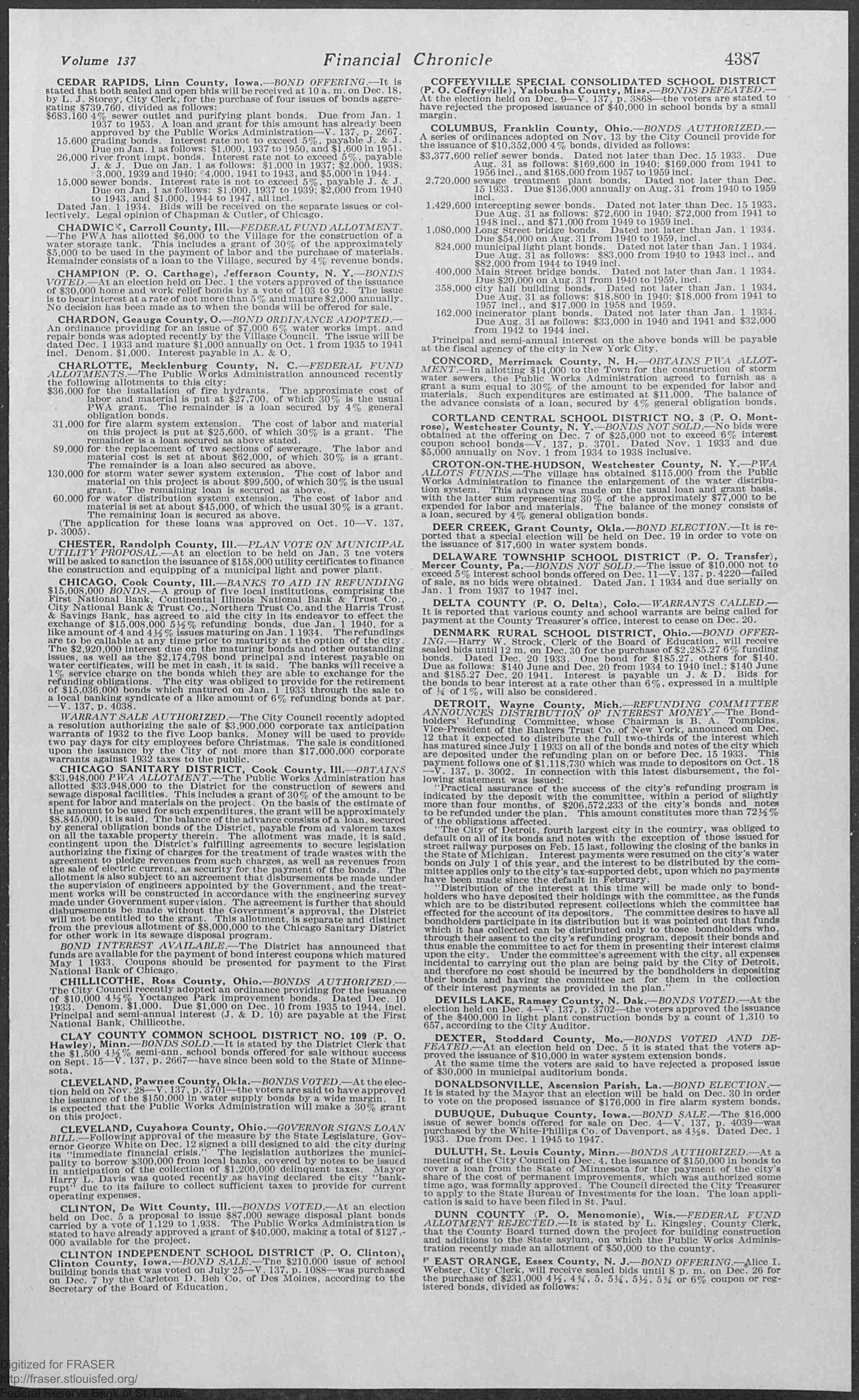
The Financial Chronicle reported a $115,000 PWA advance to enlarge Croton-on-the-Hudson’s water distribution system. It described a grant covering 30% of approximately $77,000 for labor and materials, with the balance a loan secured by 4% general-obligation bonds. The notice gives no docket number or individual facility and establishes no construction or completion date.
View full timeline →
By May 31, 1937
A Public Works Administration table lists Croton-on-Hudson docket 1541 with $115,152.69 allotted and disbursed for waterworks and equipment repairs and improvements. The accompanying letter defines disbursements as loans and grants paid into construction accounts. This account snapshot does not certify completed construction or identify a facility.
View full timeline →
Jan 3, 1940
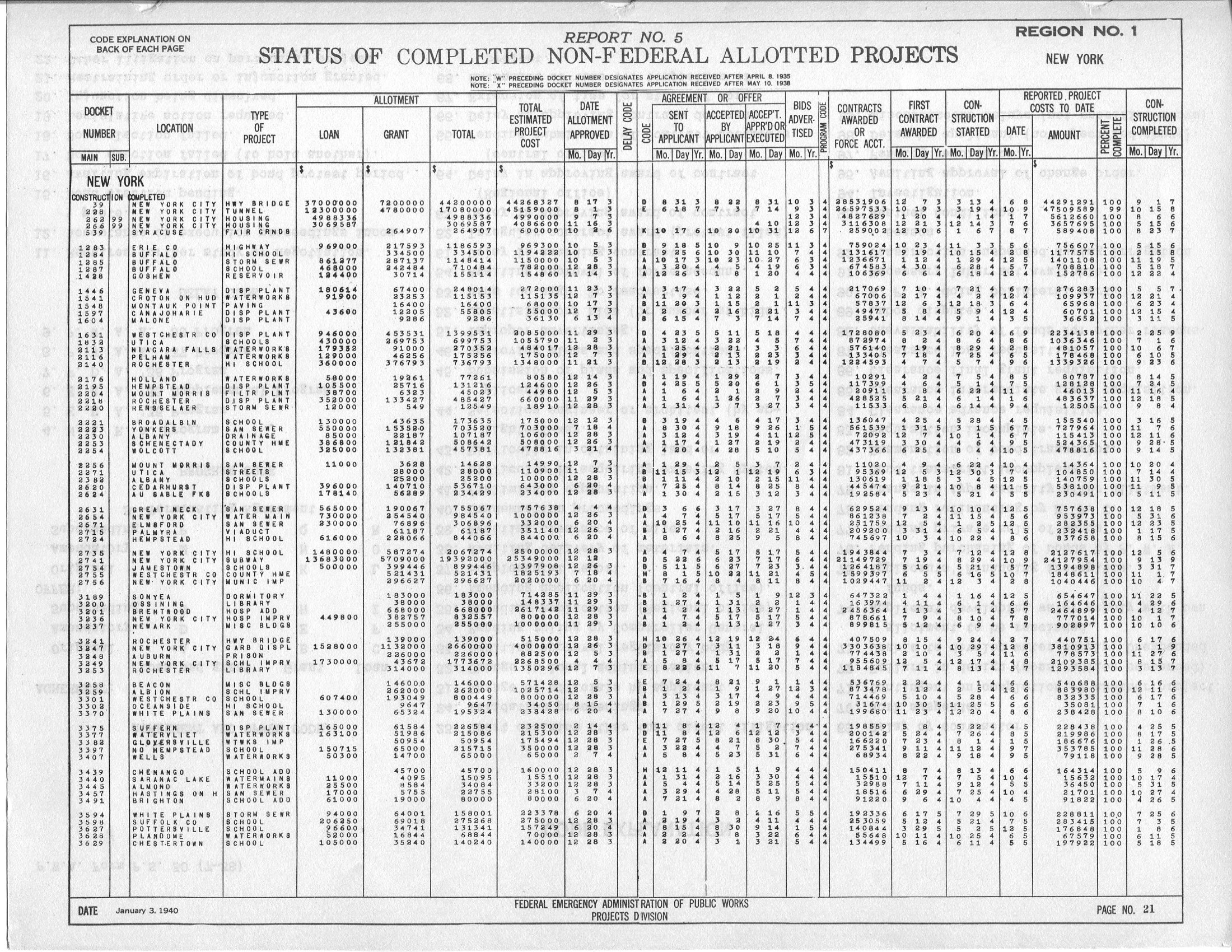
Report No. 5 lists the same Croton-on-Hudson docket 1541 under completed New York projects: a $91,900 loan and $23,253 grant, totaling $115,153 in the rounded-dollar table. Reported project costs are $109,937 and the completion field is 100 percent. The sheet does not identify a particular well, dam or reservoir.
View full timeline →
Apr 1, 1948
The village officially adds hyphens to its name, becoming Croton-on-Hudson.
1962
Brennan describes the March 1962 find with Mauck Brammer and Sigfus Olafson. Their report places Vinette I-like pottery in an upper shell layer and examines the older deposits below.
1986
After 59 years of operation, the dump is closed. Environmental remediation and capping begins — a process that will take decades.
2022
An eight-foot bronze statue by sculptor Michael Keropian is unveiled, honoring the last Wappinger sachem who traveled to London and died at Kingsbridge.