*The New Croton Dam was an engineering triumph. The settlement that built it was a story of exploitation, debt bondage, and a rough community in the Westchester hills that vanished almost without a trace.*
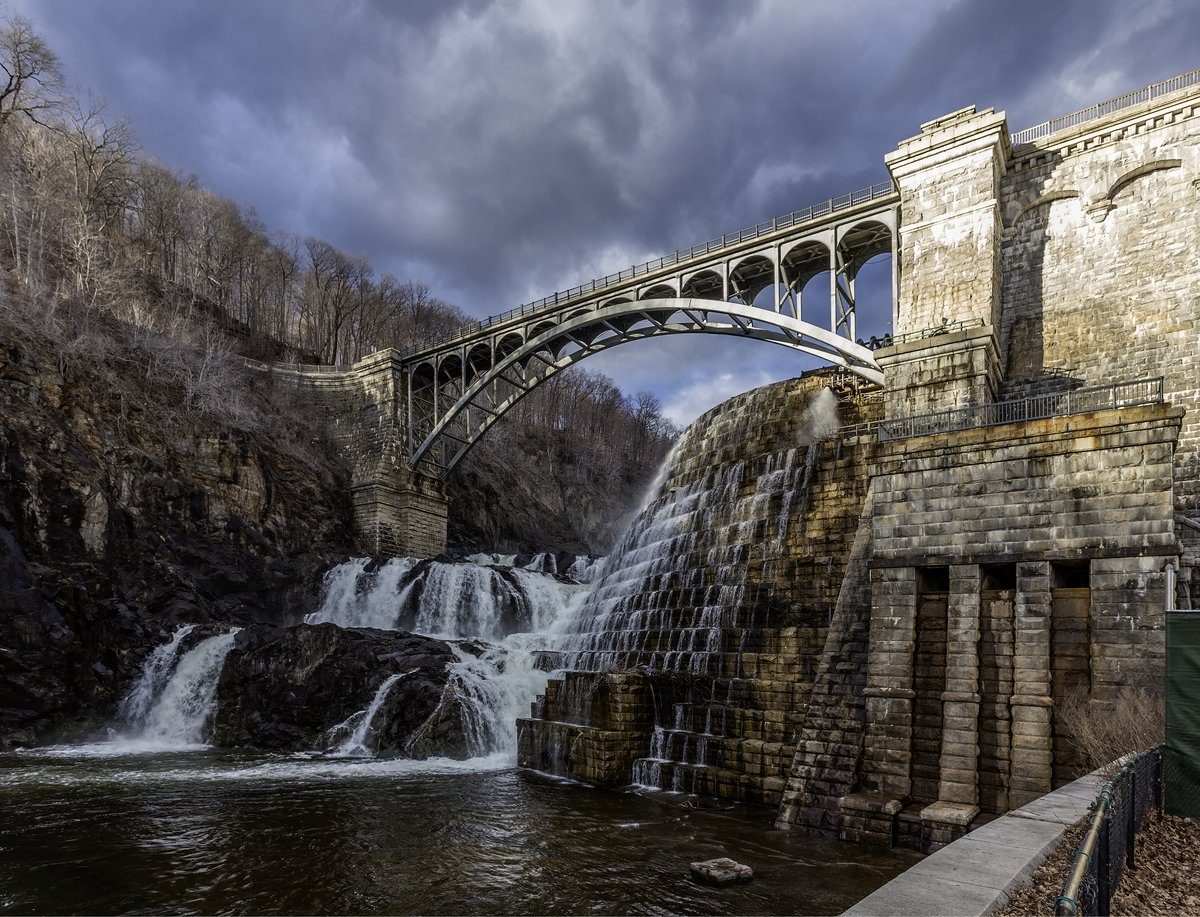
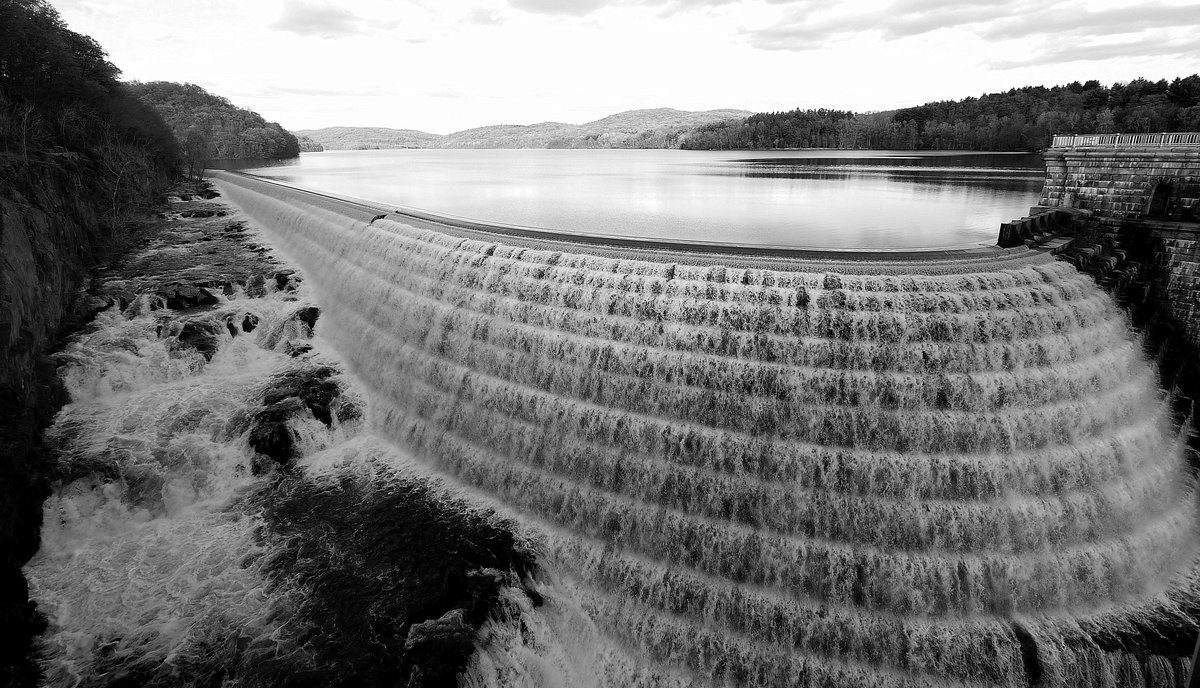
Between 1892 and 1906, hundreds of immigrant laborers carved a colossal wall of stone across the Croton River gorge. When they finished, the New Croton Dam stood 297 feet high — at completion, it ranked as “the world's tallest masonry dam” [src: photo_new_croton_dam.txt#75e707645ede]. Its S-shaped spillway became a standard reference in hydraulic engineering, known internationally as the “Croton Profile” [src: photo_new_croton_dam.txt#75e707645ede]. An architectural review in 1907 described it as “very much a cleanly articulated, sculptured object in the landscape”.
The dam is a monument to engineering ambition. But the settlement that grew up around its construction site — a place its residents called “the Bowery, or Little Italy” [src: water-over-the-dam.txt#e63a429fba25] — tells a story the monument does not.
The Padrone System
The workers came from southern Italy, recruited and controlled by *padrones* — Italian labor bosses who operated as middlemen between the immigrants and the dam's contractors. The padrone system was efficient and ruthless.
These English-speaking supervisors hired men in large groups, charged substantial commissions, and advanced passage money from Italy. They sold provisions at inflated prices and deducted percentages from wages. Each padrone managed up to 150 workers, providing board and lodging while workers remained perpetually in debt through monthly payment structures. [src: water-over-the-dam.txt#aa2f20a9d912]
The arithmetic was designed so that the worker could never get ahead. He arrived in America owing the padrone for his passage. His wages were garnished for commission. His food came from the padrone's store at inflated prices. His bed in the dormitory was deducted from his pay. Each month he fell further behind, his labor siphoned away through a dozen small fees and markups. It was a system of debt bondage that operated in full daylight.
The Settlement
A settlement called the Bowery, or Little Italy, emerged approximately one mile from the dam along the Croton River's banks. It contained worker housing in two-story structures, grocery stores, saloons, a chapel, and a schoolhouse. [src: water-over-the-dam.txt#aa2f20a9d912] The settlement was a self-contained world — isolated from the surrounding Westchester communities, organized around the rhythms of the construction site.
Housing consisted mainly of dormitory-style rooming houses with long tables and wooden benches accommodating 60 workers, with sleeping areas featuring canvas cots in large rooms. Some workers' wives established lodging houses, providing meals, mending, and laundry services to earn additional income. [src: water-over-the-dam.txt#b001b957be6c]
Oral history preserves the atmosphere with blunt clarity. One local resident recalled: “It was a rough area. Fellas would get a few drinks, you couldn't tell what the dickens they would do” [src: water-over-the-dam.txt#d54520cee3fc].
The Wage Hierarchy
The construction site maintained a racial and ethnic hierarchy written into the pay scale. Workers classified as *“intelligent labor”* earned 30 cents daily more than *“common labor,”* yet the common category subdivided into white, colored, and Italian classifications, with Italians receiving the lowest compensation. [src: water-over-the-dam.txt#537c129d4911] The Italian workers — the men doing the heaviest and most dangerous work — were paid less than any other group on the site.
The danger was constant. “An Italian saying reflected this: 'A man lost his life for every stone set on the dam'” [src: water-over-the-dam.txt#eb67c753dfab]. Whether the saying was literally true or a grim exaggeration, it captured the workers' understanding of their own expendability.
The Strike and Governor Roosevelt
In April 1900, New York State mandated an 8-hour workday for public works projects. Organized laborers subsequently demanded higher wages and improved conditions. When contractors refused, workers struck and threatened sabotage. [src: water-over-the-dam.txt#eb67c753dfab]
The response was swift and overwhelming. “Governor Theodore Roosevelt dispatched the Seventh Regiment, establishing Camp Roosevelt around the project. After three weeks of negotiations, the strike ended without substantial improvements” [src: newspaper_1906_superior_times_dam.jpg#934f6eb5a274]. The future president sent troops to protect a dam project rather than enforce the labor law that had triggered the dispute. The workers went back to twelve-hour days.
The Irish Parallel
The Italian workers of the New Croton Dam were not the first immigrants to build waterworks in the Croton Valley under brutal conditions. More than half a century earlier, in 1838, Irish laborers constructing the Old Croton Aqueduct had staged their own strike. They demanded wages of 87.5 to 100 cents per day and marched from the Croton Dam site to Sing Sing in a show of collective defiance (Old Croton Aqueduct records).
The parallel is stark: the same valley, the same work, the same pattern of imported labor, exploitation, and resistance — separated by sixty years and a change of nationality. The Irish built the aqueduct in the 1830s and 1840s; the Italians built the dam in the 1890s and 1900s. Both groups were the most recently arrived and most vulnerable workers in America, and both were used to build the infrastructure that sustained New York City's growth.
News from the Strike: The Cortland Evening Standard, April 17 and 20, 1900
For 125 years the published record of the Croton Dam strike has rested on a handful of generic secondary accounts: 8-hour workday law, padrone system, troops sent in, three-week resolution, “minimal gains.” The first-person reporting from the strike itself — what the troops actually saw when they marched into the Bowery, what the Italian strikers were doing in the moments before, who named individuals were, how a militia sergeant was shot in the dark — was preserved in 1900 in local upstate New York newspapers that have been largely uncited by later writers. One of them, the **Cortland Evening Standard**, filed telegraphic dispatches from Croton Landing throughout the strike. The complete text of those dispatches has been transcribed from microfilm by Jeff Paine at the *Cortland Contrarian* blog and is the basis for this section.[^cc]
[^cc]: Paine, Jeff. *Cortland Contrarian* blog, posts dated December 29, 2022 and January 2, 2023. The April 17, 1900 and April 20, 1900 dispatches from the *Cortland Evening Standard*, transcribed verbatim. https://jeffpaine.blogspot.com/2022/12/first-bloodshed-during-croton-dam.html and https://jeffpaine.blogspot.com/2023/01/twenty-six-striking-dam-workers.html . All quoted passages in this section are drawn from those two transcriptions and checked against the original newspaper context Paine supplies. We are grateful to the transcription.
The Assassination of Sergeant Douglass
The killing of Sergeant Robert Douglass of the **Eleventh Separate Company of Mount Vernon** was reported from the scene within hours and printed in the *Cortland Evening Standard* on April 17, 1900 under the headline *“SERGEANT MURDERED. First Bloodshed in Croton Landing Strike. SOLDIER SHOT BY ASSASSIN.” [src: cortland_standard_1900-04-17_douglass#230460dee7bd]* The dispatch preserves the exact moment and the sergeant's last sentence:
*“Douglass was talking to Corporal McDowell and other members of the guard when he suddenly slapped his hands to his stomach and said; 'Load, boys, I'm shot,' and then fell to the ground. It was pitch dark at the time, but McDowell and the others fired a volley into a clump of bushes nearby without hitting anyone.” [src: cortland_standard_1900-04-17_douglass#230460dee7bd]* The sergeant was shot at **9:50 p.m.** on Monday, April 16, 1900. The killer was never identified:
*“No one saw the flash or heard the sound of the shot which killed Douglass, and it was a most mysterious affair. Meanwhile the men picked up the fallen sergeant and carried him down the hill on a stretcher, but as soon as they reached Douglass' tent the poor fellow died without saying a word other than what he said as he fell.” [src: cortland_standard_1900-04-17_douglass#8f244ac9fcf0]* The dispatch locates the spot precisely — *“on top of the hill near Little Italy, where armed strikers were seen drilling or marching about early in the morning, brandishing rifles and shotguns. The spot is high over the huge pile of masonry, which when finished will reach as high as that point and from it one can command a view of the country for miles on each side up and down the Croton valley.” [src: cortland_standard_1900-04-17_douglass#230460dee7bd]* Lieutenant Ralph Glover took a squad of men up the hilltop to search the clump of bushes where the shot must have come from, and *“failed to find any person there.” [src: cortland_standard_1900-04-17_douglass#8f244ac9fcf0]*
Douglass is the only death of the Croton Dam strike. His dying line — *“Load, boys, I'm shot”* — is the only piece of recorded dialogue from the one man killed in the entire three-week military occupation of Croton Landing.
The March to the Dam: 200 Italians on the Sidewalks
The same April 17 issue of the *Cortland Evening Standard* carried a second dispatch, *“SITUATION AT CROTON. Seventh Regiment of New York Sent With Other Troops,” [src: cortland_standard_1900-04-17_douglass#8f244ac9fcf0]* describing the troops' arrival at the Bowery settlement earlier that day. It is the best single contemporary account of what the strike actually looked like to the men who had been sent to break it.
Before the troops arrived, the Italian workers had been pre-warned:
*“About 11 a.m. a telegram was received by one of the leaders from Consul Branchi, advising them to be quiet, and informing them of the fact that the militia was on its way to the dam. The telegram from the consul was passed about and had a good effect. Many Italians, who live in Little Italy hill, left the Bowery and went to their homes.” [src: cortland_standard_1900-04-17_douglass#7024cce2fc8e]* **Consul Branchi** — the Italian consul in New York — had sent a pacifying telegram to the Italian strike leaders, advising them to remain quiet. The Italian community in the Bowery was being coordinated from New York by diplomatic channels that ran through their country of origin, not their country of employment.
When the troops did arrive at the Croton Landing station, the Italians had their own intelligence network:
*“Their arrival was noted by an Italian on a bicycle who remained long enough about the station to count them and then started for the dam. About half a mile from the village he was met by another strike messenger on a wheel, who carried the news about a mile, where a third messenger rode with all haste to the Bowery. Before the deputy sheriffs about the works knew of the arrival of troops in Croton valley the strikers were aware of it.” [src: cortland_standard_1900-04-17_douglass#7024cce2fc8e]* **A three-man relay of bicycle messengers** — the Italian strikers had organized a Pony Express-style signal system from the railway station to the Bowery, carrying real-time news of the militia's arrival *faster than the Westchester County sheriff's deputies around the dam itself knew it was happening.* The Italian labor organization had better signals intelligence than the sheriff.
The response when the troops began their one-hour-and-fifteen-minute march from the station to the dam was theatrical:
*“There was a blowing of horns, and while the troops were resting at the station waiting for the word to move, 40 armed Italians carrying an American and two Italian flags crossed from Little Italy hill to the Bowery. They were cheered by the men in the Bowery and watched with interest by the deputy sheriff.” [src: cortland_standard_1900-04-17_douglass#4c9c5a9af8d2]* Forty armed Italians marched under an American flag and two Italian flags from Little Italy to the Bowery as the troops formed up. *Ten minutes after their arrival at the Bowery there were no weapons in sight.* The workers were signaling what they wanted the troops to see: a displayed American flag, a deliberately-chosen display of armed men, and then — ten minutes before contact — a visible disarmament. This is not the mob the published histories describe. It is a strike committee executing a coordinated plan.
When the troops finally rounded the corner into the Bowery, the scene the dispatch reports is indelible:
*“About 200 men were on the board sidewalks. Women were hanging from the windows and crowded on the stoops. About 20 Italians with mandolins and guitars were seated on the walk playing a lively tune. In the center of the street a woman about 60 years old, called 'Bowery Kate,' was dancing. In one hand she held a half of a brick and in the other a club. The advance guard passed by her and she fell in back of them marching along. The Italians laughed and continued to play. The advance guard swung up the street and over the Bowery bridge into the works.”*
**Bowery Kate** — a woman about 60, unnamed in any published history we have been able to locate — dancing in the middle of the Bowery street as the troops marched past her, carrying half a brick in one hand and a club in the other, then falling in behind the advance guard as the troops continued on. The detail is not metaphor. It is *reported*. One of the named characters of the Croton Dam strike is a woman with half a brick and a club who danced in front of the 7th Regiment as it arrived to enforce the strike-breaking order. No published history we have found mentions her. The *Cortland Evening Standard* correspondent put her on the wire to upstate New York the same day.
The Troops Themselves
The dispatch gives unit-level detail:
*“The troops now here are under the command of Major Denick, in the absence of Colonel Emmett of the First regiment. They are the Eleventh Separate company of Mount Vernon, Captain Fred Schneider; Lieutenant Ralph Glover and 75 men; the Fourth Separate company of Yonkers, Captain John I. Pruyn, Lieutenant Nugent and 73 men.” [src: cortland_standard_1900-04-17_douglass#5d650f1bd6e4]* - **11th Separate Company, Mount Vernon** — 75 men, Captain Fred Schneider, Lieutenant Ralph Glover. (Sergeant Robert Douglass, killed that same night, was a member of this company.) - **4th Separate Company, Yonkers** — 73 men, Captain John I. Pruyn, Lieutenant Nugent. - **Commander in the field:** Major Denick, in the absence of Colonel Emmett of the First Regiment. - **Armament:** three days' rations, ten rounds of ball cartridges per man.
The troops carried so little extra ammunition — ten rounds each — that they were never expected to fight a sustained engagement. They were brought to enforce a strike-breaking order by the visible threat of force, not to defeat an armed rebellion.
Two accidental discharges happened as the troops approached the Bowery:
*“As the troops were resting at the station waiting for the word to move… Upon approaching the Bowery the order was given to load, and one man in the rear guard accidentally let the hammer fall on the cartridge. It exploded and the shot started the men and two men in the advanced guard nervously pulled the triggers of their rifles and the bullets tore holes in the earth 10 feet in front of them. The impression was that some one had fired on the troops and there was a halt.” [src: cortland_standard_1900-04-17_douglass#7024cce2fc8e]* The only shots actually fired on April 17 before Sergeant Douglass was shot that night were three accidental discharges by the militia themselves — one man dropped the hammer on his own loaded rifle, and two others pulled triggers in panic, each tearing a hole in the earth ten feet in front of them.
The Arrests of April 20
Three days later, the *Cortland Evening Standard* of April 20, 1900 filed a second dispatch under the headline *“TWENTY-SIX ARRESTS. Military Authorities Busy in Vicinity of Strike. CROTON VALLEY'S LIVELY DAY.” [src: cortland_standard_1900-04-20_twenty_six_arrests#db00c14fa6d8]* The tone has changed. The troops are in full occupation; the strike leaders are being hunted:
*“Sheriff Molloy of Westchester county secured 32 warrants for arrest of strike leaders. Over 100 Italians fled their homes during the night to avoid arrest. 'Fully 150 of the men who had struck for higher wages had gone to New York and Syracuse, where they have secured other places.'” [src: cortland_standard_1900-04-20_twenty_six_arrests#db00c14fa6d8]* The military occupation is now controlling the perimeter to prevent escape:
*“General Roe's orders positioned infantry and cavalry to prevent persons escaping from Little Italy or the Bowery. Cavalrymen from Troop C stationed along western roads approximately 100 yards apart. Squadron A performed similar duty on the east side near Little Italy.” [src: cortland_standard_1900-04-20_twenty_six_arrests#77431d6be16d]* [src: cortland_standard_1900-04-20_twenty_six_arrests#77431d6be16d]
The April 20 search was a coordinated sweep:
*“Sheriff with 25 deputies, escorted by Company D of the Seventh regiment, searched houses in the Bowery for weapons and ammunition. 'There was not the slightest resistance made, except by one man, Thomaso Leviana, who was very boisterous and tried to escape.' Nine prisoners captured in the Bowery included Marcelo Rotella and his two sons, Angelo and Antonio. Search yielded one revolver, toy pistol, cartridges, dirks and stilettos.” [src: cortland_standard_1900-04-20_twenty_six_arrests#77431d6be16d]* **Named Italian strikers** from the dispatch: - **Thomaso Leviana** — “very boisterous and tried to escape” [src: cortland_standard_1900-04-20_twenty_six_arrests#77431d6be16d] - **Marcelo Rotella** and his two sons **Angelo** and **Antonio** — all three captured together in the Bowery. Rotella had been the strike leader quoted the day of Douglass's death as saying “there would be no trouble.” [src: cortland_standard_1900-04-17_douglass#5d650f1bd6e4] - **Ponassa, Monessro, Polici, Saluria, Mazezo, Maragelli, Partouchi** — seven men arrested without warrants and brought before Judge Baker on April 20.
Nineteen additional prisoners were transported by special train to Tarrytown, then by trolley to White Plains jail for examination. The dispatch reports a total of **26 arrests** on April 20 alone — the number that gave the story its headline.
The weapons recovered in the exhaustive house-to-house search were, by any military standard, trivial: *“one revolver, toy pistol, cartridges, dirks and stilettos”* in the Bowery search; *“only one revolver found, but numerous knives and cartridges collected”* in the later Little Italy search. The striking workers were carrying knives. They were not an armed rebellion — they were a strike committee with a handful of personal weapons and a dance in the street.
Four “Anarchists from New York”
One closing detail from the April 20 dispatch is worth preserving because it points at the national political context:
*“Shortly after the arrests were made on the Bowery four strangers appeared on the scene and visited the saloons… They harangued the men gathered there and advised them not to return to work. Generally believed to be anarchists from New York.” [src: cortland_standard_1900-04-20_twenty_six_arrests#0d940b26201a]* Four men — unnamed in the dispatch — arrived at the Bowery saloons *after* the April 20 mass arrests and urged the remaining Italians not to return to work. The reporter and the authorities both believed them to be anarchists from New York City. Italian anarchist networks were active in New York in 1900 — the assassination of King Umberto I by Gaetano Bresci, a Paterson, New Jersey silk worker who had traveled to Italy specifically to kill the king, would happen only three months later, on July 29, 1900. The four men who came to Croton Landing that April afternoon to argue against returning to work may have been part of the same political current.
What the Newspaper Dispatches Add
The *Cortland Evening Standard* dispatches of April 17 and April 20, 1900 — transcribed from microfilm by Jeff Paine at the *Cortland Contrarian* blog — give the Croton Dam strike a ground-level reporting quality that the generic published accounts have never had:
- **Sergeant Robert Douglass's exact unit** (Eleventh Separate Company, Mount Vernon), his **exact time of death** (9:50 p.m., April 16, 1900), the **exact identity** of the man he was talking to when he was shot (Corporal McDowell), and the **exact text** of his last sentence (*“Load, boys, I'm shot”*). - **Lieutenant Ralph Glover's fruitless hilltop search** for the killer in a clump of bushes. - **Consul Branchi's telegram** to the Italian strike leaders urging them to be quiet — an Italian diplomatic intervention in an American labor dispute. - **The three-man bicycle relay** by which the Italians learned of the troops' arrival before the sheriff's deputies did. - **The 40 armed Italians** who marched under an American flag and two Italian flags from Little Italy to the Bowery, then put their weapons away ten minutes before the troops arrived. - **“Bowery Kate”** — a 60-year-old woman dancing in the center of the Bowery street with half a brick in one hand and a club in the other, who fell in behind the advance guard of the 7th Regiment as the troops marched past. - **The 200 men on the sidewalks, the women at the windows, and the 20 Italians playing mandolins and guitars** as the militia arrived. - **Three accidental militia rifle discharges** on the march to the dam — the only shots fired on April 17 before Douglass was assassinated that night. - **Unit strength and officers**: Maj. Denick in command; Capt. Fred Schneider and Lt. Ralph Glover of the Mount Vernon company (75 men); Capt. John I. Pruyn and Lt. Nugent of the Yonkers company (73 men); three days' rations, 10 rounds per man. - **Named Italian strikers arrested**: Thomaso Leviana, Marcelo Rotella and his sons Angelo and Antonio, and Ponassa, Monessro, Polici, Saluria, Mazezo, Maragelli, Partouchi. - **Sheriff Molloy of Westchester County**, the 32 warrants, the 100+ Italians who fled during the night, the 150 who left for New York and Syracuse for other work. - **Four anarchists from New York City** who arrived on April 20 to argue against returning to work.
None of these details — not even Sergeant Douglass's full unit name, let alone “Bowery Kate” or the three-man bicycle relay — appears in the standard modern histories of the Croton Dam strike. They exist in the *Cortland Evening Standard* archive and in one transcribed blog post. We include them here as credited primary-source material, with full attribution to Jeff Paine's transcription work.
The Ceremony and the Vanishing
The final dam stone, weighing 3,200 pounds, was ceremonially placed on January 10, 1906. New York City Comptroller Herman Metz accepted the structure on behalf of the city, casting an Irish shamrock beneath the stone alongside guests' coins. Workers activated steam-powered machinery to lower the stone, followed by champagne breaking and reservoir filling. [src: water-over-the-dam.txt#6710284b218f]
The dam extended 1,168 feet across the valley with a 1,000-foot spillway. Foundation depth measured 131 feet below the riverbed, with total height reaching 297 feet, base thickness of 266 feet, and top thickness of 18 feet. [src: water-over-the-dam.txt#6710284b218f] Upon completion, the reservoir formed a great lake extending nearly twenty miles upstream, submerging the original Old Croton Dam beneath thirty-three feet of water.
The settlement vanished almost as quickly as it had appeared. Most single workers departed after 1907 to pursue other construction and railway employment, though several hundred families remained to establish new Croton neighborhoods. [src: water-over-the-dam.txt#5ad49458f545] The dormitories were torn down. The saloons shuttered. The chapel was abandoned.
Today, the New Croton Dam stands as a testament to engineering ambition, admired for its dramatic spillway and its massive stone face. But there is no marker for the Bowery, no monument to the padrone system, no plaque for the workers who built the dam while trapped in cycles of debt. An Italian proverb about a man's life for every stone is all that remains of their Little Italy on the Croton.
Sources Consulted
- "Water Over the Dam," Croton Friends of History — padrone system, settlement, wage hierarchy, strike, ceremony
- Old Croton Aqueduct historical records — 1838 Irish workers' strike
- Wikipedia, "New Croton Dam" — engineering specifications
All direct quotes are verbatim from the cited sources. Each factual claim was verified against the Croton Historical Archive database.