Croton-on-Hudson, NY · Sunday, October 25, 2026· Oct 25, 2026Independent, AI-assisted local reporting from public recordsSource-linked·Corrections welcomed
Croton requires paper notice of street and sidewalk defects
Local Law 7 of 2026 requires paper notice delivered to the Village Clerk by an approved method to satisfy Croton’s prior-notice provision. Electronic service requests do not meet that provision. Whether an injury claim can proceed also depends on the facts and recognized legal exceptions.
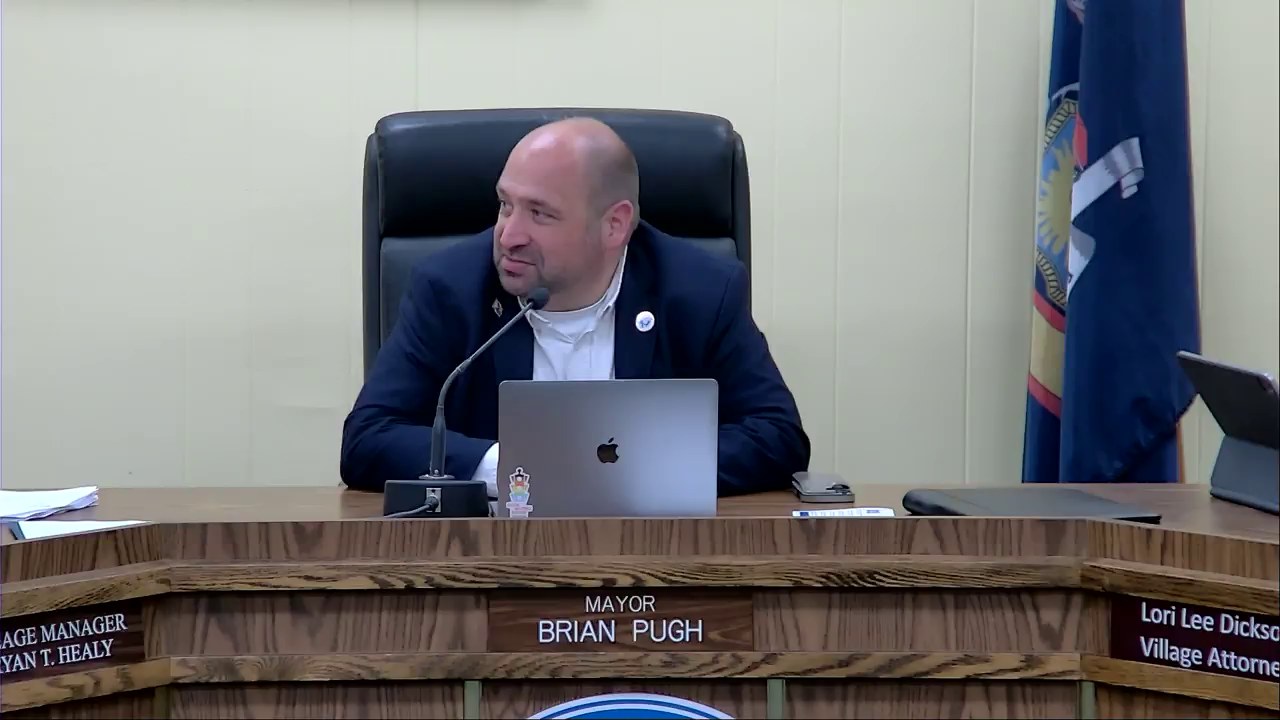
Correction, September 8, 2026: The earlier article said that no one could sue without prior written notice and implied that every electronic report in Croton previously satisfied that requirement. New York recognizes exceptions to prior-notice rules, and the Albany court decision depended on that city’s statute and reporting system. The article has been revised to explain those limits.Mayor Brian Pugh during the Board Of Trustees meeting.
If you spot a heaved sidewalk slab or a pothole in Croton and report it by email — or through any of the village's online channels — the village may well fix it. The new local law expressly excludes electronic reports from its prior-written-notice requirement.
Under Local Law 7 of 2026, the only report that counts as legal "prior notice" of a street or sidewalk defect is a paper one — hand-delivered, sent by certified mail, or sent by overnight service to the Village Clerk — and you need proof of delivery. The law says so twice, in plain terms: "Proof of delivery shall be required to proffer any claim," and "Only specific and actual notice given to the Village Clerk in paper form shall constitute notice under this section."
Electronic reports are expressly ruled out. The law lists them: notices "submitted via email, the village's website, any service, website, or application the Village uses to allow the public to submit reports or service requests to the Village, comments on a social media page maintained by the Village, or any other electronic means" do not satisfy the requirement — including, by its own text, whatever reporting tools the village itself operates.
Why that matters
Prior-written-notice rules generally require a municipality to receive notice of a specific defect and have a reasonable opportunity to address it before it can be held liable under those rules. New York also recognizes exceptions, including a municipality’s affirmative negligence that immediately creates the dangerous condition and a special use that confers a special benefit on the municipality. The Court of Appeals restated those exceptions in Calabrese v. City of Albany.
That decision concerned Albany’s own notice statute and the way its departments received and maintained SeeClickFix reports. It does not establish that every email, app report or social-media comment previously constituted valid notice in Croton. The reporting channel matters, but it alone does not decide every possible injury claim.
Four minutes, no comments, 5-0
The June 17 hearing and adoption discussion lasted about four minutes; the proposal had appeared on an earlier agenda.
The public hearing was scheduled on May 20 by Resolution #98-2026 — passed inside the consent agenda, without a word of floor discussion. At the June 17 Board of Trustees meeting, Village Manager Bryan Healy introduced the change: "this section of the code dates back to the nineteen seventies. Since that time, there have been alternate means of communications developed, including email, social media, you know, text message," Read 2:16▶ Healy said. Under the law as adopted, none of them counts.
The mayor drew the key distinction on the record. "It's to provide legal notice in advance of, establishing the village's liability for potential injuries as a result of a defect," Read 3:04▶ Pugh said, noting the law is not about requesting repairs. The village attorney added that the notice rule gives the village the "opportunity for the village to correct the condition if it can be corrected quickly. So really it's to the advantage of the public in general," Read 3:19▶ Dickson said.
Then came the hearing. "Anyone wishing to comment on this topic, this is your opportunity. Please step to the podium, state your name and address," Read 3:32▶ Pugh said. No one did. The hearing closed, and the board adopted the law 5-0 on a motion by Trustee Nora Nicholson, seconded by Trustee Len Simon — Resolution #118-2026, turning Local Law Introductory No. 8 into Local Law 7 of 2026. It took effect when the state accepted the filing on July 14.
The law arrived in the agenda packet with no memo or written analysis — just the draft text and the two resolutions. The only substantive written justification is three clauses of the resolution itself: the old law dates to 1977, communication methods have changed over 49 years, and the New York Conference of Mayors recommended the review. Asked for discussion before the vote, Healy kept it short: the group "recommended that we do this, and so, you know, we like we like to listen to their advice," Read 5:26▶ Healy said.
Why now: a court ruling and a template
Croton is not an outlier here — it is a follower in a statewide wave.
In December 2024, New York's highest court ruled in Calabrese v. City of Albany that reports submitted through Albany's SeeClickFix app — a report-a-problem system like many municipalities run — could satisfy the prior-written-notice requirement, reasoning that electronic submissions create records "functionally equivalent to writings inscribed in a physical medium." The ruling depended on the reports, Albany’s statute and the city’s processing system.
Albany disabled SeeClickFix within days and then amended its law. The New York Conference of Mayors advised municipalities to amend their own codes so online platforms are "not an acceptable method" of notice, and said it was working with municipal defense attorneys on sample legislation. By spring 2025, dozens of localities across the state were weighing the same move. Croton adopted the recommended approach in June.
The trade-off has two honest sides. Municipal officials argue that the notice rule helps the village learn of hazards and fix them quickly — "to the advantage of the public in general," as Croton's village attorney put it — and prior-notice laws have always existed because officials cannot know of every crack in every sidewalk. Critics of the wave, including the lawyer who won the Albany case, have argued that liability pressure is part of what motivates repairs, and that closing the electronic door makes it harder for ordinary people to preserve their rights.
What to do now
Two channels, two different jobs:
To get something fixed, the village's regular reporting channels still work as service requests — the law excludes them from this prior-notice provision; it does not shut down service requests.
To satisfy the local law’s prior-notice provision — deliver a written description of the specific defect and its location, on paper, to the Village Clerk at the Stanley H. Kellerhouse Municipal Building on Van Wyck Street: hand delivery, certified mail, or overnight service. Keep the proof of delivery.
The full text of the law is in our document library, and the complete record of the June 17 meeting — video, transcript, and every packet document — is on the meeting record page.
Share
Community Discussion
1 comment
One email per new comment on this story. You'll confirm by email first; unsubscribe any time. Your address is never shown publicly.
RH
Roger HammerstanSeptember 14
Brian Pugh Sucks at everything. Commie Psycho.
Be the first to comment on this story.
Sent to the editor for review
This is what you asked us to forward to the Village Board:
An editor reads it first. Once it goes, your comment here
will show a ✓ Forwarded to the Village Board mark —
that is your confirmation.
●A September 3 court order set September 11 for the county’s planned dismissal motion, October 26 for opposition, November 25 for reply and December 2 as the return date; whether the motion was filed on September 11 is not yet reported here.
●January PAC minutes and the August 19 police presentation describe different safeguards; the records do not establish a policy change.
●Rekor’s August 31 proposed national standard calls for warrant- or court-order-controlled re-identification of protected non-hotlist data; it does not establish Westchester’s current practices.
Croton-Harmon opens school with tighter device limits and new phone procedures
●Local Law 10 of 2026 amends Chapter 204, Taxation, raising the combined household income limit for the rent-regulated tax abatement under state Real Property Tax Law 467-b from $50,000 to $75,000.
●Local Law 11 of 2026 amends Chapter 197, Streets and Sidewalks, rewriting the list of sidewalks exempt from the duty to clear snow and ice: two stretches of Farrington Road added, Radnor Avenue dropped, the Old Post Road South stretch redescribed and shortened.
●Both were adopted 5-0 on September 2, filed September 8, and took effect on filing under Municipal Home Rule Law Section 27.
●Neither change has yet been folded into the chapter text published at croton.news/villagecode, which still shows the pre-amendment version.
●Still proposals, not law: Introductory Nos. 7, 10, 13, 14 and 15 of 2026.
Croton’s assistant village manager law took effect September 25
●Establishes the Assistant Village Manager position in Village Code § 31-2.
●Allows the village manager to appoint the assistant and assign duties.
●Requires the assistant to act during the manager’s absence, disability or a vacancy; trustees designate a qualified full-time Village employee if there is no assistant.
●Filed and effective September 25, 2026.
Camera case studies and a data-sharing contract shared Croton’s August 19 agenda
●Work session, 6 p.m.: discussion on the use of cameras by the Croton-on-Hudson Police Department; sole attachment is License Plate Reader Case Studies (January 2026)
●Neither the deck nor the packet contains a written camera policy, retention period, audit rule or list of agencies with query access
●Consent agenda, Resolution 187-2026: renew the RICI inter-municipal agreement with Westchester County
●The resolution authorizes a five-year renewal running November 1, 2026 to October 31, 2031; the agreement attached to it runs October 31, 2026 to July 31, 2029
●Westchester County's answer in the plate-reader class action is due August 31
Experimental project: croton.news uses AI to generate articles from public records. Content may contain errors. Please report any inaccuracies and check our corrections log.AI-assisted experimental site — may contain errors. Corrections
Community Discussion
Be the first to comment on this story.
Sent to the editor for review
This is what you asked us to forward to the Village Board:
An editor reads it first. Once it goes, your comment here will show a ✓ Forwarded to the Village Board mark — that is your confirmation.