Croton-on-Hudson, NY · Sunday, November 15, 2026· Nov 15, 2026Independent, AI-assisted local reporting from public recordsSource-linked·Corrections welcomed
◆Reviewed proposed 2026–2027 fees, including $1.50 hourly train-station parking and $120 senior winter kayak storage.
◆Reached work-session consensus around a $1,000 ADU parkland recreation fee, without a formal adopting vote.
◆Discussed $25 per $1,000 of commercial building valuation, subject to a comparison with other communities.
◆Left the $5,000 teen-program suggestion for a later recap.
◆Reviewed administration and committee budget proposals; final budget adoption was not recorded.
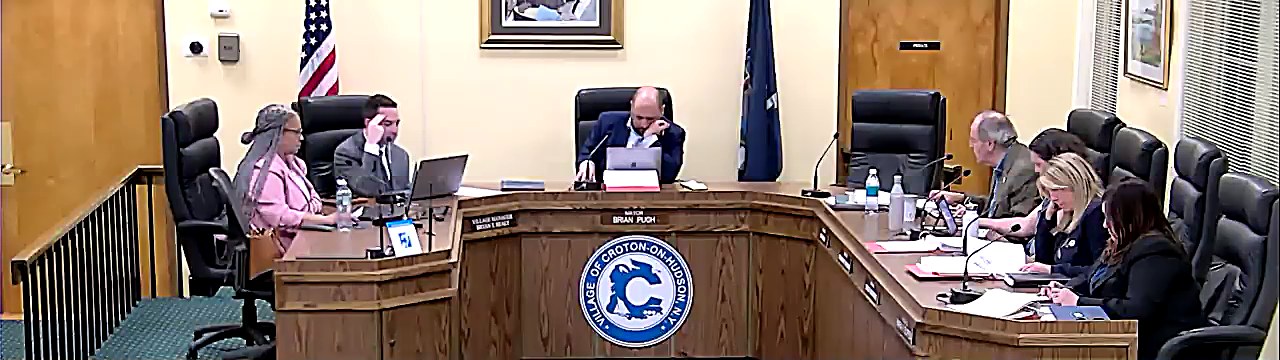
Croton trustees weighed a higher train-station parking rate and a much smaller accessory-dwelling-unit recreation fee at their April 15 budget work session, while Village Manager Bryan Healy recounted the village’s unsuccessful objection to a cannabis dispensary location. The fee and budget discussions concerned proposals for 2026–2027, rather than final fee or budget adoption.
Dispensary timeline and public notification
Healy said the Planning Board had approved a change of use for a dispensary at 370 South Riverside Avenue the previous evening. He described an initial May 2025 meeting at which the operator was told the village did not believe the location met state distance requirements. When a building-permit application arrived in October, he said, the applicant produced a municipal notification form bearing a May 8 village timestamp.
“Despite a diligent search, I have not located the physical copy of this form in our offices,” Read 34:52▶ Healy said. He believed the form had been submitted at the May meeting but had not reached his office.
“If it had been, it would have been put on a village board agenda for community notification as has been done with previous applications.” Read 35:02▶ Healy said the village attorney subsequently protested the location to the Office of Cannabis Management, citing a nearby day care center.
“OCM reaffirmed their decision that the location met the appropriate distance requirements in November 2025.” Read 35:21▶ That was Healy’s account of the state response. He said efforts to find an alternative site did not produce an agreement, and the application proceeded to the Planning Board. Building permits would still depend on the village engineer finding the application code-compliant.
Trustee Maria Slippen wanted the explanation to reach more residents: “I don’t know how like, how is there some way we can get that information out to the public in some way beyond the handful of people who are watching on TV and in the room.” Read 36:34▶
Deputy Mayor Len Simon suggested a project page containing application materials for people who do not routinely follow Planning Board agendas.
Trustee Nora Nicholson asked for clarification of comments about employee parking permits at the Planning Board meeting.
Healy said no permits had been sold in advance. He had told the applicant’s attorney that businesses could purchase up to two South Harmon lot permits and that land-use approvals had used such arrangements as parking conditions in the past.
Parking and building fees
Healy proposed increasing hourly parking at the train station from $1 to $1.50 on weekdays and weekends. He said the hourly rate had not increased in 16 years, and that credit cards and app payments accounted for most transactions.
Simon joked: “And we’ll do our next increase in 2044.” Read 43:31▶
Trustees also explored a senior-resident parking discount. Healy cautioned about implementation and similar requests from volunteer groups.
Simon asked the manager to examine arrangements in other communities before the board decided on a next step.
Healy described the proposed senior-resident winter kayak-storage rate as an increase from $80 to $120 to align the seasonal discount. He also explained that the ADU building-permit fee is calculated from the ordinary residential permit fee and then halved under the village’s ADU law. That building-permit fee is separate from the parkland recreation fee.
Trustees review proposed fees during the April 15 work session. Watch this moment
For the parkland charge, Simon described the $12,000 starting figure as causing “great heartburn to the planning board.” Read 58:53▶
Healy suggested a round $1,000 fee during the ensuing discussion.
The exchange ended in support for that figure; it was a work-session consensus, rather than a formal fee-adoption vote.
Nicholson suggested raising commercial and multifamily building-permit charges to help offset costs for resident programs.
Healy discussed $25 per $1,000 of valuation, compared with the $22 commercial rate he described, and undertook to check how it compared with other communities.
Youth programs, administration and committees
A trustee proposed adding $5,000 for teen and youth programming, with possible trips or a small pilot connecting students with the Cortlandt teen center. The discussion emphasized consulting young people and providing enough staff support, rather than promising a ready-made program.
Healy said the proposal would go into a later recap discussion and that a vote was not needed at this point.
Healy described a proposed contingency account of about $240,000, near one percent of a village budget of slightly more than $24 million. For comparison, the village’s FY2026 third-quarter financial report lists an original General Fund contingency appropriation of $163,000. He stressed that contingency money could not be spent directly: the board would have to approve a transfer to the appropriate account.
The administration review also included restoring a separate deputy village-clerk position, which Healy said had gone unfilled after a 2021 departure, and the cost of making the fire-inspector position full-time.
Healy outlined proposed committee allocations including $4,000 for the Police Advisory Committee, up from $2,500 but below its $5,455.65 request, and $1,500 for the Bicycle and Pedestrian Committee.
For Arts and Humanities, Healy discussed $11,085 against a $19,460 request. The larger request included a public-art project at Duck Pond that he had not included in his proposal, while leaving open later consideration from contingency.
Healy also described proposed allocations of $6,000 for IDEA, $4,000 for Lorraine Hansberry and $3,000 for HEART. These were part of the budget review; the recorded work session did not adopt the final budget.
*Correction, October 19, 2026: An earlier account described proposed fees and a youth-program suggestion too definitively and used inaccurate recording timestamps. This version distinguishes proposals and work-session consensus from formal adoption, attributes the dispensary’s state review to the manager’s account, and restores the prior contingency comparison confirmed by the linked financial report. A brief October 19 revision incorrectly removed that supported comparison. The senior-parking waiver discussion remains attributed to trustees collectively.*
Meeting documents and agenda items, grouped by agenda item — each links to a searchable text page and its original source.
Full meeting record with summaries →
Experimental project: croton.news uses AI to generate articles from public records. Content may contain errors. Please report any inaccuracies and check our corrections log.AI-assisted experimental site — may contain errors. Corrections