Board Approves Battery Storage Study, Eyes Winter Parking Changes for Business Districts
The Board of Trustees authorized a $2,000 study of battery energy storage on village land, moved to relax snow-parking rules for business districts, and debated a sweeping rewrite of animal-keeping regulations at a wide-ranging June 24 work session.
🔍This article passed automated fact checks (verbatim quotes, name and dollar-figure provenance against source documents) but has not had a line-by-line human review. Please report any inaccuracies.
▶Key Actions & Decisions
●Awarded towing contract to CNC Towing Inc. dba Luposello Auto Body (Resolution 153-2026, 4-0, Nicholson absent)\n- Appropriated $2,000 from sustainability trust account for BESS consultant (4-0, Nicholson absent)\n- Directed grant consultant to pursue three CFA grants: water mains (Harrison St/Sunset Trail), Gouveia Park design, salt shed relocation\n- Advanced animal/fowl code rewrite with 25-foot setbacks in RA-5 and 50-foot setbacks elsewhere\n- Agreed to convert HEART Committee from standing to ad hoc committee\n- Directed local law for daytime business-district parking during snow events
The Croton Board of Trustees tackled a packed work session agenda June 24, advancing plans to study battery energy storage on village land, overhauling winter parking rules for business districts, and wrestling with the intricacies of chicken and duck regulations.
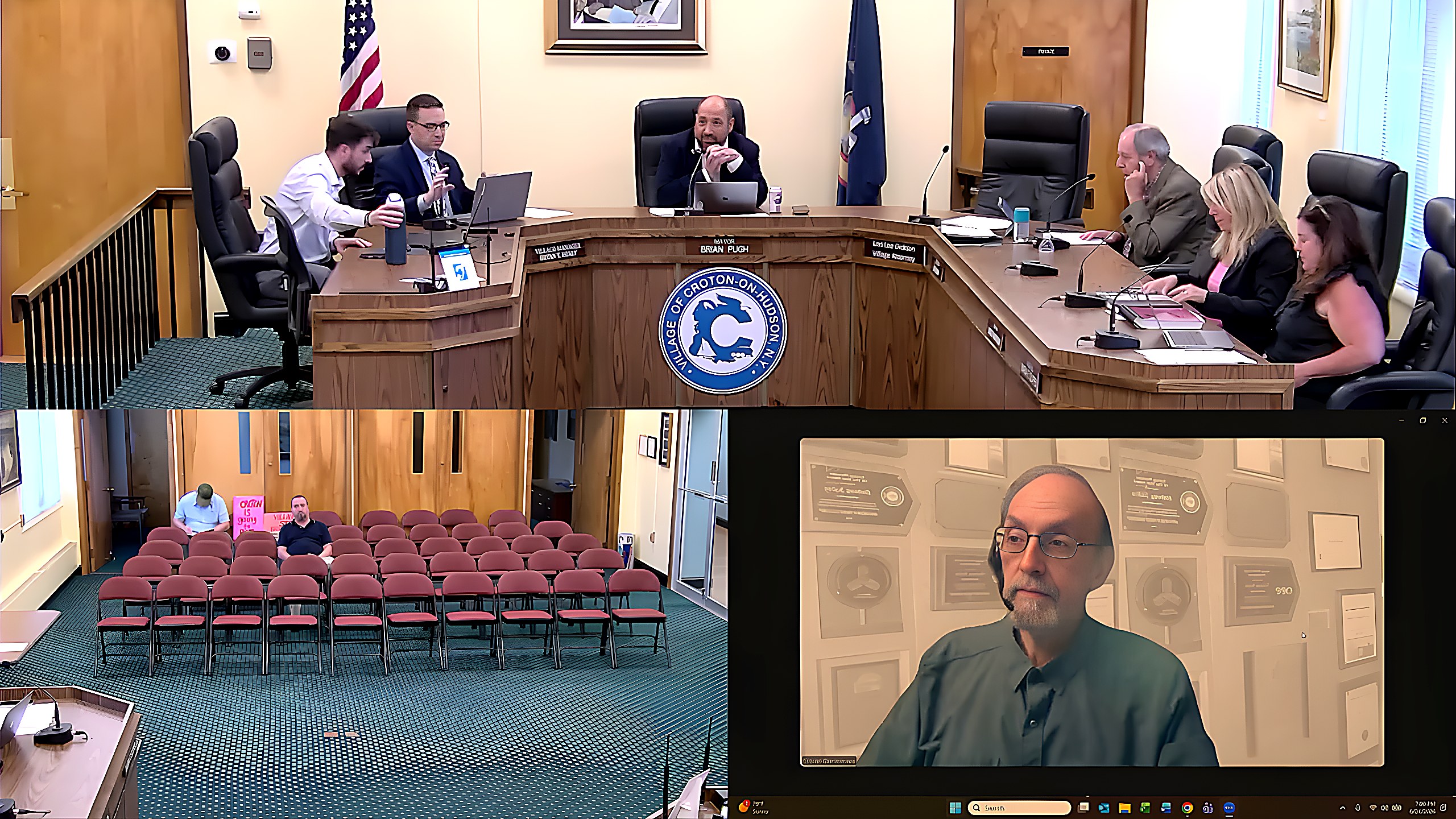
Mayor Brian Pugh leads the Croton Board of Trustees during a work session on June 24.
Trustee Nora Nicholson was absent. Mayor Brian Pugh, Deputy Mayor Len Simon, Trustee Stacey Nachtaler, and Trustee Maria Slippen were present, along with Village Manager Bryan Healy and Village Attorney Lori Lee Dickson.
Towing contract re-awarded
The board re-awarded the village's towing contract to CNC Towing Inc., doing business as Luposello Auto Body, covering June 1, 2026 through May 31, 2027. The board had previously approved the contract under the DBA name only; the revised Resolution 153-2026 references the company's official corporate name. Healy explained that the correction was made when it came to light during contract preparation that Luposello Auto Body is a DBA, not the legal entity. The vote was 4-0.
Battery energy storage exploration authorized
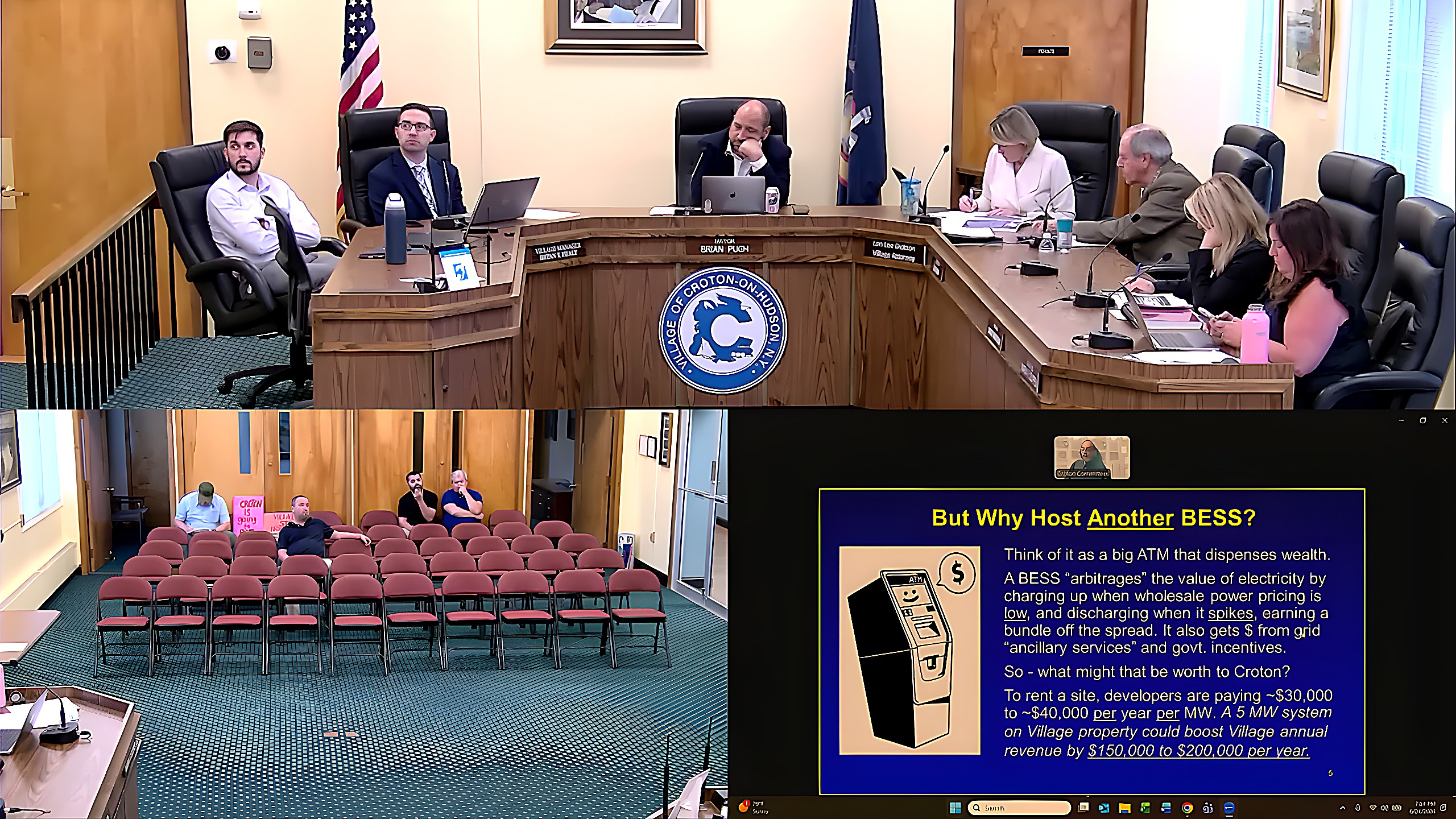
Lindsay Audin, chair of the village sustainability committee, presented a proposal to explore hosting a commercial-scale battery energy storage system (BESS) on village-owned property. Developers currently pay $30,000 to $40,000 per megawatt annually in site leases, Audin said, meaning a five-megawatt system could generate $150,000 to $200,000 per year in revenue for the village, plus a $50,000 building permit fee.
The village already hosts a BESS at the Croton-Harmon train station, charged by the solar canopy panels. That system has been tested but is not yet fully operational. A second, privately owned system operates at Croton Auto Park.
Audin requested $2,000 to hire a consultant to identify viable village sites near power lines with available hosting capacity and to issue requests for interest and proposals. The process would take three to four months, and no commitment to install anything would follow, Audin emphasized.
Audin noted that hosting capacity on nearby power lines is a first-come, first-served opportunity. "If there are available lines like this near village property, we want to lock them up and get that revenue for the village," Audin said during the presentation.
Trustee Maria Slippen pressed for a more deliberate public process, noting that other municipalities have enacted moratoriums on battery storage. Slippen said the presentation felt too polished for an early-stage concept. "I think I described it to the manager as the horse is out of the barn," [source][31:58] Slippen said, urging the board to communicate the process authentically to residents.
Audin countered: "We haven't even found if there is a horse." [source][38:09]
Pugh noted that the village has two existing BESS installations without controversy and that no residents had contacted the board with concerns about the proposal. Croton was among the first communities in the region to adopt specific safety standards for battery energy storage systems in 2022.
The village attorney clarified that any project would still need to go through the planning board's special permit and site plan review process, and that as a municipal property owner, the board retains greater control than a private landowner would.
The board voted 4-0 to appropriate the $2,000 from the sustainability trust account. Deputy Mayor Simon made the motion, seconded by Trustee Nachtaler.
Grant applications prioritized
Village Manager Healy presented a monthly grant update on behalf of consultant Valerie Monastra, who was absent. The board agreed to pursue three of four state Consolidated Funding Application opportunities:
• Water Infrastructure Improvement (WIIA): $425 million available statewide, with a 30% local match up to $5 million, targeting water main replacement on Harrison Street and Sunset Trail.
• Environmental Protection Fund: $28.75 million available, 50% match up to $675,000, for design and engineering of the house at Gouveia Park.
Lindsay Audin, chair of the sustainability committee, presents the potential financial benefits of hosting a battery energy storage system on village land.
• Water Quality Improvement: $75 million available, 25% match up to $600,000, for relocation of the salt shed from its current flood-zone location at the train station.
The board declined to pursue a Climate Smart Communities grant for sidewalks requiring green infrastructure enhancements, noting that existing sidewalk projects on Municipal Place and South Riverside are already funded through county grants.
Animal code rewrite advances — with debate
The board spent extensive time on proposed changes to the village code governing animals and fowl, informed by research from Cornell University, Penn State, the USDA, and the CDC. The proposed language would limit permitted fowl to chickens and ducks (excluding roosters) and establish setbacks of 25 feet in the RA-5 district and 50 feet in all other districts — a fivefold increase from the current five-foot accessory structure standard.
Trustee Nachtaler suggested limiting smaller lots to hens only, noting that ducks are flighted birds more likely to create nuisance and enforcement issues. The board ultimately agreed to proceed with the consultant's recommendation of chickens and ducks across all districts for now, with the possibility of further restricting ducks as the proposal moves through the review process.
Slippen urged removing the word "fowl" from the code entirely, noting it had been a source of confusion at the zoning board. The village attorney confirmed there would be no grandfathering for animals that become prohibited under the new law.
The board also asked that a chart modeled on Briarcliff Manor's regulations — which permits certain farm animals on lots of two acres or more — be incorporated into the draft for review. The zoning amendment process takes approximately two months.
Student member policy takes shape
The board reviewed a draft policy for student members on advisory committees. Students would serve as non-voting members, be juniors or seniors in high school, and serve terms aligned with the school year.
Slippen, who has championed the initiative for about a year, recommended dropping a proposed 2.5 GPA requirement and allowing nominations through school guidance counselors rather than formal letters. Slippen also stressed the need for parental acknowledgment for minors and safeguards against conflicts of interest for committee chairs.
The board reached general consensus, with a formal policy to be drafted.
HEART Committee to become ad hoc
The board agreed to convert the HEART Committee from a standing committee to an ad hoc committee. The change allows members who serve on other committees to continue participating without running afoul of the village's committee membership rules. The committee, which honors community members through events, will retain its name and current operations but with a less formal structure.
Winter parking rules eyed for business districts
Healy proposed allowing daytime parking from 7 a.m. to 7 p.m. on one side of the street in business districts — North Riverside, Harmon, South Riverside, and the Upper Village — during snow events. Overnight restrictions would remain in force to allow DPW crews to clear streets curb to curb.
The current regulations, unchanged since 1993, prohibit on-street parking once two inches of snow accumulates. Business owners and residents complained during the past winter that the rule was too restrictive for smaller storms.
Simon called the proposal innovative and said business owners would be pleased. "I think they're going to be very pleased," he said.
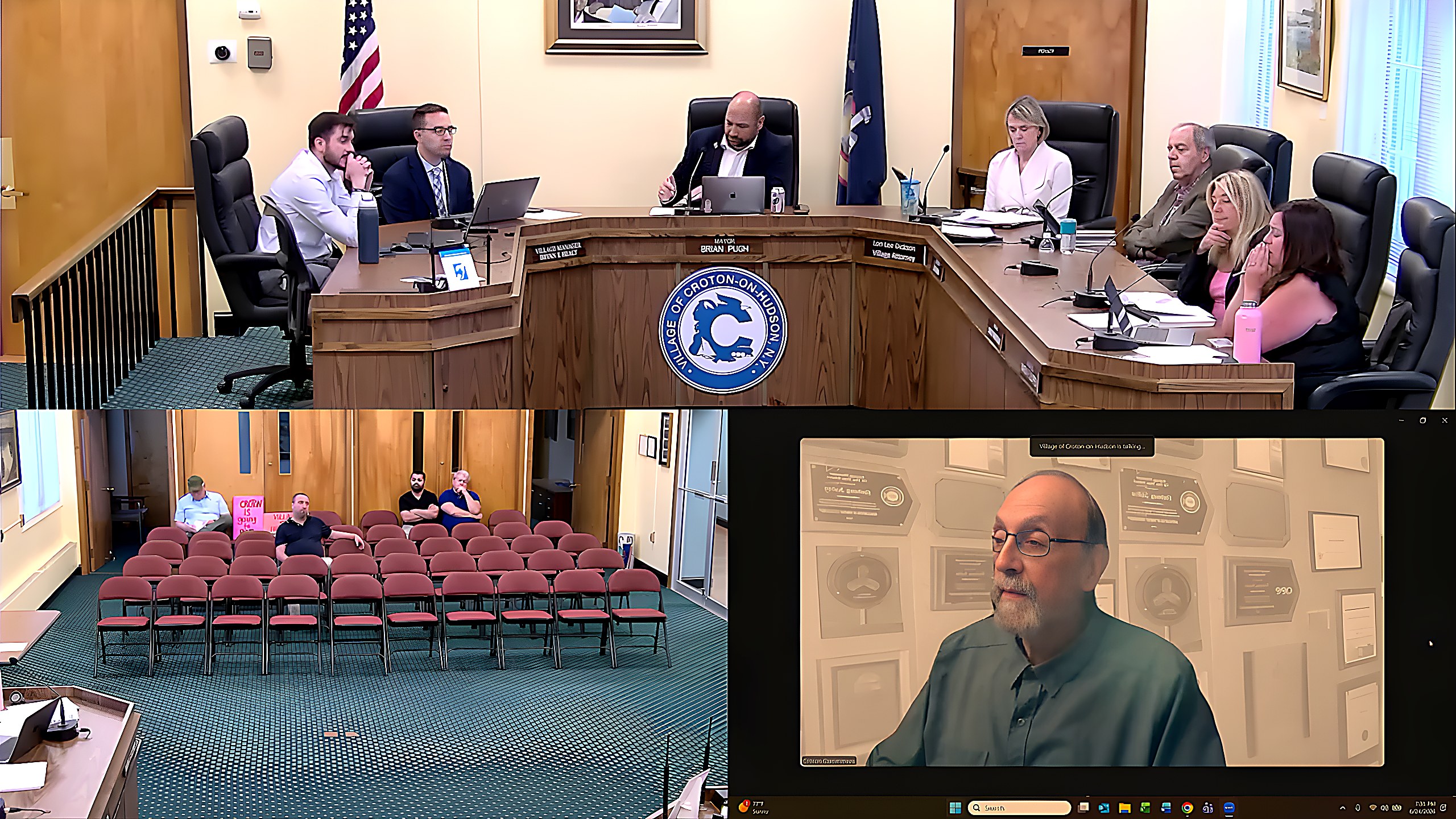
Trustee Maria Slippen raises concerns about community perception and process regarding the proposed battery energy storage study.
Healy also announced that the DPW will notify property owners — primarily commercial properties along South Riverside and Croton Point Avenue — that they will be responsible for clearing adjacent sidewalks starting this winter, as those sidewalks had been cleared by the village without a clear basis in code. A section of Farrington Road near Palmer will be added to the list of sidewalks the village exempts and clears itself, due to accessibility issues.
The winter parking changes require a local law amendment, with a public hearing likely scheduled for August.
Share
Coverage of the Board of Trustees Work Session meeting on 2026-06-24,
Village of Croton-on-Hudson, NY.
· Read full transcript
This article was drafted by our automated AI newsroom from the official meeting
transcript, then checked by an AI editor and an automated fact-verification gate.
Quotes link to source video timestamps for verification.
Read our editorial policy.
🔍Ask Croton
Have a question about this story? Search across meeting transcripts, village history, and municipal code.
Related Board of Trustees Work Session Meetings
Trustees Take Up Signage Overhaul, Pigeon Regulations, and Cannabis Dispensary Moratorium in Marathon Work Session
●Brook Street Drainage: Trustees are poised to allocate $700,000 (50% funded by Westchester County) to fix chronic flooding on Brook Street, coordinating with a Con Ed gas main replacement.
●Snow Removal Upgrade: The plan includes purchasing a new loader with a "snowblower" attachment and upfitting a "hook and go" truck to improve efficiency during winter storms, following a season of heavy overtime.
●Park Safety: The Board moved to fund security cameras at Croton Landing and Senasqua Park, a project deferred last year when funds were diverted to repairs at Jobs Field.
●Farrington Road Steps: After receiving a $400,000 bid in 2024—nearly triple the budget—the village will try a "joint venture" with a mason and in-house labor to rehabilitate the historic steps for roughly $250,000.
●Streetlight Improvements: Trustees approved $18,000 to replace green streetlight globes in the Harmon business district with warmer, black-colored LEDs to match the rest of the village.
●Traffic Safety: A bond resolution will fund pedestrian and vehicle safety improvements at the intersection of Old Post Road North and Michaels Lane, though residents pushed for more robust community outreach.
●Water System Expansion: Using settlement funds from PFAS litigation, the village will design a water main extension up Route 129 to serve the DPW facility and the Hendrick Hudson bus garage.
●REFERENCES_USED: R1, R2, R4, R9, R19
Police Chief Warns Body Cameras Will Bring 'Exponential' Workload as Trustees Weigh Staffing Study
●Village Manager Bryan Healy directed to draft a "Budget Priorities Survey" based on models from Timmins, Canada.
●Board requested a one-page "budget primer" accompany the survey to explain the difference between Village, School, and Town taxes.
●Draft survey to be presented to the Board for review at a January work session.
●Board discussed potentially collaborating with the Police Advisory Committee to avoid "survey fatigue."
●Trustees debated asking residents to rank hypothetical spending (e.g., new recreation vs. tax relief).
Community Discussion
0 comments
Be the first to comment on this story.
Experimental project: croton.news uses AI to generate articles from public records. Content may contain errors. Please report any inaccuracies and check our corrections log.
Community Discussion
0 commentsBe the first to comment on this story.