Croton-on-Hudson, NY · Monday, October 12, 2026· Oct 12, 2026Independent, AI-assisted local reporting from public recordsSource-linked·Corrections welcomed
49 Apartments, 31 Questions: Planning Board Opens Its Review of 425 S. Riverside
The Planning Board opened what its acting chair called "a long, long process" on Carmel Riverside LLC's 49-unit apartment proposal at 425 S. Riverside Ave., with Chairman Rob Luntz recused, 31 issues flagged by the village's planning consultant, and the applicant agreeing to complete the application before variance requests go to the Zoning Board of Appeals. The board also plans to flag the chicken-coop setback in its comments back to the trustees on the proposed animal-keeping law.
●No action taken on the Carmel Riverside application; the session was a working discussion, not a public hearing
●No referral to the Zoning Board of Appeals yet; the applicant agreed to complete the application before any variance requests go there
●Documents to supplement the application are due this Friday to make the next regular meeting, by the acting chair's reckoning
●On Intro Local Law 10, Luntz said the board can flag the chicken-coop setback in a referral note back to the trustees
●Minutes of the prior meeting approved without corrections
Croton's Planning Board on Tuesday opened its review of Carmel Riverside LLC's application to build a 49-unit apartment building at 425 South Riverside Avenue — a session that began with the board's chairman stepping aside and ended with the applicant carrying home a seven-page list of questions from the village's planning consultant.
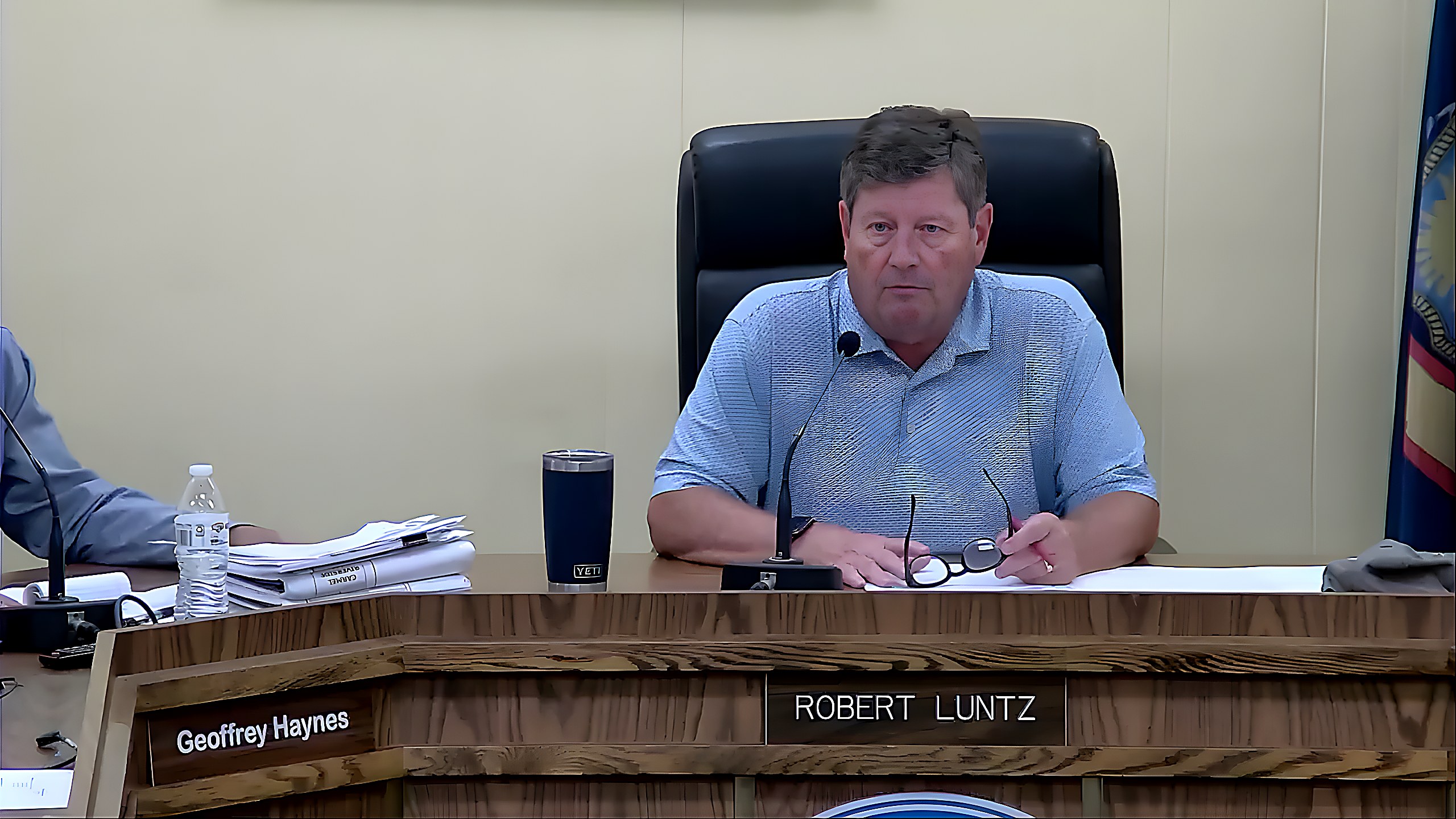
Planning Board Member Rob Luntz during the Planning Board meeting.
Chairman Rob Luntz recused himself moments after calling the meeting to order. "I have a relationship with one of the principals in this application who I have ongoing business with, mister Leggio," Read 0:50▶ he said, and handed the item to deputy chairman Geoffrey Haynes, leaving the dais until the application had been heard. Leggio is the applicant's managing partner; Andrew Cortese introduced him at his side later in the meeting.
Haynes said the board is beginning "a long, long process," Read 1:25▶ and that the consultant's report identifies 31 areas needing clarification or additional information. Tuesday was structured as a working discussion with the developer — not a public hearing, and not yet a project presentation. "Obviously, no decisions are gonna be made tonight nor anytime in the immediate future," Read 4:50▶ he said.
The property sits in the C-2 commercial district and the Harmon South Riverside Gateway overlay district, and the application asks the board for a special permit and site plan approval — each with a public hearing to come — and, as read into the agenda, a steep slope permit as well. Village Attorney Lori Lee Dickson, standing in for the Planning Board's regular counsel, explained the board's boundaries: the Board of Trustees has already determined by legislation that the proposed use is permitted at this location under a special permit, so the Planning Board's job is to test the project against the criteria in Article 10 of the zoning code — and to approve it, approve it with conditions, or deny it on substantial evidence in the record. "You can't legislate it and say this use is not appropriate," Read 13:00▶ she said.
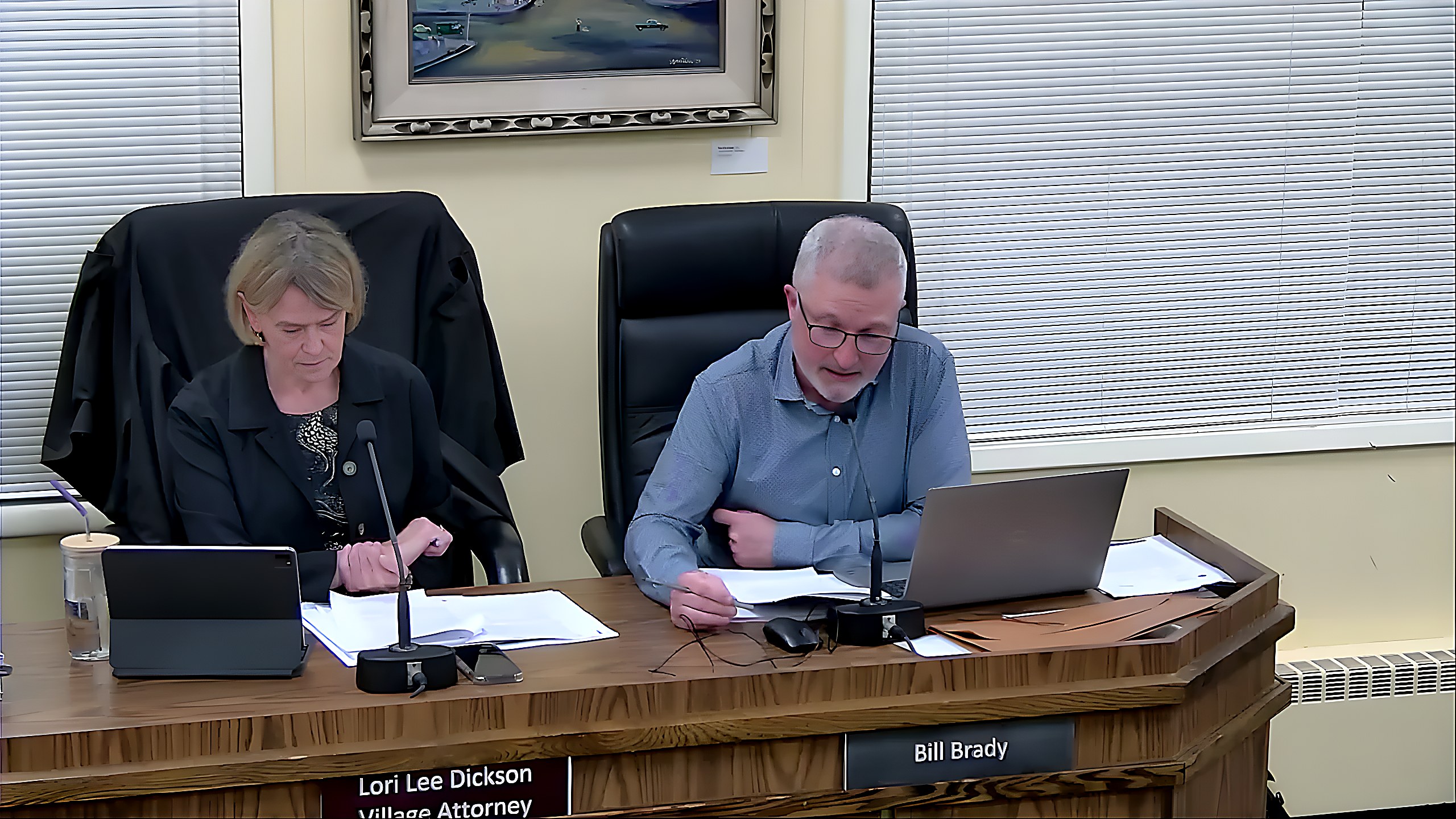
Bill Brady of Nelson Pope Voorhis, the village's planning consultant, then walked the board through his firm's July 24 review memo. Among the potential zoning variances he flagged: a front-yard setback that complies with neither the C-2 rules for lots within 25 feet of a residential district boundary nor the overlay district's own standard, and a building that appears to exceed the code's 20,000-square-foot cap on a single building — items that would go to the Zoning Board of Appeals. He asked the applicant to supply an exact floor-area-ratio calculation against the 0.8 maximum and height calculations against the 35-foot limit. The project would meet the minimum parking counts, he said, but "the zoning table has a wrong calculation for the required parking." Read 25:49▶
The memo's site-plan comments run from the three tiers of proposed retaining walls — Brady asked whether geotechnical studies have been done on the slopes and said the board may want a structural engineer to review the plans — to fire-truck access, a request for an illumination contour plan for the proposed outdoor lighting, a question about blasting, and trash collection: "the garbage truck can only back into the site blocking the driveway and the sidewalk," Read 33:48▶ he said. Brady also said the project will need steep slope, tree removal, and excavation-and-filling permits.
Andrew Cortese, the applicant, told the board he has done real estate development and construction in Westchester County for the last thirty years, that he and his partner purchased the property about two and a half years ago and cleaned up violations on it, and that the tenants still living there are aware of the redevelopment plans. Asked by board member Steve Krisky whether the units would be for sale or for rent, Cortese answered, "Probably for rent, but we're still not a 100% certain." Read 48:10▶Village Attorney Lori Lee Dickson and Planning consultant Bill Brady during the Planning Board meeting.
The applicant's attorney, Jacob Amir of Zarin & Steinmetz, called the consultant's memo "a great road map for us" Read 37:31▶ and pressed for one thing he did not get: an immediate referral to the Zoning Board of Appeals for the variances he said the project will clearly need. Amir acknowledged that "the onus is on us to make as complete a variance request as possible," Read 40:46▶ but said he hoped to get that process started now. Krisky, speaking for himself, was unmoved: "I don't wanna submit anything to the zoning board until the application's complete to our satisfaction." Read 41:46▶ Amir agreed to supplement the application first. Earlier, Haynes had declined Amir's suggestion that the applicant's assembled consultants share their thoughts on the project, saying "we really wanna keep the focus on these outstanding issues, get a complete application together," Read 38:08▶ though he allowed the board could entertain responses that stuck strictly to the questions raised.
On water, Haynes read from the applicant's own preliminary engineering report: testing shows the existing six-inch main on South Riverside can supply the building's domestic needs, but the main's fire flow falls short of the required specification. He named two options — an on-site water storage and pump system, or a water connection brought down from Wayne Street whose easement has been under discussion for quite a while. Cortese said the current design includes the pump and tank system.
On schools, Haynes flagged an inconsistency in the enrollment table of the schools impact report and pressed for a more accurate estimate of the building's future assessed value — the figure behind the report's conclusion that, on the preliminary estimate, new tax revenue to the school district would more than cover the expected additional students. Dickson noted that units sold in a condominium format are assessed under a different formula than a multifamily rental. Cortese offered to have an appraisal done and to talk to the town assessor.
On traffic, Haynes said the study leaves the Blaze unaddressed — Historic Hudson Valley's fall event at Van Cortlandt Manor, which he called "a crowded scene" — and raised a pedestrian problem: the building's walkway leads directly across the street to a ShopRite driveway ramp that is not meant for pedestrians but is widely used as one. He also asked that the standard trip-generation tables be supplemented with numbers from apartment complexes just built in Croton, naming Maple Commons and 25 North Riverside. There was also a request from the dais that the study be expanded to cover traffic flow through South Riverside Avenue and Croton Point, where more development is expected.
What happens next: documents are usually due 15 days before a meeting, village engineer Vincent Salanitro said; to make the next regular meeting, Haynes reckoned, that means this Friday. If solid responses come in, Haynes said, the board could potentially hear the project presentation at that meeting, with a public hearing potentially to follow. Dickson laid out two more clocks: the project must go to the County Planning Board for review and comment before the board can reach a decision, and under a recently adopted code provision it must also be transmitted to the Board of Trustees for comments — a thirty-day process that starts when the application is placed on a trustees' agenda. It will appear on that board's August 19 agenda, she said.
With Luntz back at the dais, the board took up a referral from the Board of Trustees seeking comments on Introductory Local Law 10 of 2026, which rewrites the zoning code's rules for keeping animals. Haynes said the most prominent change is that "the keeping of roosters and pigeons shall be prohibited," Read 70:41▶ something he did not believe was spelled out in the previous law. Under the draft, chickens and ducks are capped by lot size, and coops must sit at least 25 feet from any lot line in the RA-5 and RB districts and 50 feet in all other residence districts.
The rewrite began with a question of definition — what the village code means by "fowl" — that surfaced in a zoning dispute over a permitted pigeon coop, the subject of our earlier analysis of the proposed ban. The definition of fowl, Haynes said, "I think is where it started from." Read 70:41▶ As a reader observed in the comments on that piece, pigeons are not biologically fowl at all — the term covers the chicken and duck lineages, while pigeons belong to a different order — so a law that began as a clarification of one word now reaches, by name, a bird outside it.
Krisky, working through what the setback would mean on his own narrow lot, said he was not opposing the rule but saw an inconsistency in it: "I can have an ADU on my property, but I can't have a chicken coop." Read 72:20▶ Of the setback on a 50-foot lot, Luntz said, "It's almost precluding it from happening," Read 76:06▶ and said he thought the board could include the point in a referral note back to the trustees, recommending they review the provision. Dickson said the trustees are collecting comments in advance of scheduling a public hearing on the law. Comments can be sent to the Board of Trustees at BoardofTrustees@crotononhudson-ny.gov.
One more thing the paper trail shows: the draft in the Planning Board's packet — the text Haynes read from on Tuesday — is the version prepared for the trustees' July 1 meeting, which prohibits roosters and pigeons outright and carries no effective date. The Waterfront Advisory Committee, which received the same referral for its July 8 meeting, was sent a different draft. In that version, roosters — "including cockerels" — are prohibited immediately; the second prohibition is expanded to "pigeons, geese, and swans" and takes effect January 1, 2027; and a new subsection ties the rules to the zoning code's enforcement and penalty sections. The two documents carry different law-firm control numbers, and neither packet says which text will advance to the public hearing.
The board closed by approving the minutes of its prior meeting without corrections.
Share
Community Discussion
0 comments
One email per new comment on this story. You'll confirm by email first; unsubscribe any time. Your address is never shown publicly.
Be the first to comment on this story.
Sent to the editor for review
This is what you asked us to forward to the Village Board:
An editor reads it first. Once it goes, your comment here
will show a ✓ Forwarded to the Village Board mark —
that is your confirmation.
Coverage of the Planning Board meeting on 2026-07-28,
Village of Croton-on-Hudson, NY.
· Read full transcript
Why it's hereA week before the Planning Board took up 425 S. Riverside, the trustees walked through code amendments meant to preserve local scrutiny of development as state SEQR exemptions expand — the review framework this application now enters.
▶
Key Actions & Decisions
●Authorized the village manager to reject all bids under Bid No. 22-2025 for HVAC trade labor so the changed scope of work can be re-bid
●Reached consensus to raise the income limit for senior citizen and disability rent increase exemptions in the village's five ETPA buildings, with a public hearing expected to be called Aug. 19
●Reviewed code amendments preserving local environmental review after state SEQR exemptions; referrals to the Planning Board, WAC and county planning expected at the Aug. 19 meeting
●Village manager to meet with the planner and village attorney on a zone-based approach to cannabis dispensary locations
●Agreed to add an "animal-related uses, general" category to commercial zoning districts while leaving kennels unlisted, and therefore prohibited without a zoning amendment
●Appointed Carolyn Whiting chair of the reconstituted ad hoc HEART Committee, reappointed its members, and reappointed Whiting to the Police Advisory Committee
Planning Board OKs Moving EV Charging Stations Outside at Hudson Condos
Why it's hereThe Planning Board's previous meeting, whose minutes were approved Tuesday — including work at 25 and 352 S. Riverside, two other development sites on the same corridor as the Carmel Riverside proposal.
▶
Key Actions & Decisions
●Voted 5-0 to open and immediately adjourn the Spring Come, LLC public hearing to July 14 because revised plans were not submitted.
●Voted 5-0 to approve the amended site plan for The Hudson Condos to place all four EV charging stations outdoors, relocating the two originally planned inside.
●Voted 5-0 to approve the sign permit for The Hudson Condos with confirmed nine-inch letters.
●Approved the landscape plan for 425 S. Riverside Ave. with a condition requiring a two-year bond for the plantings.
●Agreed to coordinate with the Department of Public Works on a solution for the visible chain-link fence on village property.
Croton Board Advances Animal Law Overhaul, Opens Advisory Committees to Students Amid Con Edison Backlash
Why it's hereThe trustees introduced Local Law 10 — the animal-keeping rewrite with its rooster and pigeon ban — at this July 1 meeting and referred it to the Planning Board for the comments the board took up Tuesday.
▶
Key Actions & Decisions
●Introduced Local Law Introductory No. 10 of 2026 to overhaul animal regulations, with proposed January 1, 2027 compliance deadline
●Approved guidelines for high school students to serve as nonvoting members on eight advisory committees
●Authorized $11,534 to Kofile for digitizing microfilm records
●Approved SPCA of Westchester shelter contract at $4,400
●Authorized free cybersecurity services agreement with NYS DHSES
●Approved $2,628 for battery-powered DPW equipment
●Approved $5,700 for Duck Pond aeration compressor replacement
Trustees set cannabis-moratorium hearing, seek leaf-blower review
Why it's hereThe animal-keeping rewrite began here: the trustees' marathon May work session where pigeon regulations first reached the board's agenda.
▶
Key Actions & Decisions
●Set a June 17 public hearing on a proposed six-month cannabis-dispensary moratorium.
●Renewed the school speed-zone camera home-rule request, 4-0.
●Referred about 40 residents’ leaf-blower comments to the Conservation Advisory Council, 4-0.
●Temporarily suspended a committee-membership restriction concerning HEART for 30 days.
Experimental project: croton.news uses AI to generate articles from public records. Content may contain errors. Please report any inaccuracies and check our corrections log.AI-assisted experimental site — may contain errors. Corrections
Community Discussion
Be the first to comment on this story.
Sent to the editor for review
This is what you asked us to forward to the Village Board:
An editor reads it first. Once it goes, your comment here will show a ✓ Forwarded to the Village Board mark — that is your confirmation.