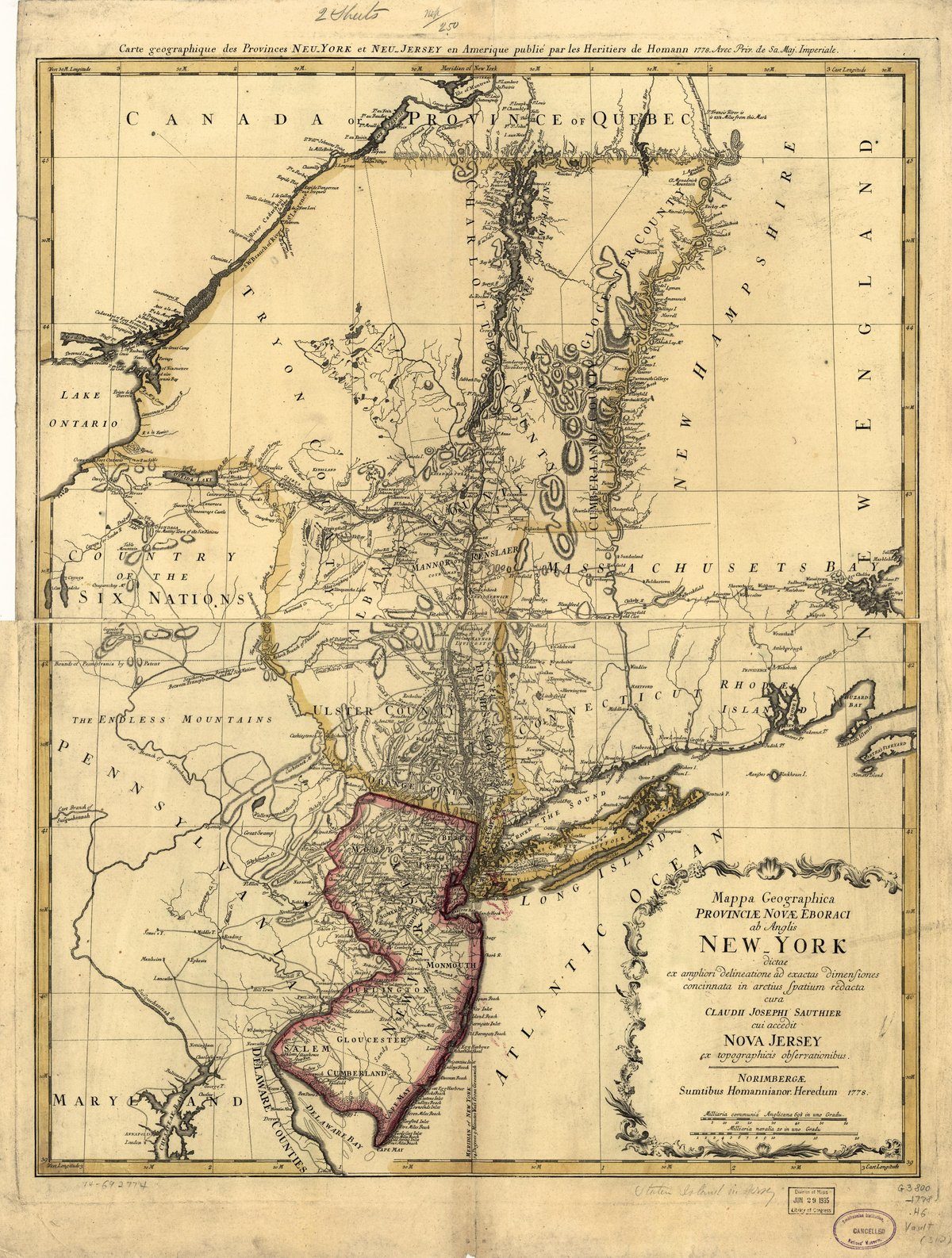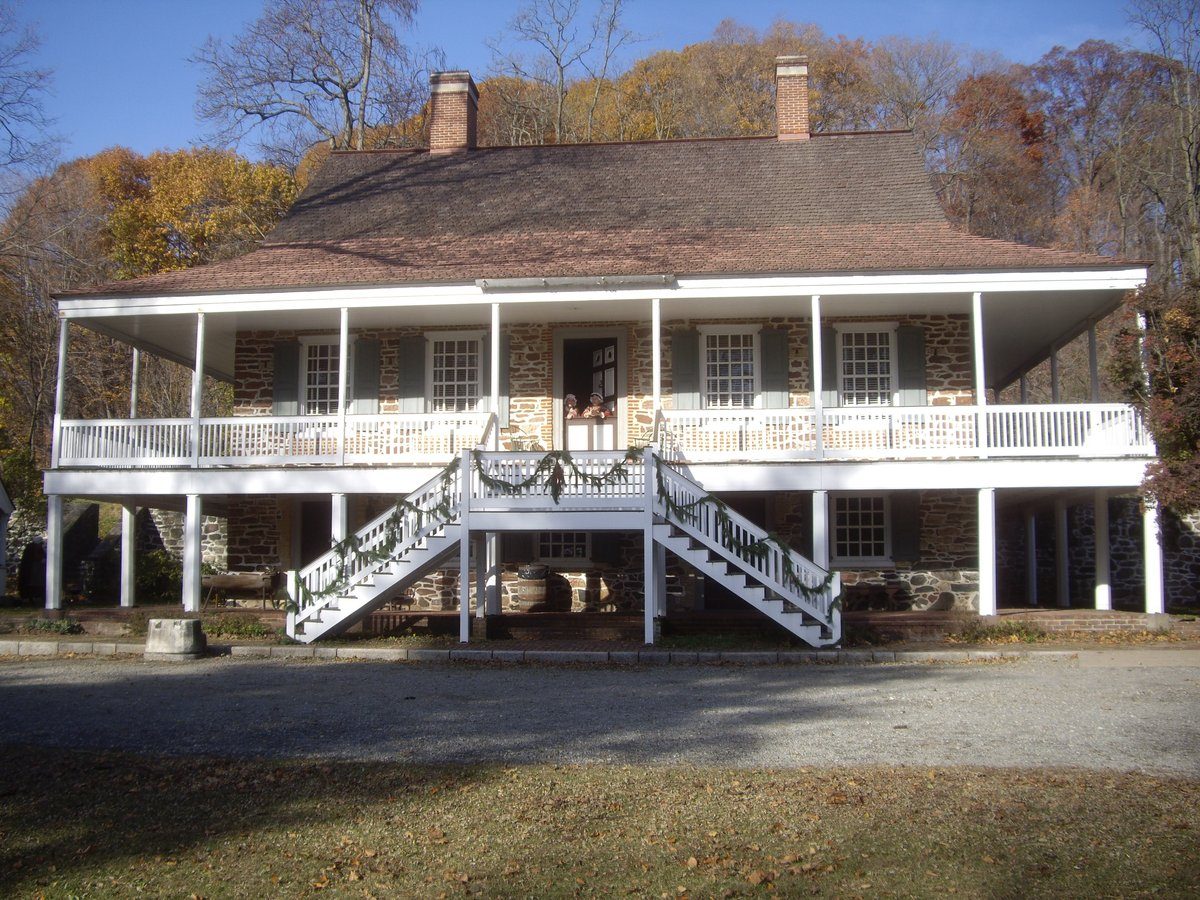
*The Van Cortlandt and Philipse families, linked by marriage, hosted Washington, Lafayette, Rochambeau — and, on the Philipse side, the British army. Both held Native Americans and Africans in bondage. A 1730 will and a 1705 deed tell the story the museum doesn't.*
Van Cortlandt Manor sits along the Croton River near its confluence with the Hudson, a handsome stone house surrounded by gardens that today operates as a museum of colonial life. During the American Revolution, the manor served as a gathering place for the patriot cause. George Washington passed through its doors. The Marquis de Lafayette and the Comte de Rochambeau visited. It is remembered as a house of liberty. Less than ten miles south, at Philipsburgh, the Philipse family — into which the Van Cortlandts had married in the previous generation — sided with the British Crown and had its manor confiscated after the war. One family became the country's Patriot host, the other its most notorious Loyalist lord. Both held enslaved people.
The documentary record — preserved in Robert Bolton's 1848 *History of the County of Westchester* — tells the story in the voices of the manor lords themselves.
“My Indians or Muster Slaves” [src: bolton_1881_v1#2c9b2736cda6]
The single most explicit primary-source document of indigenous slavery in the Hudson Valley manor lords' orbit is preserved in Bolton's 1848 *History of the County of Westchester*. It is the 1730 will of **Catharine Philipse** — born a Van Cortlandt, sister of Jacobus van Cortlandt, widow of the first Frederick Philipse. Catharine had married into the neighboring Philipse family; her household at the time of her death was the Philipse manor at Philipsburgh, not Van Cortlandt Manor proper. But she was a Van Cortlandt by birth, and her will links the two manor lineages the way Westchester's actual eighteenth-century gentry were linked — by marriage, property, and a shared reliance on unfree labor.
The key clause reads with startling specificity: *“Item, I will and direct, that Matty and Sarah, my Indians or muster slaves, shall be manumitted and set at full freedom.” [src: bolton_1881_v1#2c9b2736cda6]* (*A History of the County of Westchester*, Vol. I, Bolton's transcription of the will of Catharine Philipse, née Van Cortlandt.) The phrasing is remarkable. “Indians or muster slaves” acknowledges that Matty and Sarah were Native Americans held in bondage — not indentured servants, not war captives in temporary custody, but slaves whom the testator possessed the legal power to free.
The will's residuary clause leaves us in no doubt about Catharine's family network: *“another fifth part of my said estate to the three grandchildren of my deceased sister Sophia Teller”* — the Tellers of Teller's Point, the Croton Point founding family — and *“I do give, devise and bequeath, to my brother Jacobus van Cortlandt, one-fifth.” [src: bolton_1848_v1#63bf72d08d19]* This is a document that sits at the exact center of the Van Cortlandt, Philipse, and Teller family triangle, and the estate it distributes includes the persons of Matty and Sarah as property.
The act of manumission, while it freed two individuals, simultaneously confirmed the system that had enslaved them. You cannot free someone you do not own.
“Robin, My Indian Slave”
Immediately following the Catharine Philipse will, Bolton appended a footnote on slavery in Westchester that reproduces a second, and even more disturbing, primary document. This one has nothing to do with either the Van Cortlandt or Philipse manors directly — it is a 1705 deed of gift from **Elizabeth Legget of Westchester** to her daughter Mary, included by Bolton as context for how slavery operated in the county as a whole. The language reads: *“I hereby give, grant and confirm, unto the said Mary, her heirs and assigns forever, my two negro children, born of the body of Hannah, my negro woman, of the issue of the body of Robin, my Indian slave.” [src: bolton_1848_v1#63bf72d08d19]*
Bolton's framing explains why he reached for the Legget deed at this point in the text: *“It is a well known fact, that slavery existed in this county at an early period of its settlement, of which abundant evidence can be produced, but no record appears that native Indians were enslaved until 1705.” [src: bolton_1848_v1#63bf72d08d19]* The Legget deed is the earliest record he could find. The language reveals the intertwined nature of the system. Hannah was an enslaved African woman. Robin was an enslaved Native American man. Their children — the “two negro children” of the deed — were of mixed African and Native American heritage, and they were being transferred as property from mother to daughter. The deed treated human beings as chattel, specifying parentage as one might document the bloodlines of livestock.
Bolton added that *“there are also several bills of sale recorded of Indian squaws being furnished by a dealer in New York, named Jacob Decay” [src: bolton_1848_v1#63bf72d08d19]* — establishing that the enslavement of indigenous women was not an isolated incident but a documented trade. The Legget family was not gentry. They were small Westchester landholders. If even a family at their social tier was buying enslaved Indigenous women from a New York City dealer in 1705, the practice cannot have been rare.
The Kitchawank Connection
The presence of enslaved Native Americans in Westchester in 1705 has a specific historical context. The Kitchawank, the Wappinger band that had occupied Croton Point and the surrounding territory, had signed a peace treaty with the Dutch in 1645 after the devastating Kieft's War. By 1682, they had sold Croton Point to Cornelius Van Bursum — the same deed that preserved the place-names Navish and Senasqua (Scharf 1886).
The Van Cortlandt Manor itself was built on territory assembled through purchases from indigenous peoples. Stephanus Van Cortlandt had acquired land between the Croton and Peekskill beginning in the 1670s, eventually accumulating 86,000 acres under a royal charter in 1697. The land acquisition involved purchases from the Kitchawank — a Wappinger band of the Munsee-speaking Lenape — and the Rumachenanck people. Both communities were weakened by Kieft's War (1643–1645) and the Esopus Wars of the 1660s, and by the 1670s were selling land for a fraction of what they had controlled a generation earlier.
The progression is painful to trace: within a generation of selling their land, indigenous peoples in Westchester were being enslaved on the estates built on that land. Bolton's documents do not identify Matty, Sarah, Robin, or Hannah by tribal affiliation. But the timeline — indigenous land sales in the 1680s, indigenous slavery documented by 1705 — suggests that the people being enslaved may have come from the very communities that had recently lost their territory.
The Philipse Parallel
The intertwining of the two manor lineages was not incidental. Catharine's marriage to the first Frederick Philipse placed Matty and Sarah in a Philipse household — and the Philipse wealth, which made that household grand, had its roots in the trade that Scharf would later describe, in his 1886 *History of Westchester County*, as implicating the first Frederick Philipse in *“complicity with piracy, smuggling and the slave trade.”* Philipse's ships ran goods to Madagascar in the late seventeenth century, returning with Africans to sell into the New York labor market. His grandson Frederick Philipse III, the last Lord of the Manor, would side with the British in the Revolution and have his estate confiscated in 1779.
Shonnard's 1900 history adds context about the colonial slave trade more broadly: the “approved course usually pursued was to load a ship with goods for exchange and sale on the Island of Madagascar. Rum costing two shillings per gallon” was a principal trade good. The same Hudson River corridor that served as a smuggling route for colonial-era slave traders would, two centuries later, serve the bootleggers of Prohibition. But that is a story for another article.
What matters for Catharine's will is that the Philipse household into which she married was not a modest country estate. It was the hub of a transatlantic slaving operation. Matty and Sarah were manumitted by a woman whose husband had trafficked in the kind of human cargo she was now directing her executors to release.
What the Museum Tells
Today, Van Cortlandt Manor presents the domestic life of the colonial period with careful attention to material culture — the kitchens, the gardens, the furnishings. The Wikipedia entry for the manor acknowledges that “the estate's operations relied on enslaved Africans, despite the family's later Revolutionary ideals” (Wikipedia).
The challenge for any honest interpretation of the site is to hold two truths simultaneously: that this was a place where the ideals of liberty were discussed and advanced, and that it was a place where human beings were owned. Bolton's documents add a dimension that even the museum's acknowledgment of African slavery does not fully capture: that Native Americans were also enslaved here, that mixed-race enslaved families existed, and that indigenous people were bought and sold by dealers in New York City.
The Revolutionary generation that gathered at Van Cortlandt Manor to plan the war for independence did so in a house maintained by enslaved hands. The contradiction was not hidden — it was simply unresolvable within the moral framework of the time. Two centuries later, it remains unresolved in the way we tell the story.
Seven Voices from the McDonald Interviews
Bolton's 1848 documents — the Van Cortlandt will, the Legget deed — preserve the *legal apparatus* of slavery in Westchester County. They do not preserve enslaved people's own voices, or the violence done to them, or the range of roles they occupied within the military economy of the Neutral Ground. For that, we have had to wait until the McDonald Interviews could be transcribed. In April 2026, we ran the WCHS manuscript pages through vision OCR. What came back fills in the seven-voice gap that Bolton's legal documents alone could not.
Jack, at the Montross Farm: “Master, freedom is a great thing — I feel it here” [src: mcdonald_interview_montross_nathaniel_1489#4af5d7db34a7]
Nathaniel Montross of Yorktown, interviewed by McDonald on October 17, 1848 (WCHS item 1489), preserves a direct quotation from an enslaved man named **Jack**. When Jack was “upwards of fifty,” Montross's father David offered him his freedom — with the practical advice to remain on the farm for security. *“Jack answered by putting his hand on his breast and saying, 'Master, freedom is a great thing — I feel it here.'”* He was manumitted. He did not do well afterward — he was sick, and the Montross family supported him *“at great expense”* for the rest of his life. The anecdote is the rarest thing in the slavery record of Westchester County: a direct quoted sentence from an enslaved person about his own desire to be free.
It is also a difficult story to romanticize. Jack was manumitted *on advice to stay on the farm*. The freedom he gestured toward was a freedom without property, without savings, without a market wage he could live on. He took it anyway, and his former owners then paid for his care because emancipation on those terms was not survivable. Bolton's legal documents — the wills, the deeds — would frame this as a generous master; Jack's own phrase frames it as a human desire for dignity that had been waiting fifty years to be honored. Both framings are in the record now.
Lunnon, the Enslaved Fiddler: DeLancey's Executioner
The joint Amelia Edwards / Andrew Corsa interview conducted by McDonald on August 13, 1844 (WCHS item 331) preserves a harder story. When Col. James DeLancey's Loyalist cavalry hanged the young Patriot Tim Knapp for stealing DeLancey's horse, the man who fitted the rope and carried out the execution was not a Loyalist soldier but an enslaved Black man named **Lunnon**, employed by DeLancey as a fiddler in the Morrisania headquarters. *“A black man (Lunnon), a fidler, was the executioner, and received Knapp's suit of clothes which was very fine as compensation.” [src: mcdonald_interview_edwards_amelia_and_corsa_andrew_331#9ee0ec9f8776]* Lunnon is paid not in coin but in the dead man's clothes.
Lunnon's role in the DeLancey apparatus is the kind of thing that survives only in a very specific oral tradition. It is preserved by a woman (Amelia Edwards) and a man (Andrew Corsa) who were both neighbors to DeLancey's Morrisania headquarters and both witnessed the execution cycle at first hand. The figure of an enslaved Black fiddler conscripted as an executioner — inside a Loyalist military household — complicates every binary reading of “Black loyalism” or “Black patriotism” in the American Revolution. Lunnon is neither running away toward the British lines for his freedom nor fighting in Colonel Greene's Rhode Island Regiment. He is hanging men for a Loyalist colonel in exchange for clothing.
Entry 19 of the [Original Research page](/story/20_original_research) gives the full citation and manuscript text.
Lydia Vail on Pines Bridge: “I think there were no negroes at Davenport house, but my grandfathers” [src: mcdonald_interview_vail_lydia_1353#b3ca72066d2f]
One of the sharpest single corrections in the entire McDonald collection is Lydia Vail's 1847 statement (WCHS item 1353) about the Battle of Pines Bridge. The standard narrative has Colonel Christopher Greene's 1st Rhode Island Regiment — the “Black Regiment” — stationed at the Davenport House on the morning of May 14, 1781, when DeLancey's Refugees attacked. Lydia Vail, whose grandfather Richardson Davenport *owned* the house where Greene was killed, contradicts this directly: *“I think there were no negroes at Davenport house, but my grandfathers, when Greene was surprised.”* The only Black men inside Davenport House when Greene died were **Davenport's own two enslaved servants**, one of whom was wounded in the arm and the other in the shoulder during the attack.
Vail's testimony does *not* erase the Rhode Island Black Regiment from the Pines Bridge engagement. Other McDonald witnesses — Weeks, Wood, Lyon, and Sutton — place the Black troops nearby and document their destruction. But Vail's grandfather's enslaved men are a separate category of Black casualty that the published histories collapse into either “Rhode Island troops” or “servants at the house.” They were enslaved by the Whig family that was hosting the American command, they were wounded during the Refugee attack on that command, and they survived with non-fatal injuries to arm and shoulder. Their names are not recorded.
The Widow Griffin's House: Refugees “cut up the negroes unmercifully”
Among the most significant findings from the McDonald corpus is James Wood's 1847 account of a *second* atrocity site that morning. After killing Greene and Flagg at the Davenport House, part of DeLancey's Refugee force advanced a quarter-mile further — waiting for the planks of Pines Bridge to be replaced, as they were every morning — and attacked the Widow Griffin's house, where several Black soldiers were quartered. *“They then attacked the widow Griffen's about a quarter of a mile off. Here the negroes were cut up unmercifully — Refugees very bitter against them on account of Captain Totten.” [src: mcdonald_interview_moseman_elizabeth_662#ccc4df2463f3]* (WCHS item 1372.)
Wood's testimony is the first time any source names the Widow Griffin's house as a second site of violence on May 14, 1781, and the first time any source identifies Captain Gilbert Totten — the Refugee officer who had been wounded by Colonel Greene's sword inside the main house — as the personal motive for the racial slaughter that followed. **Abraham Weeks** (WCHS item 1288) independently preserves Totten's actual quoted threat, spoken at Pines Bridge in the days before the attack: *“When I come up again it will be with a red flag, and after that that niggers will be scarce!” [src: mcdonald_interview_weeks_abraham_1639#3df742fe3141]* Weeks also locates the cantonment: *“The Negro troops then lay near Pines-Bridge at Widow Griffen's and Mr. Montross's.” [src: mcdonald_interview_weeks_abraham_1639#3df742fe3141]*
And **James Lyon and James Sutton**, interviewed jointly on November 17–18, 1847 (WCHS item 1376), give independent confirmation of the coordination: *“In May 1781, Pines Bridge was guarded by negroes, and they were attacked by the Refugees at the same time in the morning that Davenports house was surprised and taken. This negro guard was entirely cut to pieces, but by a different party from that which surprised Greene and Flagg.” [src: mcdonald_interview_lyon_james_and_sutton_james_1376#5b87039c6fc6]*
Four independent McDonald witnesses — Wood, Weeks, Lyon, Sutton — describe a coordinated two-site attack on the morning of May 14, 1781 in which the Rhode Island Black Regiment's picket at Pines Bridge and the Black troops quartered at the Widow Griffin's house were “entirely cut to pieces” by a Refugee detachment that was specifically motivated by Totten's bitterness at having been guarded by Black soldiers. The standard published narrative of Pines Bridge — a military surprise attack on a Continental headquarters — does not mention any of this. The McDonald manuscripts make it inescapable.
Phoebe Turner's Enslaved Companion: Died of Fright
Amelia Edwards's separate 1847 interview (WCHS item 1726) preserves one more Black casualty of the Neutral Ground atrocities. When Edwards's aunt Phoebe Turner — a widow — was found hacked to death by men identified as Emmerich's Chasseurs, a second body was found beside her: *“An old black woman living with her was found dead and unwounded and was supposed to have died from fright.” [src: mcdonald_interview_edwards_amelia_1726#6e97e038dda0]* Turner's unnamed enslaved household companion dies not from a weapon but from the witnessing of her mistress's murder. The published histories of Westchester's atrocities do not record her at all.
A Black Soldier's Bravery at Mosier's Fight
Nor is the picture of Black service in the Westchester theater entirely one of victimization. Brigadier General Jacob Odell (1756–1845), interviewed earlier in the McDonald project (WCHS item 1937), singled out the bravery of a Black soldier — *“a servant to Capt. Sackett” [src: mcdonald_interview_jacob_odell_1937#c61545f97b9c]* — during the December 2, 1781 engagement known as Mosier's Fight. Odell, a militia officer in his own right and later a state militia general, is recording the combat performance of an enslaved or formerly enslaved man attached to a Patriot captain's household. The phrasing (“servant to Capt. Sackett”) almost certainly euphemizes “enslaved man”; the bravery is recorded as a fact.
Three kinds of Black experience in the Westchester Revolution emerge from these seven voices: enslaved men manumitted with nowhere to go, enslaved men pressed into Loyalist household service including as executioners, enslaved men wounded while protecting their enslaver's American headquarters, enslaved Black Continental soldiers “cut up unmercifully” in a targeted racial atrocity, and enslaved men fighting bravely in American militia units. The published record of slavery at Westchester's manor houses has the legal documents but none of the voices. The McDonald Interviews have the voices.
**Editor's note (April 2026):** Earlier drafts of this article cited the Matty/Sarah will as a Van Cortlandt manor document. It is more properly a Philipse manor document — the testator, Catharine, was a Van Cortlandt by birth (sister of Jacobus) but a Philipse by marriage, and her household at the time of the will was at Philipsburgh. The two families were linked by this marriage, and slavery was documented across both estates. The correction does not affect the article's thesis: it sharpens it.
Sources Consulted
- **Bolton, Robert Jr.** *A History of the County of Westchester*, Vol. I (1848) — Catharine Philipse's 1730 will [src: bolton_1848_v1#ba370b260f94] naming Matty and Sarah as "my Indians or muster slaves," [src: bolton_1881_v1#2c9b2736cda6] and the footnote [src: bolton_1848_v1#ba370b260f94] reproducing the 1705 Elizabeth Legget deed transferring two mixed African-Indigenous children as property.
- **Scharf, J. Thomas.** *History of Westchester County* (1886) — the first Frederick Philipse's "complicity with piracy, smuggling and the slave trade" appears in Scharf's biographical treatment of the Philipse lineage; the specific chunk number is not cited here pending a citation audit against the current index.
- **Shonnard, Frederic, and W.W. Spooner.** *History of Westchester County* (1900) — Madagascar-to-Hudson slaving-rum trade pattern that financed the early Philipse fortune.
- **McDonald, John MacLean.** *The McDonald Papers* (NYHS manuscript, 1844–1851) — Part I, Chapter I (Jack/Montross), and Part II material (Lunnon/DeLancey, Lydia Vail, James Wood, Abraham Weeks, James Lyon and James Sutton, Amelia Edwards, Jacob Odell). The only direct enslaved-voice quotation in the Westchester record — Jack's "Master, freedom is a great thing — I feel it here" [src: mcdonald_interview_montross_nathaniel_1489#4af5d7db34a7] — is preserved in this source.
- **Wikipedia**, "Van Cortlandt Manor" — land acquisition from the Kitchawank and Rumachenanck peoples, and acknowledgment that the estate's operations relied on enslaved Africans.
All direct quotes are verbatim from the cited sources. Each factual claim was verified against the Croton Historical Archive database.