Croton-on-Hudson, NY · Thursday, October 29, 2026· Oct 29, 2026Independent, AI-assisted local reporting from public recordsSource-linked·Corrections welcomed
Croton pauses pigeon law, awaiting Cornell advice on whether grounding birds is humane
Trustees paused the animal-law proposal after a debate over bird welfare, neighbors’ complaints and whether grandfathering means much if the birds cannot be released to fly. No law was adopted or new hearing scheduled.
Croton’s proposed pigeon compromise would let an existing keeper ask permission to keep his birds, but forbid releasing them for exercise or training. On Wednesday, trustees could not get past that contradiction.
At their October 28 work session, trustees declined to advance the revised animal law to another public hearing while they await advice on whether grounding flighted birds is humane. The law was not adopted, and no new hearing date was set.
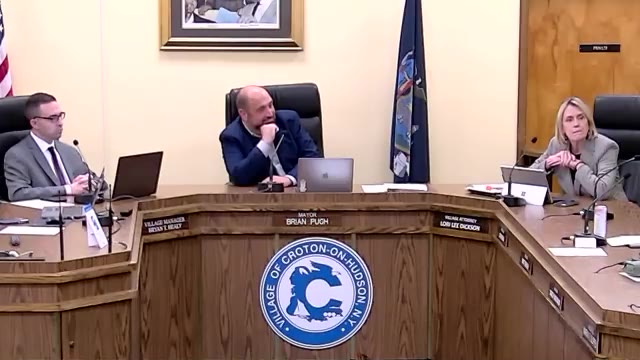
Village officials discuss the animal-law proposal at the October 28 work session. Watch this moment
Village Manager Bryan Healy pressed the board to settle the parts it could agree on. Trustee Maria Slippen questioned making rules for the entire village around a dispute between neighbors. Newly seated Trustee Matt Berger questioned the flight restriction itself. And Village Attorney Lori Lee Dickson warned that the proposed compromise might not accomplish what its authors intended.
“It's entirely possible that as laypeople, what we've added as potential mitigation is not effective or appropriate,” Dickson said.Read 115:20▶
The village is seeking advice from Cornell on whether it is humane to restrict flighted birds from flying. Healy said he had contacted Cornell repeatedly but had not received a callback by the meeting. No expert answer was presented.
For the keeper, the distinction between keeping birds and flying them is the heart of the dispute. He told trustees on August 19 that he releases his pigeons once a day for one or two hours of training. He described a hobby dating to childhood and a connection to his late father. The new draft offers a way to keep the flock, but not that routine.
*Berger questions grounding the birds*
Berger began by disclosing that he had signed a petition asking the board to revisit the animal proposal and had served on the Zoning Board of Appeals when a related fowl question came before it. He said neither would interfere with his work as a trustee.
His first concern was whether restricting flighted birds from flying would be humane. Later, he described pigeonkeeping as an interesting hobby in a world increasingly spent on screens: “it's something that's very physical rather than being on your phone.”Read 85:44▶ He suggested considering its educational possibilities rather than treating it only as a problem to prohibit.
Berger also asked whether, if the birds were allowed to fly, some kind of registration system could establish that they were healthy. That was a suggestion, not a new requirement. Dickson recalled the keeper’s testimony about veterinary care but said she could not independently confirm it.
Trustee Stacey Nachtaler approached the same problem from both directions. She said she was not prepared to move the proposal forward without more discussion about whether its grandfathering conditions were cruel. She also emphasized neighbors’ complaints about noise, droppings and birds lingering on other properties.
Nachtaler brought a possible alternative: New Castle’s pigeon rules. Those allow certain existing flocks to remain and permit limited releases for exercise, training and competition. They also prohibit pigeons from perching or lingering on other people’s property.
The distinction matters. New Castle’s code combines grandfathering with rules for flying and controlling the birds. Croton’s proposed grandfathering would prohibit exercise and training flights from the place of confinement. Trustees discussed the New Castle approach but did not adopt it.
*A neighbor dispute becomes a villagewide law*
Slippen’s objection was broader than the flight clause. The board was trying to update rules for animals throughout Croton while one pigeon dispute dominated the discussion.
She described both neighbors as suffering in different ways and said the village should find a way to help them without allowing that situation to determine every other part of the law. The board was making a legislative decision for 8,000 residents, she said, while focusing on “one micro situation in the village.”Read 96:15▶
“I couldn't possibly cast a vote one way or the other even to just move this forward at this point,” Slippen said.Read 97:34▶
Healy urged decisions. The discussion had lasted months, he said; another animal issue could arise while the village was still debating this one.
“I think we should try to get as much of this law passed as we can,” he said.Read 97:49▶
Healy said the staff and attorney could research options, but could not make the board’s policy choices for it. He also characterized the underlying dispute as a civil matter between neighbors, saying no village law was being broken and the village was not their mediator.
That did not settle the question. Nachtaler argued that the village had already been involved through the advice and zoning process that brought the dispute to this point, and asked whether its resources could help with mitigation. Slippen remained uncomfortable advancing the law around this particular conflict.
Dickson warned of a drafting trap: under her reading of the proposal, allowing chickens and ducks while deleting the pigeon provision could still leave other outdoor birds excluded. Healy pointed to the broader definition of domestic animals and offered a different reading.
Healy suggested deleting the disputed provisions and moving ahead with the rest. Mayor Brian Pugh resisted that route: waiting for Cornell might take less time than rewriting the law and getting it adopted. The board left the proposal on hold.
“I don't think anyone thinks it's ready for public hearing,” Pugh said.Read 106:27▶
*Who would decide who gets to keep a flock?*
Even the grandfathering process remained unsettled.
The current draft would prohibit keeping fully flighted birds, expressly including pigeons, outside residential dwellings in residence districts beginning January 1, 2027. An existing keeper could apply to the Zoning Board of Appeals for an exception, with a public hearing and written decision. Approval would not be automatic.
Even an approval could not permit an increase in the flock or “flight-based exercise or training from the place of confinement.” The enclosure would have to satisfy the zoning chapter’s minimum setbacks for accessory buildings. January 1 is the proposed start of that outdoor-keeping prohibition; the draft’s general effective-date clause is filing with the Secretary of State. None of this has been enacted.
Berger questioned sending grandfathering decisions to another board rather than having trustees handle them. Pugh strongly opposed bringing individual applications to the Board of Trustees. Trustees set policy, he argued, while land-use boards apply it. Making grandfathered birds the exception would reverse that division of responsibilities.
Deputy Mayor Len Simon did not participate in the animal-law discussion. He announced his recusal and left the dais before it began. Simon had taken part in the earlier debate, disclosed a nearby personal connection in May and pressed against grandfathering in July before announcing his recusal in September. That history is documented in our detailed story and timeline.
*Flying is part of the care routine*
The welfare question is not peculiar to this one flock. Published care guides treat exercise flights as a normal part of keeping racing and flying pigeons.
The Royal Pigeon Racing Association’s beginner guide recommends starting with six to ten birds in a small loft and introducing outdoor exercise once a day, then twice a day. The National Birmingham Roller Club describes flying rollers once daily as usual practice, with exceptions for illness, predators and extreme temperatures.
Australia’s national poultry-welfare guidelines recommend daily opportunities for racing pigeons to fly and planned free-flight exercise for at least 30 minutes a day during pre-training and racing. Those are care recommendations, not New York law or an expert assessment of this particular flock.
Near the end of Wednesday’s discussion, Pugh separated health concerns from nuisance complaints.
“I think that the public health question has more or less been resolved,” he said.Read 115:10▶ Noise, droppings and how to manage them remained in dispute.
New York City’s Health Department describes pigeon-related diseases as rare and routine cleanup as posing no serious health risk for most people. Large accumulations and people with weakened immune systems warrant additional precautions. That guidance does not establish the condition of any individual property.
The board’s remaining question is how to address nuisance concerns without making its promise of grandfathering hollow. Wednesday’s discussion produced neither a ban nor a right to keep flying. It established that trustees were not prepared to proceed with the restriction as written.
*The petitions and the complete record*
Both petition statements remain available: the petition letter dated May 29 and the Petition in Support of Responsible Pigeon Keeping in Croton. These copies reproduce the statements without signers’ names, signatures or addresses.
Croton News’ publisher helped create the petition supporting responsible pigeon keeping.
*What can you do?*
Watch the October 28 work session; the animal-law discussion begins about 1:16:29 into the recording. No date for another public hearing was announced during that discussion.
You can contact the Board of Trustees about the flight restriction, grandfathering process and birds’ welfare.
For future meeting dates, changes to the proposal and opportunities to respond, sign up for Croton News’ pigeon-issue action updates. The list is just for this issue, requires email confirmation and lets you unsubscribe at any time.
Sign the petition on Polis.
*Further reading and background video*
Read our original meeting preview, preserved as published before the work session.
Watch the earlier pigeon explainer on YouTube. It covers the earlier debate, not the October 28 meeting.
Read the detailed story and timeline for the dispute’s history, Simon’s early role and recusal, and both petition statements.
Read the legal analysis for the drafting problems, ambiguities and legal questions in the proposal.
Documents and meetings behind this story
Every one of these is a
public record. Links go to original public records or our meeting pages.
Why it's hereThe detailed timeline documents earlier hearings, both petition statements, and Len Simon’s role and recusal.
▶
Key Actions & Decisions
●October 28 work session: further discussion of the proposed animal law.
●Existing bird owners could seek case-by-case grandfathering, with no flock expansion or releases from confinement for flight-based exercise or training.
●Proposed January 1, 2027 outdoor-bird prohibition remains unadopted.
Experimental project: croton.news uses AI to generate articles from public records. Content may contain errors. Please report any inaccuracies and check our corrections log.AI-assisted experimental site — may contain errors. Corrections
Community Discussion
Be the first to comment on this story.
Sent to the editor for review
This is what you asked us to forward to the Village Board:
An editor reads it first. Once it goes, your comment here will show a ✓ Forwarded to the Village Board mark — that is your confirmation.