Croton-on-Hudson, NY · Sunday, October 11, 2026· Oct 11, 2026Independent, AI-assisted local reporting from public recordsSource-linked·Corrections welcomed
Trustee candidates differ on transparency, housing growth and camera privacy
At the October 8 LWV forum, Mary Lynn Dlabola, Len Simon and Maria Slippen offered different approaches to public trust, development and license plate reader privacy. All three answered residents’ questions about affordability, infrastructure and village services.
Croton’s three village trustee candidates offered different answers to questions about public trust, housing growth and camera privacy at the October 8 League of Women Voters forum. Mary Lynn Dlabola called for more openness and an assessment of development’s cumulative impacts; Len Simon defended the village’s record while acknowledging room to improve; Maria Slippen emphasized stronger communication and a clearer understanding of how decisions and technology affect residents.
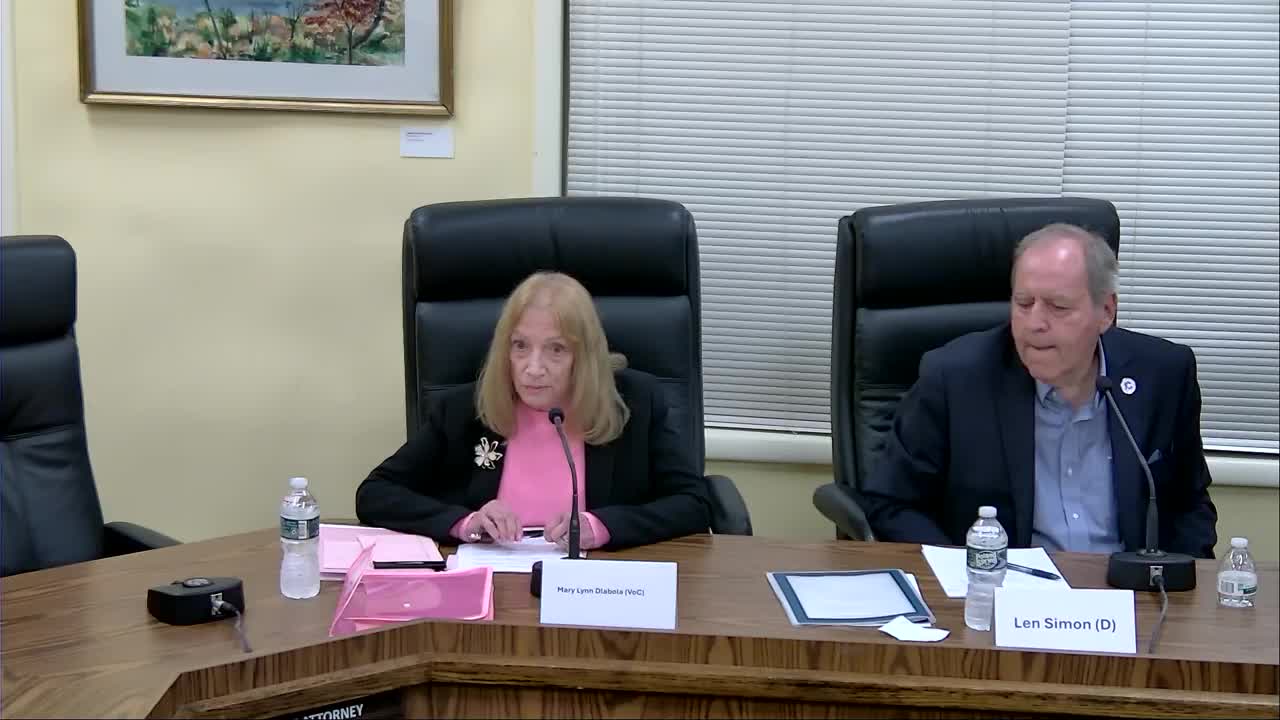
Mary Lynn Dlabola answers a question about accountability at the October 8 LWV forum, with Len Simon seated beside her. Watch this moment
Dlabola, running on the Voice of Croton line, joined Democratic incumbents Simon and Slippen for the forum hosted by the League of Women Voters of Northwest Westchester. Moderator Susan Weisfeld posed questions submitted by residents before the event. The candidates’ answers described their positions and proposals; this was a campaign forum, not a board meeting adopting policy.
Asked how to restore public confidence, Simon disputed the question’s premise but said the board should improve when it falls short. Simon said: “we can always do better.” Read 21:07▶ He welcomed criticism while defending the quality of village services.
Dlabola argued that the village needs to be more accountable and open with residents. Dlabola said: “We need to be open and honest with our constituents. They need... They have a right to know what's going on in the government.” Read 23:04▶ Her emphasis was on giving residents a meaningful opportunity to be heard before decisions.
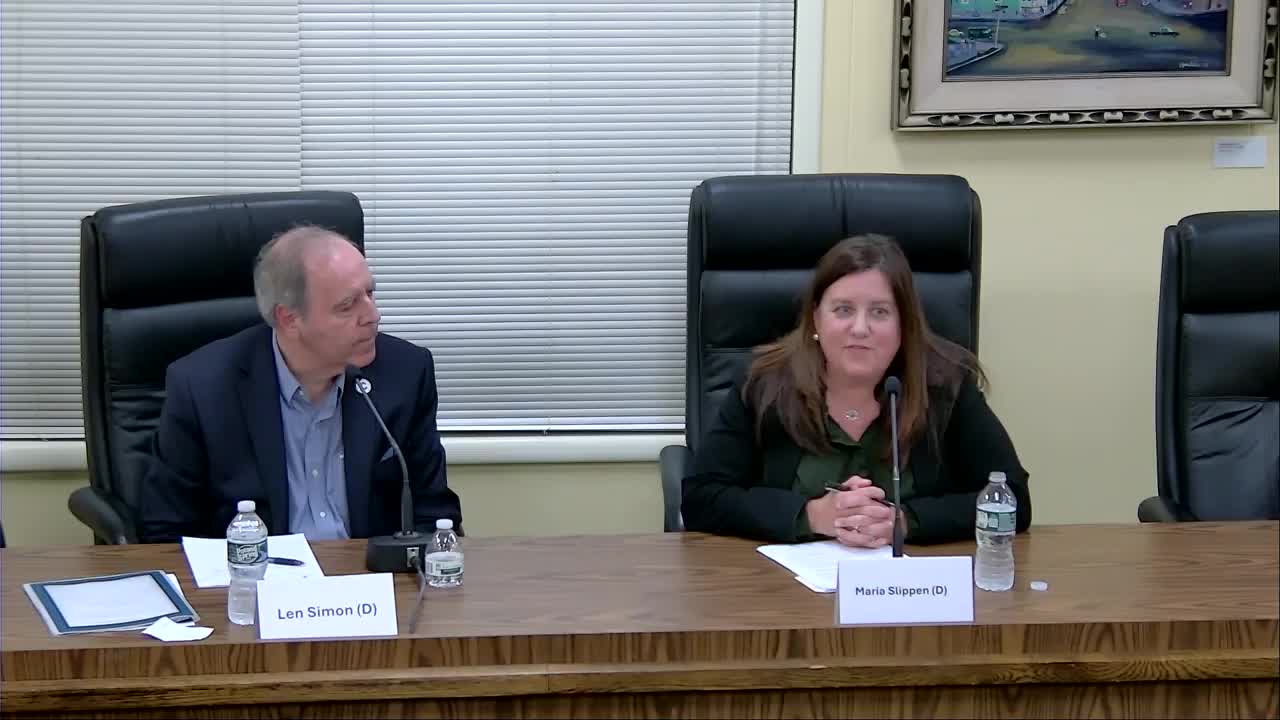
Slippen proposed that trustees work with the attorney on a written policy to share information and rebuild trust within the board. Slippen said: “I have found that if we work together on a statement and write it down and commit to it, that's gonna help us move forward.” Read 19:25▶ On communicating with the public, she put responsibility on trustees and staff, citing the website, Facebook, newsletters and other channels. Simon encouraged residents to contact officials, attend meetings and volunteer on committees.
Maria Slippen discusses public trust at the October 8 LWV forum, with Len Simon seated beside her. Watch this moment
On housing, Simon opposed a moratorium and pointed to the village’s 1% growth policy as a better guide. Simon said: “I don't support a moratorium. In fact, I I think the 1% that we've adopted is, is much better than a moratorium.” Read 36:47▶ Slippen also opposed a moratorium, arguing that proposals should withstand scrutiny and that the village must be willing to reject unsuitable projects. Slippen said: “good projects survive scrutiny.” Read 33:17▶ She highlighted the planner’s role in evaluating proposals, including 425 South Riverside Avenue.
Dlabola did not commit to a moratorium, instead urging an assessment of completed developments before further expansion. Dlabola said: “I don't know that we need a moratorium. I think we need to just be more cautious going forward.” Read 35:54▶ She supported affordable homeownership while raising concerns about how condominium taxation could affect single-family homeowners.
The candidates also approached accessory dwelling units through different kinds of review. Asked about the cap on accessory dwelling units, Dlabola wanted more information about their effects before choosing a limit. Slippen called for neighborhood-specific analysis and clearer criteria to assess capacity. Simon said an expansion should remain possible after reviewing the law’s effects; he disputed the suggestion that approvals were already close to the 50-unit cap.
On developer costs, Simon described escrow-funded technical review and negotiations over infrastructure and amenities. Slippen wanted the village to compare completed projects with its earlier predictions. Dlabola argued that residents’ requests, including interest in a community center, deserve more weight.
Camera privacy brought another clear difference: Simon defended the license plate readers, describing the system as closed and stressing their crime-solving value, while calling for continued scrutiny. Simon said: “I think we need constant vigilance on whether there could be any crack in the system.” Read 58:09▶ Slippen supported giving police useful tools but said the board needs to better understand contracts and data handling before settling on a policy. Slippen said: “I'm not really policy ready on this one.” Read 61:11▶ Dlabola called for a privacy policy and expressed concern about a private company holding data. Dlabola said: “I'd feel much better if it was, for example, with the county or something like that.” Read 62:27▶
Dlabola said a cannabis-shop cap would probably be a good idea, while acknowledging uncertainty about the village’s authority. Simon said he was not eager for more than one shop. Slippen emphasized thoughtful zoning, locations and how new businesses fit Croton.
On gas-powered leaf blowers, Simon favored strengthening the existing restrictions. Slippen wanted to respect the Conservation Advisory Council’s review and recommendation. Dlabola said she personally dislikes leaf blowers and is interested in the review’s findings.
On affordability, Simon emphasized low tax growth and revenue from village assets. Slippen pointed to controlling village expenses, supporting local assistance organizations and working with legislators. Dlabola cautioned that broader economic forces limit the relief village government can provide.
Asked about uneven enforcement, Simon described rewriting the sign law after earlier problems. Slippen said the sign dispute had been handled poorly and stressed acknowledging mistakes. Dlabola emphasized transparency and avoiding the appearance of impropriety.
For infrastructure, Simon prioritized public safety, roads, sidewalks, water and sewer work. Slippen wanted a more regular channel for departments to alert trustees to needs, citing residents’ discolored-water complaints. Dlabola also raised water complaints while expressing confidence in public works staff.
On bicycle and pedestrian safety, Slippen urged a broader conversation about sharing roads. Dlabola suggested safety courses, age restrictions and possibly insurance for some motorized vehicles. Simon highlighted training and the bicycle-pedestrian committee’s work, while allowing that some additional regulation may make sense.
The full forum recording and timestamped transcript let voters compare the answers in context. The League’s voter information page provides election and forum information.
Share
Community Discussion
0 comments
One email per new comment on this story. You'll confirm by email first; unsubscribe any time. Your address is never shown publicly.
Be the first to comment on this story.
Sent to the editor for review
This is what you asked us to forward to the Village Board:
An editor reads it first. Once it goes, your comment here
will show a ✓ Forwarded to the Village Board mark —
that is your confirmation.
Coverage of the LWV Candidates Forum meeting on 2026-10-08,
Village of Croton-on-Hudson, NY.
· Read full transcript
Why it's hereBackground on the assistant village manager position discussed in the candidates’ answers about communication and staff.
▶
Key Actions & Decisions
●Establishes the Assistant Village Manager position in Village Code § 31-2.
●Allows the village manager to appoint the assistant and assign duties.
●Requires the assistant to act during the manager’s absence, disability or a vacancy; trustees designate a qualified full-time Village employee if there is no assistant.
●Filed and effective September 25, 2026.
Westchester Was Scheduled to Seek Dismissal of Plate-Reader Lawsuit on September 11
Why it's hereEarlier coverage of the plate-reader lawsuit provides context for the candidates’ privacy questions.
▶
Key Actions & Decisions
●A September 3 court order set September 11 for the county’s planned dismissal motion, October 26 for opposition, November 25 for reply and December 2 as the return date; whether the motion was filed on September 11 is not yet reported here.
●January PAC minutes and the August 19 police presentation describe different safeguards; the records do not establish a policy change.
●Rekor’s August 31 proposed national standard calls for warrant- or court-order-controlled re-identification of protected non-hotlist data; it does not establish Westchester’s current practices.
Croton narrows where cannabis shops could open, creates assistant village manager post
Why it's hereEarlier trustees coverage follows the cannabis zoning and staffing issues discussed at the forum.
▶
Key Actions & Decisions
●Adopted Local Law Introductory No. 15 of 2026, which becomes Local Law No. 12 of 2026, amending Chapter 31 of the Village Code to create the position of assistant village manager
●Directed the village attorney to draft cannabis zoning allowing dispensaries as a special permit use in C-2 outside the gateway overlays, C-1RA, the light industrial district and the North End Gateway
●Directed that the local draft include a 1,000-foot minimum separation between dispensaries and a 500-foot buffer around public youth facilities
●Deferred extending the same siting rules to direct-to-customer alcohol and tobacco sales pending a legal review of state preemption
●Approved a warrant of $270,866.03 across the general, water, sewer, capital and trust funds
Croton Sign Rewrite Nears a Public Hearing, With Deadlines for Signs Already Up
Why it's hereEarlier coverage follows the sign-law rewrite the candidates discussed when asked about fair enforcement.
▶
Key Actions & Decisions
●Completed a second review of Local Law Introductory No. 7 of 2026, the sign code rewrite, with one change requested: striking the word "harmonious" from the design standards.
●Directed the village manager to bring the sign law back on Sept. 30 to set a public hearing, which he expects to be held Oct. 21.
●Voted to move the public hearing on Local Law Introductory No. 14 of 2026, the waterfront revitalization consistency amendment, from Sept. 23 to Sept. 30 at 7 p.m.
●Agreed to have a local law drafted adopting the state's now-optional property tax exemption for veterans with 100% service-connected disabilities.
●Agreed the proposal at 425 South Riverside should come out of the village's New York Forward materials because it is not zoning compliant.
Croton trustees approve police study as Lounsbury resident presses water fix
Why it's hereCoverage of the September 30 trustees meeting follows the water complaints and public safety work raised in the forum.
▶
Key Actions & Decisions
●Approved a $57,750 police staffing and operations study, without approving staffing changes.
●Approved a Route 129 resolution urging state tree work and pavement rehabilitation; no state construction date was announced.
●Authorized a 2025–26 budget amendment using $500,000 in water-fund balance for Lounsbury Road relining while county plan approval remains pending.
●Closed the Local Law 14 waterfront hearing without voting on the law; voted to accept 21 Cook Lane and authorized the manager to execute transfer documents.
●Set October 21 hearings on sign and site-plan proposals and referred a proposed cannabis-dispensary law for review; none was adopted.
Experimental project: croton.news uses AI to generate articles from public records. Content may contain errors. Please report any inaccuracies and check our corrections log.AI-assisted experimental site — may contain errors. Corrections
Community Discussion
Be the first to comment on this story.
Sent to the editor for review
This is what you asked us to forward to the Village Board:
An editor reads it first. Once it goes, your comment here will show a ✓ Forwarded to the Village Board mark — that is your confirmation.