Croton-on-Hudson, NY · Friday, October 16, 2026· Oct 16, 2026Independent, AI-assisted local reporting from public recordsSource-linked·Corrections welcomed
◆Authorized the village manager to reject all bids under Bid No. 22-2025 for HVAC trade labor so the changed scope of work can be re-bid
◆Reached consensus to raise the income limit for senior citizen and disability rent increase exemptions in the village's five ETPA buildings, with a public hearing expected to be called Aug. 19
◆Reviewed code amendments preserving local environmental review after state SEQR exemptions; referrals to the Planning Board, WAC and county planning expected at the Aug. 19 meeting
◆Village manager to meet with the planner and village attorney on a zone-based approach to cannabis dispensary locations
◆Agreed to add an "animal-related uses, general" category to commercial zoning districts while leaving kennels unlisted, and therefore prohibited without a zoning amendment
◆Appointed Carolyn Whiting chair of the reconstituted ad hoc HEART Committee, reappointed its members, and reappointed Whiting to the Police Advisory Committee
The Board of Trustees spent its July 22 work session assembling the village's answer to a sweeping state rollback of environmental review — a package of zoning amendments meant to keep local scrutiny of development intact — while sketching out where cannabis dispensaries could eventually operate and moving to expand rent relief for lower-income senior and disabled tenants.
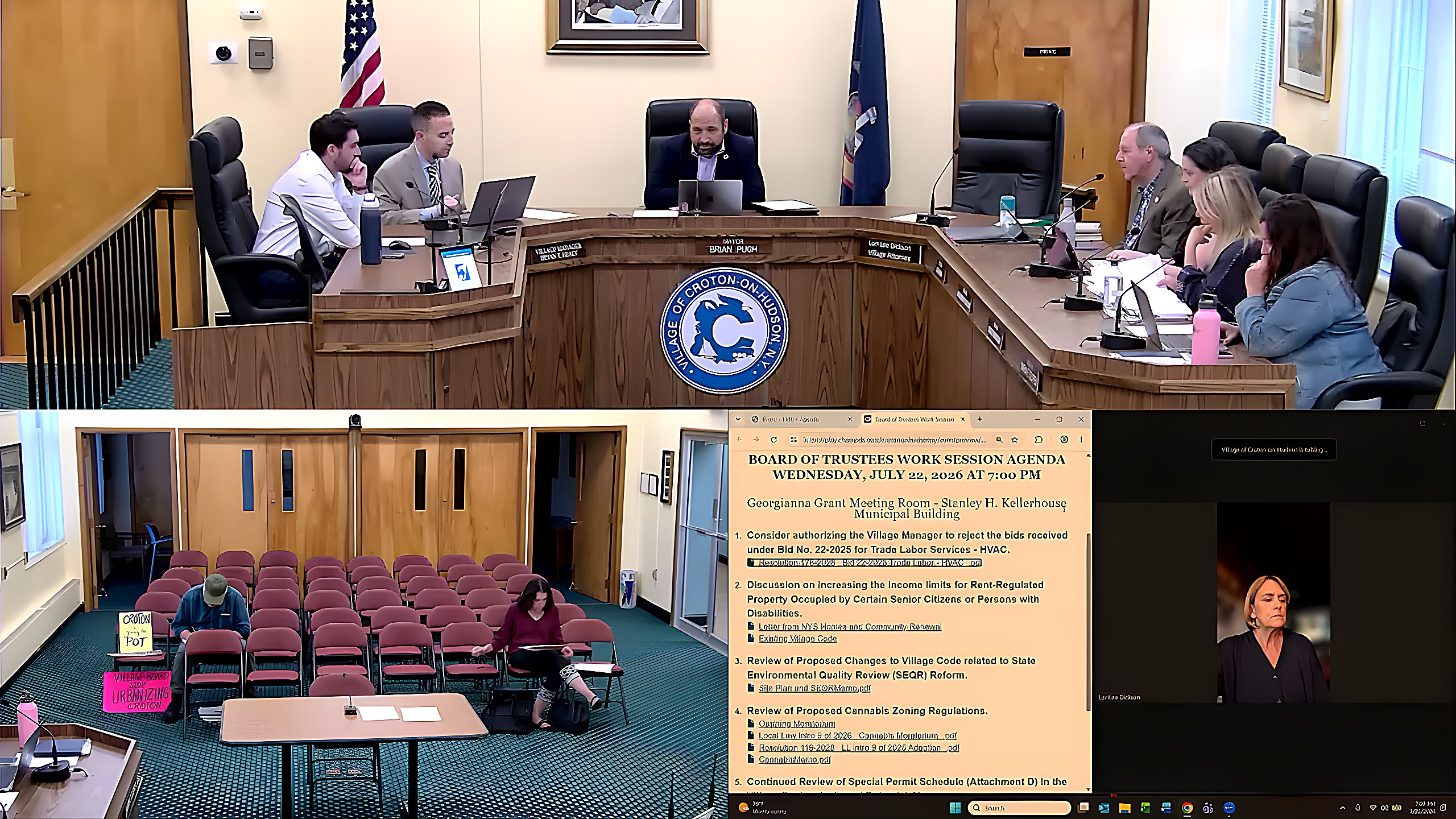
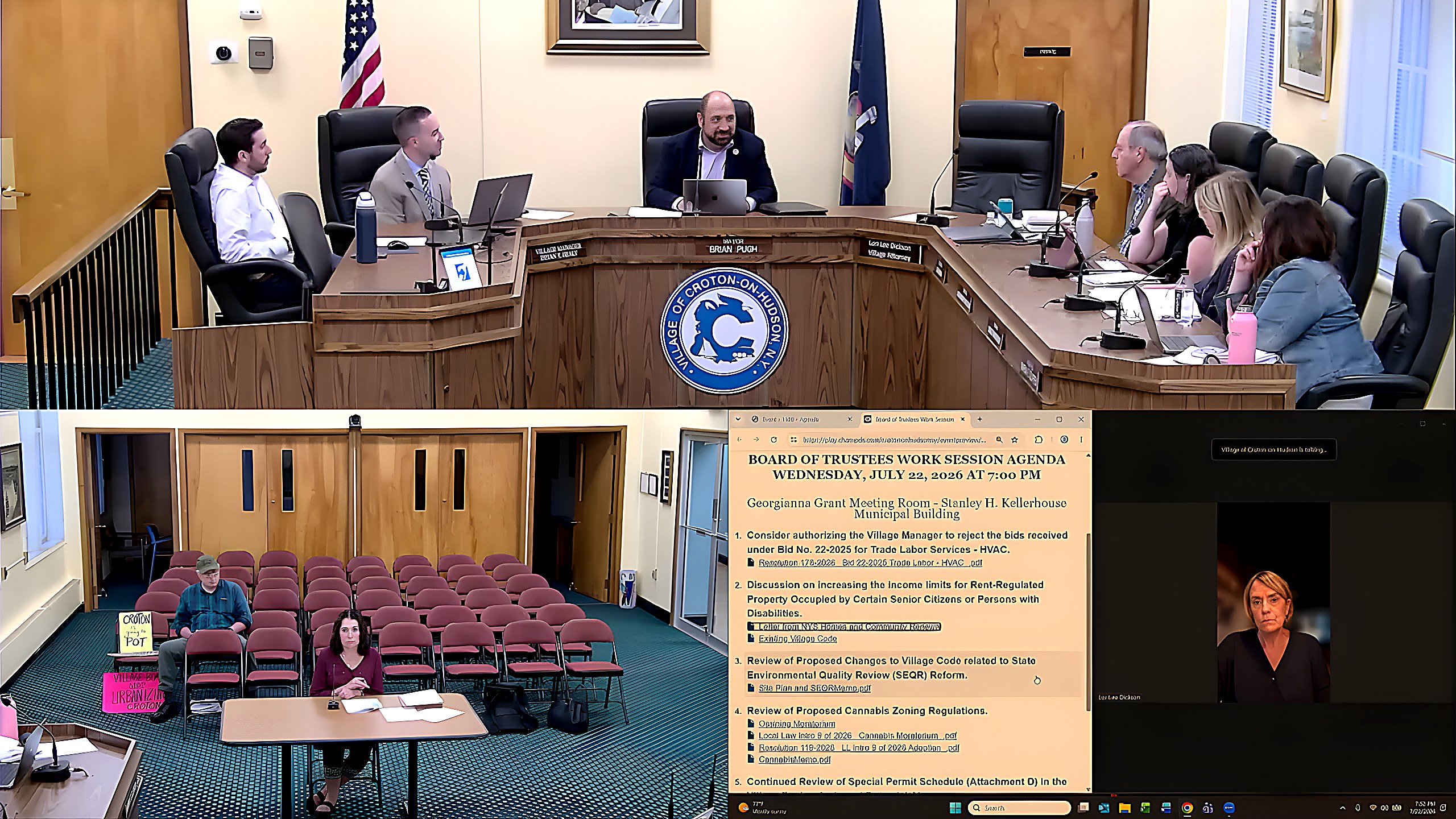
Mayor Brian Pugh during the Board of Trustees Work Session meeting.
New York's newly adopted state budget amended the Environmental Conservation Law to create "qualifying actions," categories of projects that no longer require review under the State Environmental Quality Review Act, known as SEQR. Valerie Monastra, the village's planning consultant, told the board the change that hits closest to home exempts residential developments of 300 dwelling units or fewer in census-defined urban areas — a definition that includes Croton — when they are connected to public water or sewer and sit on previously disturbed sites. "That definition of previously disturbed site is very, very flexible," Read 15:19▶ Monastra said: any property improved two or more years ago counts, which covers most parcels in the village.
Because the state exemptions do not override local laws, Monastra recommended writing the substance of that review directly into the village's own site plan regulations. Her proposed amendments would add references to the comprehensive plan and Local Waterfront Revitalization Program; review criteria for historic and archaeological resources and the village's critical environmental area; school, police, fire, EMS and fiscal impact analyses at the Planning Board's request; a complete streets policy; checks for threatened and endangered species; disclosure of hazardous-waste remediation; energy-use information; construction phasing plans; and a tree removal plan among required submissions.
The board settled two details on the spot. Referrals to the Waterfront Advisory Committee, currently tied to a project's SEQR classification, would instead be triggered automatically by any special permit application or by projects of about six units or more — with Mayor Brian Pugh suggesting the unit count be converted to an equivalent square footage — an apartment-unit size multiplied by six, with staff to pin down the exact figure — so the threshold applies no matter how a building mixes its uses. The board also expanded what a traffic study, when the Planning Board requests one, must take into account: Trustee Stacey Nachtaler asked that major events be considered, and Village Manager Bryan Healy added high-traffic facilities such as a property next to the train station.
The zoning amendments themselves must — "somewhat ironically," Healy noted — go through SEQR review. Healy outlined the path: referral to the Planning Board, the Waterfront Advisory Committee and the county planning board at the board's Aug. 19 meeting, followed by a public hearing. The village attorney is scheduled to brief the Planning Board on the state changes next week, Healy said.
The presentation detoured into the evening's most animated debate when Nachtaler argued the moment calls for stronger tree protections. Local Law 13 of 2025 significantly strengthened the village's tree regulations, she said, but with some housing projects now facing less environmental review, she wants Croton to consider regulating large-scale clearing rather than only individual removals. "The amount of clear cutting has been significant and shocking to residents in certain instances," Read 38:23▶ she said.
Healy responded that the code already reaches much of that conduct: taking down three or more trees in a year requires a permit, replacements must carry 90 percent of the removed tree's value — or the owner pays into a tree fund the village uses to plant trees — and, as came up later in the session, clearing involving 20 percent or more of a property goes to the Planning Board as a minor site plan. Trustee Nora Nicholson added that the incidents residents remember most either predate the tree law or disregarded the rules in effect at the time.
Trustee Maria Slippen said part of the problem resists codification: a neighbor's fully lawful clearing, replaced with saplings of equal appraised value, still transforms a neighborhood. "There is an emotional value to the way our neighborhoods look and feel right now," Read 53:35▶ she said.
Village Manager Bryan Healy and Mayor Brian Pugh during the work session discussion of tree regulations.
Pugh said he has no issue with revisiting the tree law but proposed tabling that conversation while the SEQR changes proceed, with staff following up — including talking with the village's new engineer about protecting tree root zones. Village Attorney Lori Lee Dickson cautioned that aggressive restrictions could raise constitutional questions, pointing to recent U.S. Supreme Court decisions on exactions: "We'd have to tread very lightly in this direction." Read 48:55▶
Nachtaler also questioned why minor site plans — a category that includes clearing 20 percent of a site, larger pools and retaining walls over six feet — carry no mailed notice to neighbors. Healy said notice still runs through published agendas and the newspaper, and that mailings would add to the workload of the Planning Board and engineering department; he said he had favored making applicants pay for mailings, an idea the board previously did not adopt.
On cannabis, a recently enacted moratorium on processing dispensary applications gives the village time to write rules within tight state limits. Monastra laid out the state's rules: dispensaries must be at least 200 feet from a house of worship on the same road and 500 feet from a school, they cannot operate between 2 a.m. and 8 a.m., and no local rule may restrict them to fewer than 70 operating hours a week unless the operator agrees to fewer — leaving municipalities mainly hours, parking, traffic, odor, noise and historic-district aesthetics to regulate. Nachtaler called the 70-hour floor outrageous: "We have businesses that are open less than seventy hours a week in the village right now." Read 85:48▶ The draft regulations propose hours of 9:30 a.m. to 9 p.m., which Monastra said were picked to match hours the Planning Board previously approved — but Nachtaler said she would support only the state minimum, and Slippen predicted "the market's gonna dictate" Read 89:27▶ when the store is actually open.
On location, which Pugh said generates more concern than hours based on what he heard at a Planning Board meeting, Healy offered his suggestion: the O-1 zone. Pugh, identifying those parcels as the Hilbert Building and the North Riverside parcels, proposed formalizing the idea as a defined overlay, possibly extended by drawing in southern commercial areas. "I don't think anyone could say it's an unreasonable location," Read 97:14▶ the mayor said.
Monastra and Dickson both urged care. Monastra noted recent court challenges, particularly on Long Island, where a community's restrictive cannabis zoning was overturned. Dickson said the governing standard bars rules that make dispensary siting "unreasonably impracticable" — a vague test applied in the sole discretion of the state's cannabis regulators — and that any local law must be sent to the Office of Cannabis Management, which issues an opinion; the village, she said, could build a record justifying limits to particular zones. Pugh noted the village was an original opt-in community with an approved dispensary already, and that the moratorium protects the village while it works. Healy said he will set up a meeting with Monastra and Dickson and come back with what could potentially work.
The board also reached consensus on raising the income ceiling for the village's senior citizen and disability rent increase exemptions, which shield qualifying tenants in Croton's five buildings regulated under the Emergency Tenant Protection Act from rent increases, with the village paying landlords the difference. The current limit is an income under $50,000 a year; Trustee Len Simon endorsed taking it "up to 75," calling the change worth doing given inflation. Healy said about 131 units are covered, that tenants apply through New York State Homes and Community Renewal every two years, and that the program drew no applications last year and two approvals the year before, at a cost of about $2,000.
Slippen pressed for outreach so eligible tenants actually use the program: "I just want people who should be taking advantage of this to know about it," Read 5:38▶ she said. The small number of covered units makes a direct mailing practical, Healy said, and he sketched a timeline: a draft local law at the next meeting, a public hearing called Aug. 19 and potentially held at the first September meeting, then adoption and a state filing — effective as soon as early October. Nicholson suggested contacting the buildings' landlords beforehand so they understand the change would not affect them financially, and noted that this year the county's rent guidelines board allowed increases of 3.5 percent on one-year renewals and 4.5 percent on two-year renewals.
In the session's first vote, the board authorized Healy to reject all bids received under Bid No. 22-2025 for HVAC trade labor services. Six bids arrived by the January deadline, three covering HVAC, but as the resolution Healy read put it, the scope of work has changed, "necessitating a new bid to be undertaken." Read 0:18▶ Nicholson moved the authorization and Simon seconded it.
The board also agreed to replace "animal hospitals" in the zoning schedule of uses with a broader "animal-related uses, general" category, which Monastra said would cover animal hospitals to pet stores. More intensive uses such as kennels were deliberately left off the schedule. "The general rule is if it's not specifically permitted somewhere, it's prohibited," Read 109:54▶ Dickson explained — so a would-be kennel operator would have to come in with a zoning amendment, Healy noted.
At the close, on a motion by Slippen seconded by Simon, the board appointed Carolyn Whiting to chair the HEART Committee — Help, Exemplify, Aid, Respect, Teach — newly reconstituted as an ad hoc committee, reappointed its current members, and reappointed Whiting to the Police Advisory Committee.
Attachments from the meeting packet, grouped by agenda item — each links to a searchable text page and the village's original PDF.
Full meeting record with summaries →
Consider authorizing the Village Manager to reject the bids received under Bid No. 22-2025 for Trade Labor Services - HVAC.
Experimental project: croton.news uses AI to generate articles from public records. Content may contain errors. Please report any inaccuracies and check our corrections log.AI-assisted experimental site — may contain errors. Corrections