Croton-on-Hudson, NY · Friday, October 23, 2026· Oct 23, 2026Independent, AI-assisted local reporting from public recordsSource-linked·Corrections welcomed
Croton-Harmon opens school with tighter device limits and new phone procedures
Croton-Harmon began the school year with tighter classroom-device limits and revised high-school phone procedures. September 3 reports offered early impressions, while a new advisory committee will examine technology and learning.
Croton-Harmon has begun its 2026-27 technology reset, combining tighter limits on classroom devices with revised procedures for phones at the high school. The first public reports describe teachers and students adjusting to the changes; they do not yet establish their effect on learning.
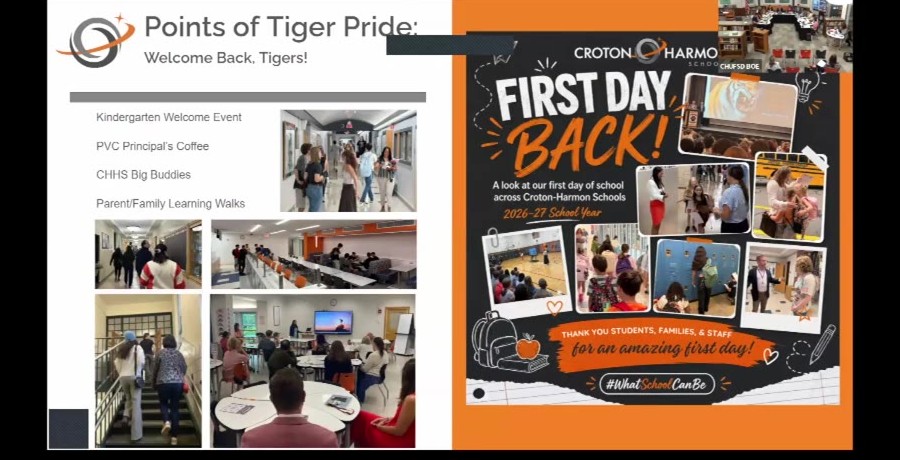
At the September 3 Board of Education meeting, the superintendent's report described classroom visits during the first three days of school and a smooth transition by teachers. The board's two new student trustees ex officio, Nicky Mukherjee and Madeline Kramer, gave their first reports. One described mixed student feelings about the restrictions. The other described the technology reset as successful so far. These were early impressions, offered during the opening week. September 3 meetingA district presentation at the September 3 school-board meeting highlights the first day of school. Watch this moment
The first student representative said: “On one hand, many students are excited about putting their phones away as they won't be inclined to check them in class and ultimately get distracted.” Read 18:48▶
The same student also reported the other response: “Of course, there are some that are upset at the fact that they won't be able to use their phone or electronic device in any school area during the school day.” Read 18:54▶
The district's August 28 update sets especially narrow rules for kindergarten through second grade: iPads are reserved for the required STAR assessments three times a year and occasional projects approved by school and district administrators. In grades three and four, devices move away from student desks into classroom storage, with access for structured, teacher-led activities requiring digital tools. At the high school, teachers are to begin and end instructional blocks without students on devices and avoid video lessons for initial teaching. District technology communications
Some middle-school arrangements continue practices begun in 2025-26. The August 27 presentation identifies fifth-grade devices staying at school, sixth-grade devices staying over weekends, and devices remaining at school during breaks. The reset also changes lab-period use: online work is to reflect individual student needs instead of a standard time requirement. The district's June communication says families may request device access for academic work at home through a school administrator. August 27 presentation item and attachment
The high-school implementation plan presented August 27 calls for students to place phones in classroom storage for the entire period and keep them off and put away during free periods and community lunch. The revised consequence sequence begins with a verbal warning and parent contact. A second offense sends the phone in an envelope to the main office until the end of the day; a third requires parent pickup. Persistent violations can lead to morning check-in at the office. Phone implementation presentation item and attachment
The underlying personal-device policy remains distinct from rules for instructional technology. Policy 5695, revised in August 2025, includes exceptions for specified educational uses, medical needs, emergencies and required accommodations. District-supplied educational devices are treated separately from personal internet-enabled devices. Parents seeking to reach a child during the day can contact the school's main office. Policy 5695
On September 3, the board also voted 6-0 to create a Community Advisory Committee on Technology to assess the role of technology in learning. Its charge includes grade-band guidance, responsible use, artificial intelligence and student privacy. The resolution asks the committee to distinguish student engagement from demonstrated learning when evaluating technology. The committee will advise the board and superintendent; it cannot set policy or direct district staff. Its final written recommendations are due by June 10, 2027. Committee resolution and recorded vote
The preceding ad hoc committee's report drew on a summer survey with 182 respondents, 155 of whom identified as parents or guardians, plus two listening sessions. Respondents could select more than one role. This material describes concerns and priorities gathered before the school-year rollout, rather than results of the new rules. September 3 Board Reports item and attached committee report
This report draws on the August 27 presentation, the September 3 meeting and opening-week observations. The board vote and student trustees' remarks also appear in the district's posted September 3 minutes.
Correction (October 2): An earlier version described the September 3 minutes as a draft. The current posted copy carries no draft label; the article has been updated.
Share
Community Discussion
0 comments
One email per new comment on this story. You'll confirm by email first; unsubscribe any time. Your address is never shown publicly.
Be the first to comment on this story.
Sent to the editor for review
This is what you asked us to forward to the Village Board:
An editor reads it first. Once it goes, your comment here
will show a ✓ Forwarded to the Village Board mark —
that is your confirmation.
●A September 3 court order set September 11 for the county’s planned dismissal motion, October 26 for opposition, November 25 for reply and December 2 as the return date; whether the motion was filed on September 11 is not yet reported here.
●January PAC minutes and the August 19 police presentation describe different safeguards; the records do not establish a policy change.
●Rekor’s August 31 proposed national standard calls for warrant- or court-order-controlled re-identification of protected non-hotlist data; it does not establish Westchester’s current practices.
Croton requires paper notice of street and sidewalk defects
●Local Law 7 of 2026 adopted 5-0 on June 17 (Resolution #118-2026); effective on state filing July 14
●The local law requires paper notice to the Village Clerk by hand delivery, certified mail or overnight service, with proof of delivery
●Email, the village website, report-an-issue apps, and village social media are expressly declared insufficient
●The public hearing drew no speakers; scheduling passed on the May 20 consent agenda without discussion
●The Calabrese ruling addressed Albany’s particular reporting system and notice statute; it did not establish that every electronic report in Croton previously qualified
Croton's rent-relief income limit rises to $75,000 as two local laws take effect
●Local Law 10 of 2026 amends Chapter 204, Taxation, raising the combined household income limit for the rent-regulated tax abatement under state Real Property Tax Law 467-b from $50,000 to $75,000.
●Local Law 11 of 2026 amends Chapter 197, Streets and Sidewalks, rewriting the list of sidewalks exempt from the duty to clear snow and ice: two stretches of Farrington Road added, Radnor Avenue dropped, the Old Post Road South stretch redescribed and shortened.
●Both were adopted 5-0 on September 2, filed September 8, and took effect on filing under Municipal Home Rule Law Section 27.
●Neither change has yet been folded into the chapter text published at croton.news/villagecode, which still shows the pre-amendment version.
●Still proposals, not law: Introductory Nos. 7, 10, 13, 14 and 15 of 2026.
Croton’s assistant village manager law took effect September 25
●Establishes the Assistant Village Manager position in Village Code § 31-2.
●Allows the village manager to appoint the assistant and assign duties.
●Requires the assistant to act during the manager’s absence, disability or a vacancy; trustees designate a qualified full-time Village employee if there is no assistant.
●Filed and effective September 25, 2026.
Camera case studies and a data-sharing contract shared Croton’s August 19 agenda
●Work session, 6 p.m.: discussion on the use of cameras by the Croton-on-Hudson Police Department; sole attachment is License Plate Reader Case Studies (January 2026)
●Neither the deck nor the packet contains a written camera policy, retention period, audit rule or list of agencies with query access
●Consent agenda, Resolution 187-2026: renew the RICI inter-municipal agreement with Westchester County
●The resolution authorizes a five-year renewal running November 1, 2026 to October 31, 2031; the agreement attached to it runs October 31, 2026 to July 31, 2029
●Westchester County's answer in the plate-reader class action is due August 31
Experimental project: croton.news uses AI to generate articles from public records. Content may contain errors. Please report any inaccuracies and check our corrections log.AI-assisted experimental site — may contain errors. Corrections
Community Discussion
Be the first to comment on this story.
Sent to the editor for review
This is what you asked us to forward to the Village Board:
An editor reads it first. Once it goes, your comment here will show a ✓ Forwarded to the Village Board mark — that is your confirmation.