Croton-on-Hudson, NY · Sunday, October 18, 2026· Oct 18, 2026Independent, AI-assisted local reporting from public recordsSource-linked·Corrections welcomed
◆Approved a Community Advisory Committee on Technology, with final recommendations due June 10, 2027.
◆Reviewed district goals and plans for regular public reporting on student achievement.
◆Approved instructional and support appointments, May and June financial reports, and August 27 minutes.
Croton-Harmon will put its use of classroom technology under a broader public review after the school board voted September 3 to create a Community Advisory Committee on Technology. The committee is charged with examining whether digital tools improve learning, how their use should differ by age and what safeguards students need.
The six board members voting supported the resolution. It follows a summer review by the board's smaller ad hoc committee and comes as schools begin implementing the district's technology reset. The new panel will advise the board and superintendent; it will not set policy, direct staff or make operational decisions. Resolution and recorded vote
Its charge goes beyond deciding how much time students spend on screens. The committee is to compare technology with available alternatives, distinguish student engagement from demonstrated learning and consider whether educational benefits justify collecting student data. Artificial intelligence, academic integrity, student well-being and the collection, sharing and retention of data are also part of the review.
Responding to a perception of tension between parents and teachers, a member of the ad hoc committee said: “This was a very collaborative process. We were working together with the administration on this. Teacher voice is an instrumental voice. Student voice is an instrumental voice.” Read 63:40▶
The board will select six community members through an application process, with up to three trustees serving as liaisons. Teachers, administrators and students will also be represented. The resolution calls for substantive work to begin no later than October 26 and a final written report by June 10, 2027. The committee will dissolve after completing its charge unless the board reauthorizes it.
The summer report that informed the resolution combined two listening sessions with a survey of 182 respondents. Of those respondents, 155 identified as parents or guardians; people could select more than one role. The report captures community priorities before the school-year rollout, not evidence of how the new classroom practices are working. Ad hoc committee report
The meeting offered some early impressions of that rollout. During the superintendent's report, classroom visits in the first three days of school were described as showing a smooth transition by teachers. A student representative reported mixed feelings among high-school students: some welcomed having phones put away to reduce distraction, while others disliked the restrictions. A second student representative described the reset as successful so far, while noting that there had been little new student feedback in the first few days. Those observations preceded any longer-term assessment of learning or student experience. Meeting recording
The first student representative said: “On one hand, many students are excited about putting their phones away as they won't be inclined to check them in class and ultimately get distracted.” Read 18:48▶
The same student also reported the other response: “Of course, there are some that are upset at the fact that they won't be able to use their phone or electronic device in any school area during the school day.” Read 18:54▶
A separate presentation laid out six district goals for 2026-27, covering community communication, curriculum consistency, mathematics, elementary and middle-school English language arts, college and career readiness, and public reporting of results. The board discussed the goals without a recorded adoption vote. District goals presentation
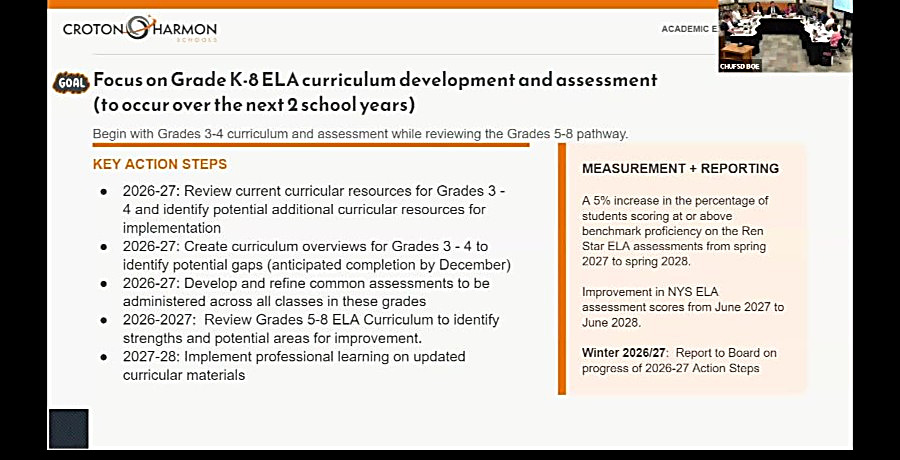
For families, the plans include learning walks at all three schools, town halls and surveys about district communication. Curriculum work would establish common assessments and student experiences while retaining teachers' choice of instructional approaches. In mathematics, the district plans to examine the first year of eighth-grade Algebra for All and adjust earlier grades' curriculum to prepare students for it. The English language arts review begins with grades three and four while examining the pathway through grades five to eight; that work extends into the following school year.
A school-board slide outlines plans for K–8 English language arts curriculum and assessment. Watch this moment
The reporting plan calls for public data updates three times a year and a comprehensive year-end report in July 2027. Presentations are to include strengths, outliers and areas for growth. The college and career readiness work would examine interdisciplinary courses, Advanced Placement and dual enrollment, including access to those courses and assessment results.
That framing drew a challenge during public comment. A resident urged the district to make noncollege career paths more visible in its goals.
The resident said: “not everybody in the school is gonna go to college. It's not a 100% of people that make it to college, make it all the way through college. We have to acknowledge that that's a reality and support it because those are also real jobs.” Read 120:08▶ In response, the board president pointed to technical and career education through Putnam/Northern Westchester BOCES and described plans to invite participating students to explain their programs. Public comment and response
Board President Anamika Bhatnagar said: “I think it also supports the idea that there are sort of many paths to what comes after high school.” Read 121:33▶
The board also filled instructional and support roles. Separate recorded votes approved a Tiger Learning Conference coordinator and Seal of Biliteracy coordinators at the high school, a leave-replacement special education teacher at Carrie E. Tompkins Elementary School, and a high-school nurse appointment effective September 17. Each action received six yes votes. The consent agenda added transportation and substitute staff, co-curricular and mentor appointments, and an occupational therapy assistant's benefit agreement.
The same consent vote approved the treasurer's reports for May and June and the August 27 work-session minutes. September 3 meeting record
Attachments from the meeting packet, grouped by agenda item — each links to a searchable text page and the village's original PDF.
Full meeting record with summaries →
Experimental project: croton.news uses AI to generate articles from public records. Content may contain errors. Please report any inaccuracies and check our corrections log.AI-assisted experimental site — may contain errors. Corrections