Referral from Village Board of Trustees to review Local Law Introductory No. 13 of 2026, the CAF and EAF to amend Chapter 230, Zoning, of the Village Code to provide clarification in the review of site development plans by the Planning Board.
◆Reviewed the Village Board's referral of Local Law Introductory No. 13 of 2026, with the CAF and EAF, amending Chapter 230, Zoning, of the Village Code
◆Recommended changing "Conformance" to "Consistency" in Section 230-70(B)(1), and that Section 230-70(B)(2) say "Consistency with the Complete Streets Policy"
◆Asked the village's planning consultant for language letting the board request a fiscal analysis of tax revenue and public service costs
◆Approved the July 28, 2026 minutes as amended, 5-0
◆Noted that the accessory dwelling unit application for 66 Emerson Ave. was postponed
New York State changed the rules on housing review this year, and on Sept. 8 the Croton-on-Hudson Planning Board spent its meeting working out what the village can still demand of a developer without them.
The board's one substantive item was a referral from the Village Board of Trustees asking it to review Local Law Introductory No. 13 of 2026, along with the CAF and EAF, which would amend Chapter 230, Zoning, of the Village Code to clarify how the Planning Board reviews site development plans. Chairman Rob Luntz said he "definitely appreciated the presentation of this" Read 0:08▶ — both a markup that made the proposed changes legible and a thorough review from the village's planning consultant, Nelson Pope Voorhis.
What the state changed
Bill Brady of Nelson Pope Voorhis explained that New York changed its requirements for development proposals earlier this year: new housing developments of up to 100 units are now exempt from review under the State Environmental Quality Review Act, and in Croton the exemption reaches sites that were previously developed. According to the minutes, the change came in the 2026-2027 Enacted State Budget.
Brady said the exemption does not let a project override zoning — a proposal still goes through site plan review — but it removes the SEQRA framework that for decades forced boards to weigh traffic, schools, public services and softer questions such as visual impact and neighborhood character. The draft local law is meant to move those questions into the village's own code.
"It's our recommendation that you make sure that someone can't say at a meeting, it doesn't say anything in the code about requiring this and that for traffic or this and that assessment of impacts on schools and impact on village services," Read 6:15▶ Brady said.
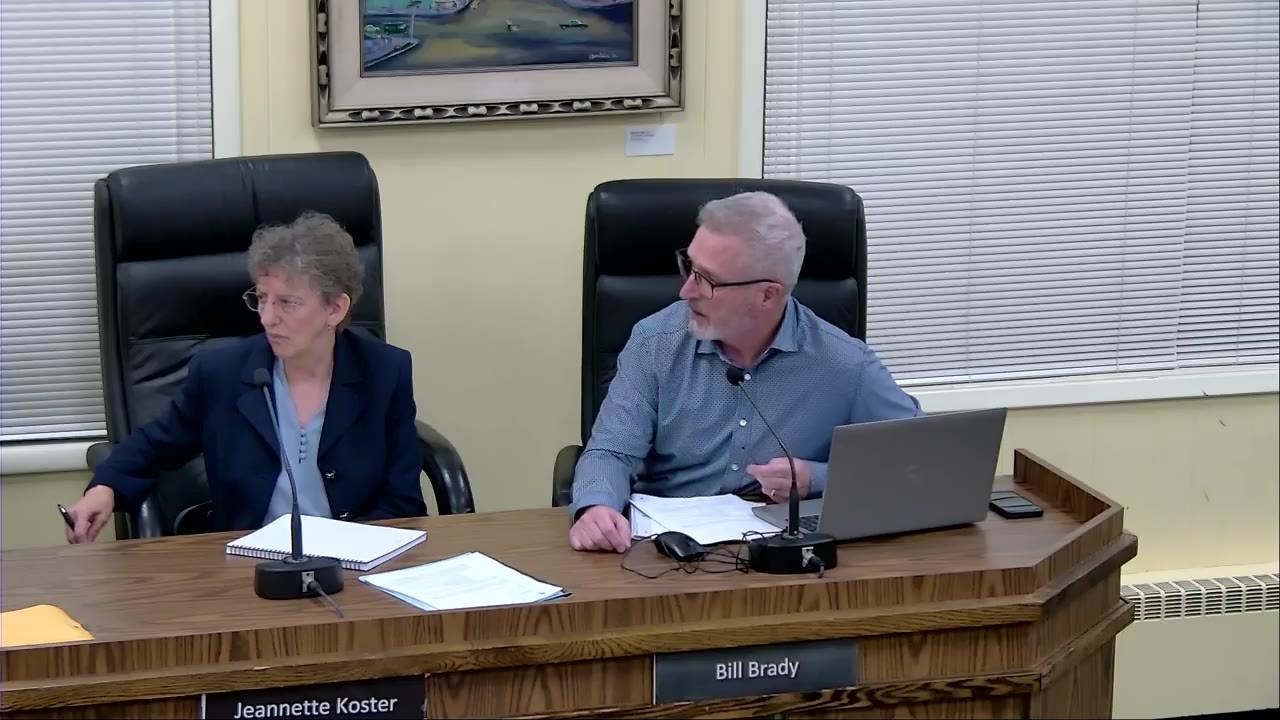
Presenters discuss proposed site-plan review rules at the September 8 Planning Board meeting. Watch this moment
Under the draft, an applicant would also have to address the village's comprehensive plan in writing. "We're making you write a narrative about how this is or isn't consistent with your comprehensive plan," Read 8:56▶ Brady said. Associate Village Attorney Jeannette Koster told the board that the proposed law codifies consistency with the village's Comprehensive Plan, according to the minutes.
Does it reach the project already filed?
Geoffrey Haynes asked whether the new law would be retroactive and how it would affect an application already in front of the village. The minutes record that the new SEQR law took effect immediately when it was filed with the office of the Secretary of State. Because the application for a new multi-family building on South Riverside Avenue was submitted after the state change, Brady said, that application would be exempt from SEQR.
Steve Krisky pressed the point, playing devil's advocate: the applicant, he said, has so far only filed an application — no public hearing, no presentation — so a filing date alone did not settle the question for him. Rob Luntz said he would assume that an applicant who applied after the state law changed would be subject to the state's new rules.
The larger point, Krisky said, was that the board's leverage does not hinge on the local law: "that wouldn't stop us from requesting virtually any study that we think is reasonable and applicable to the new community regardless of what gets passed here." Read 15:35▶
Conformance, or consistency
Haynes got stuck on a single word. Section 230-70(B)(1) asks about "conformance" with the comprehensive plan — and a comprehensive plan, Haynes noted, is aspirational. "If we're saying that an applicant has to conform to the comprehensive plan, I mean, the law of the land for us is the zoning code," Read 25:09▶ Haynes said.
Brady offered "consistency" as the softer substitute: "Conformance is a little bit more black and white." Read 26:39▶ Krisky said the board would be "shooting ourselves in the foot" Read 26:20▶ if it demanded strict adherence to a document written as a set of aspirations.
The minutes record two recommendations from the board: in Section 230-70(B)(1) the word "Conformance" should be changed to "Consistency," and Section 230-70(B)(2) should say "Consistency with the Complete Streets Policy."
The fiscal question
Krisky asked which section of the draft addressed analysis of taxes on a new development, and how that relates to the finances of the village if it has to expand infrastructure or police and fire coverage. According to the minutes, Brady pointed to Section 230-70(B)(10), on whether adequate public-school facilities and other public services exist or can be created, and to Section 230-70(B)(12), which refers to requesting a traffic study.
Haynes followed up with an example. The applicant for the South Riverside Avenue project, he said, had supplied "not only how many students they expect, but also how much revenue would be generated for the school district" Read 34:16▶ — along with the average cost of educating each student. That table, Haynes said, was a model he would like other applicants to follow for schools and for police and fire services.
Haynes wanted the board to be able to ask an applicant, based on its projected tax rate, how much revenue a building would generate for the school district, the village and the Town of Cortlandt — enough, for example, to fund one additional police officer. "I'd love for us to be able to request that table that shows based on their best guess of what this building's gonna be worth," Read 43:14▶ Haynes said. "The more data we can get, the better decisions we can make." Read 44:54▶
Koster suggested recasting Section 230-70(B)(10) so that it covers the adequacy of public-school facilities and other public services, such as fire, police and emergency services, and so that it states the Planning Board may request a fiscal analysis of public services to evaluate the needs and impacts of a proposed site development. Brady said he would look into language for the revenue table.
Water, slopes and character
Krisky put a hypothetical to the consultant: a 10-story building that forces the village to lay a larger set of water pipes and electric service. How, he asked, does the village protect itself against infrastructure costs that overwhelm the tax benefit? Brady pointed to Sections 230-70(B)(8) and 230-70(B)(9), which cover the adequacy of water supply, sewage disposal facilities and utilities to support energy demand. "I really do think 10 covers it," Read 37:25▶ Koster said.
On steep slopes, Koster pointed to Sections 230-69(3)(C) and 230-69(4)(K). Brady said the recommendations also put in cross-references to other sections of the code on different topics, including steep-slope protection. Asked about floor area ratio, Brady said FAR is built into the building code and the bulk requirements, which this amendment does not edit.
Krisky's last question was neighborhood character: the Zoning Board weighs five criteria, one of them the character of a neighborhood, and he thought the Planning Board should be able to talk about character too. It was noted that the code already mentions it, in Section 230-70(B)(3), which covers site layout including the location, character and appearance of proposed buildings and signs. Krisky said that language was clear enough and did not need rewording.
Asked whether a fiscal analysis would also capture costs such as road and sewer maintenance, Krisky said the draft's water and sewer provisions addressed the point.
Who meets the applicant first
Haynes turned to Section 230-68, which the amendment does not touch: before a formal site development plan is submitted, it says, the applicant should meet in person with the Planning Board or its designated representative.
Village Engineer Vincent Salanitro said that meeting is in practice run by his office. "For the pre-submission meeting itself, there's nothing, like, formal. But during that meeting, we usually tell them what is required, like, what's in the code," Read 23:16▶ Salanitro said, adding that applicants are walked through the required submissions in Section 230-69 and asked for a site plan and, ideally, floor areas and elevations.
Luntz said the engineering department has generally handled the pre-submission meeting, and that he would leave it to the department's discretion to say when a project warrants one, two or all of the board's members sitting in. Salanitro said he would reach out accordingly if that came up.
Krisky asked whether the village manager sat in on those early meetings. Salanitro said he did not: the meetings on the current application were mainly himself, the assistant engineer and the development team.
Deputy Mayor Len Simon, a Planning Board liaison for the Village Board, said there "might have been a courtesy meeting at the very, very early stages" Read 21:29▶ of a potential project, but that once it got down to submitting documents, to his understanding and recollection, it had always been at the engineering department level.
Postponed, and the record
At the start of the meeting Luntz told the audience that the application for an accessory dwelling unit at 66 Emerson Ave. had been postponed and would not be heard.
The board approved the July 28, 2026 minutes as amended, 5-0, on a motion by Krisky seconded by Haynes. The amendments included replacing a reference to "some zoning districts" with zoning districts RA-5 and RA-9.
Nelson Pope Voorhis is to come back with proposed wording on the fiscal analysis. The board's recommendations go to the Village Board of Trustees, which has Local Law Introductory No. 13 of 2026 in front of it.
Attachments from the meeting packet, grouped by agenda item — each links to a searchable text page and the village's original PDF.
Full meeting record with summaries →
New Business — Referral from Village Board of Trustees to review Local Law Introductory No. 13 of 2026, the CAF and EAF to amend Chapter 230, Zoning, of the Village Code to provide clarification in the review of site development plans by the Planning Board.
Experimental project: croton.news uses AI to generate articles from public records. Content may contain errors. Please report any inaccuracies and check our corrections log.AI-assisted experimental site — may contain errors. Corrections