Croton-on-Hudson, NY · Tuesday, November 10, 2026· Nov 10, 2026Independent, AI-assisted local reporting from public recordsSource-linked·Corrections welcomed
Carmel Riverside, LLC - 425 S. Riverside Ave (79.13-2-91) Applications for a Special Permit and Site Plan Approval for a New 49-Unit, Multi-Family Building
Referral from Village Board of Trustees to review Local Law Introductory No. 10 of 2026, the CAF and EAF to amend Chapter 230, Zoning, of the Village Code that seeks to amend the text of Chapter 230 "Zoning" to provide clarification as to the harboring or keeping of animals in the Village
◆No action taken on the Carmel Riverside application; the session was a working discussion, not a public hearing
◆No referral to the Zoning Board of Appeals yet; the applicant agreed to complete the application before any variance requests go there
◆Documents to supplement the application are due this Friday to make the next regular meeting, by the acting chair's reckoning
◆On Intro Local Law 10, Luntz said the board can flag the chicken-coop setback in a referral note back to the trustees
◆Minutes of the prior meeting approved without corrections
Croton's Planning Board on Tuesday opened its review of Carmel Riverside LLC's application to build a 49-unit apartment building at 425 South Riverside Avenue — a session that began with the board's chairman stepping aside and ended with the applicant carrying home a seven-page list of questions from the village's planning consultant.
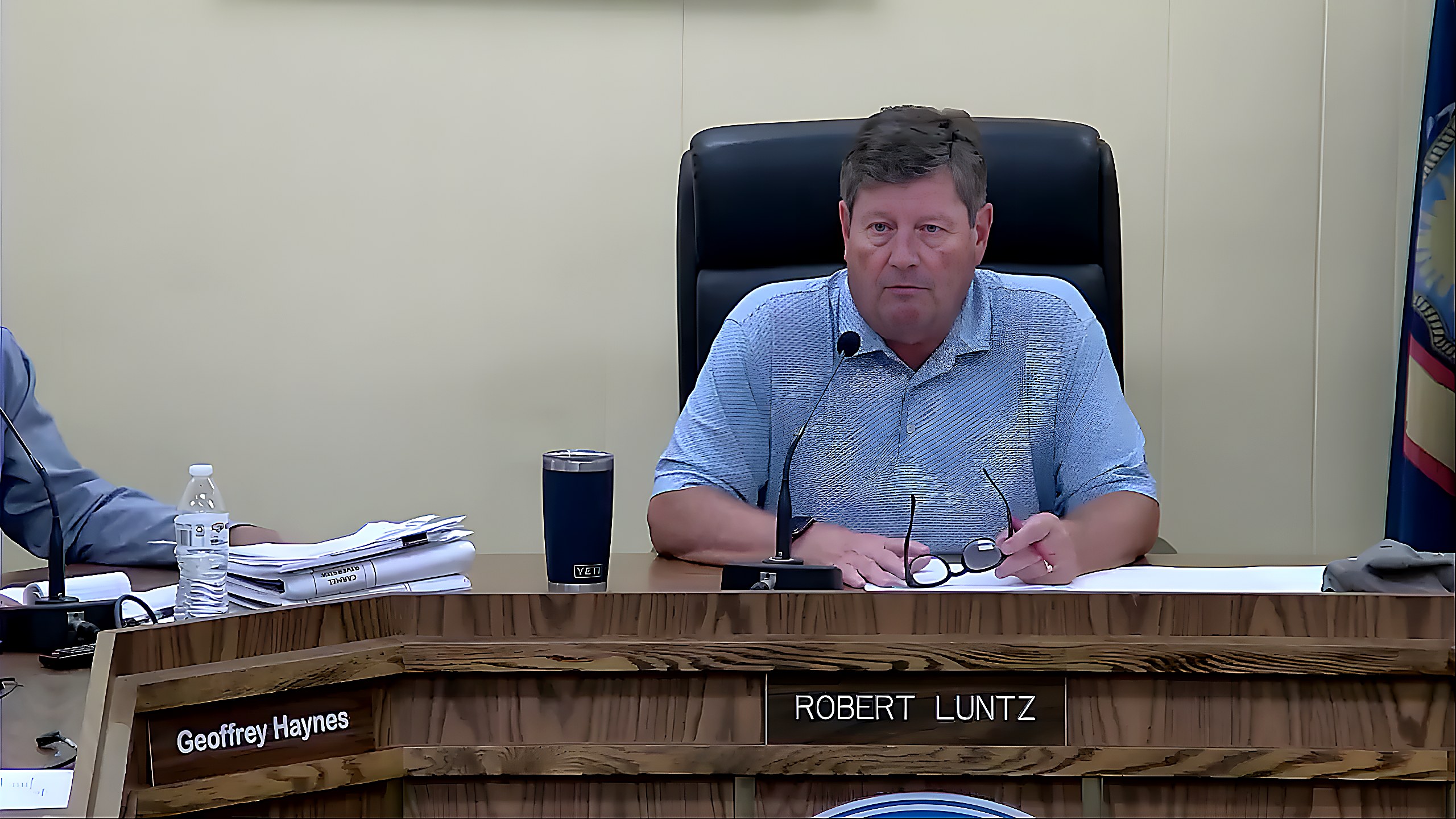
The chair at the dais during the July 28 Planning Board meeting. Watch this moment
Chairman Rob Luntz recused himself moments after calling the meeting to order. "I have a relationship with one of the principals in this application who I have ongoing business with, mister Leggio," Read 0:48▶ he said, and handed the item to deputy chairman Geoffrey Haynes, leaving the dais until the application had been heard. Leggio is the applicant's managing partner; Andrew Cortese introduced him at his side later in the meeting.
Haynes said the board is beginning "a long, long process," Read 2:02▶ and that the consultant's report identifies 31 areas needing clarification or additional information. Tuesday was structured as a working discussion with the developer — not a public hearing, and not yet a project presentation. "Obviously, no decisions are gonna be made tonight nor anytime in the immediate future," Read 6:35▶ he said.
The property sits in the C-2 commercial district and the Harmon South Riverside Gateway overlay district, and the application asks the board for a special permit and site plan approval — each with a public hearing to come — and, as read into the agenda, a steep slope permit as well. Village Attorney Lori Lee Dickson, standing in for the Planning Board's regular counsel, explained the board's boundaries: the Board of Trustees has already determined by legislation that the proposed use is permitted at this location under a special permit, so the Planning Board's job is to test the project against the criteria in Article 10 of the zoning code — and to approve it, approve it with conditions, or deny it on substantial evidence in the record. "You can't legislate it and say this use is not appropriate," Read 13:09▶ she said.
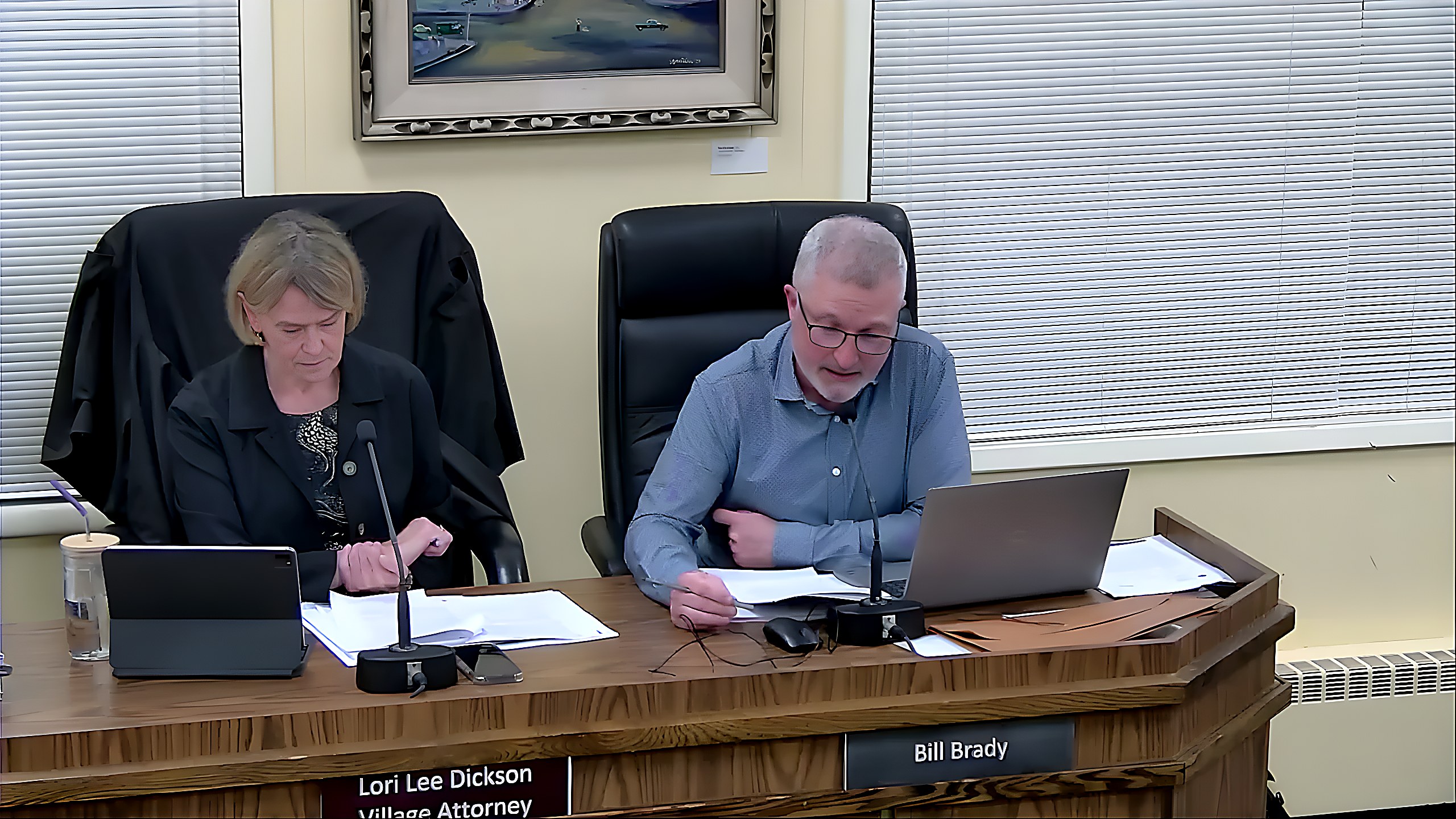
Bill Brady of Nelson Pope Voorhis, the village's planning consultant, then walked the board through his firm's July 24 review memo. Among the potential zoning variances he flagged: a front-yard setback that complies with neither the C-2 rules for lots within 25 feet of a residential district boundary nor the overlay district's own standard, and a building that appears to exceed the code's 20,000-square-foot cap on a single building — items that would go to the Zoning Board of Appeals. He asked the applicant to supply an exact floor-area-ratio calculation against the 0.8 maximum and height calculations against the 35-foot limit. The project would meet the minimum parking counts, he said, but "the zoning table has a wrong calculation for the required parking." Read 26:42▶
The memo's site-plan comments run from the three tiers of proposed retaining walls — Brady asked whether geotechnical studies have been done on the slopes and said the board may want a structural engineer to review the plans — to fire-truck access, a request for an illumination contour plan for the proposed outdoor lighting, a question about blasting, and trash collection: "the garbage truck can only back into the site blocking the driveway and the sidewalk," Read 35:25▶ he said. Brady also said the project will need steep slope, tree removal, and excavation-and-filling permits.
Andrew Cortese, the applicant, told the board he has done real estate development and construction in Westchester County for the last thirty years, that he and his partner purchased the property about two and a half years ago and cleaned up violations on it, and that the tenants still living there are aware of the redevelopment plans. Asked by board member Steve Krisky whether the units would be for sale or for rent, Cortese answered, "Probably for rent, but we're still not a 100% certain." Read 48:15▶Presenters review documents during the July 28 Planning Board meeting. Watch this moment
The applicant's attorney, Jacob Amir of Zarin & Steinmetz, called the consultant's memo "a great road map for us" Read 37:36▶ and pressed for one thing he did not get: an immediate referral to the Zoning Board of Appeals for the variances he said the project will clearly need. Amir acknowledged that "the onus is on us to make as complete a variance request as possible," Read 41:14▶ but said he hoped to get that process started now. Krisky, speaking for himself, was unmoved: "I don't wanna submit anything to the zoning board until the application's complete to our satisfaction." Read 42:02▶ Amir agreed to supplement the application first. Earlier, Haynes had declined Amir's suggestion that the applicant's assembled consultants share their thoughts on the project, saying "we really wanna keep the focus on these outstanding issues, get a complete application together," Read 38:23▶ though he allowed the board could entertain responses that stuck strictly to the questions raised.
On water, Haynes read from the applicant's own preliminary engineering report: testing shows the existing six-inch main on South Riverside can supply the building's domestic needs, but the main's fire flow falls short of the required specification. He named two options — an on-site water storage and pump system, or a water connection brought down from Wayne Street whose easement has been under discussion for quite a while. Cortese said the current design includes the pump and tank system.
On schools, Haynes flagged an inconsistency in the enrollment table of the schools impact report and pressed for a more accurate estimate of the building's future assessed value — the figure behind the report's conclusion that, on the preliminary estimate, new tax revenue to the school district would more than cover the expected additional students. Dickson noted that units sold in a condominium format are assessed under a different formula than a multifamily rental. Cortese offered to have an appraisal done and to talk to the town assessor.
On traffic, Haynes said the study leaves the Blaze unaddressed — Historic Hudson Valley's fall event at Van Cortlandt Manor, which he described as crowded — and raised a pedestrian problem: the building's walkway leads directly across the street to a ShopRite driveway ramp that is not meant for pedestrians but is widely used as one. He also asked that the standard trip-generation tables be supplemented with numbers from apartment complexes just built in Croton, naming Maple Commons and 25 North Riverside. There was also a request from the dais that the study be expanded to cover traffic flow through South Riverside Avenue and Croton Point, where more development is expected.
What happens next: documents are usually due 15 days before a meeting, village engineer Vincent Salanitro said; to make the next regular meeting, Haynes reckoned, that means this Friday. If solid responses come in, Haynes said, the board could potentially hear the project presentation at that meeting, with a public hearing potentially to follow. Dickson laid out two more clocks: the project must go to the County Planning Board for review and comment before the board can reach a decision, and under a recently adopted code provision it must also be transmitted to the Board of Trustees for comments — a thirty-day process that starts when the application is placed on a trustees' agenda. It will appear on that board's August 19 agenda, she said.
With Luntz back at the dais, the board took up a referral from the Board of Trustees seeking comments on Introductory Local Law 10 of 2026, which rewrites the zoning code's rules for keeping animals. Haynes said the most prominent change is that "the keeping of roosters and pigeons shall be prohibited," Read 70:52▶ something he did not believe was spelled out in the previous law. Under the draft, chickens and ducks are capped by lot size, and coops must sit at least 25 feet from any lot line in the RA-5 and RB districts and 50 feet in all other residence districts.
The Planning Board’s draft would replace the old provision allowing no more than 25 fowl with separate definitions and rules for domestic and farm animals. Haynes said the definition of fowl had been the starting point. Related background is available in our earlier analysis of the proposed ban.
Krisky, working through what the setback would mean on his own narrow lot, said he was not opposing the rule but saw an inconsistency in it: "I can have an ADU on my property, but I can't have a chicken coop." Read 73:04▶ Of the setback on a 50-foot lot, Luntz said, "It's almost precluding it from happening," Read 76:09▶ and said he thought the board could include the point in a referral note back to the trustees, recommending they review the provision. Dickson said the trustees are collecting comments in advance of scheduling a public hearing on the law. Comments can be sent to the Board of Trustees at BoardofTrustees@crotononhudson-ny.gov.
The paper trail also shows two different drafts. The three-page text in the Planning Board’s July 28 packet was prepared for the trustees’ July 1 meeting. It would prohibit roosters and pigeons outright; its Section Seven says the local law would take effect immediately upon filing with the New York State Secretary of State. The four-page draft sent to the Waterfront Advisory Committee for July 8 would prohibit roosters, including cockerels, upon filing, while its prohibition on pigeons, geese and swans would take effect January 1, 2027. That version also adds a subsection linking to the code’s enforcement and penalty provisions. The documents carry different law-firm control numbers. Both are proposals in these meeting packets; neither establishes that the prohibitions were already in effect on July 28.
The board closed by approving the minutes of its prior meeting without corrections.
The complete official July 28 minutes and attached memoranda record this as a preliminary application discussion and a recommendation on the proposed animal rules.
*Correction, October 19, 2026: The Planning Board packet’s animal-law draft does contain a general effective-date clause: immediate effect upon filing with the New York State Secretary of State. An earlier version incorrectly said it had no effective date. The separate Waterfront Advisory Committee draft contains a future January 1, 2027 clause for pigeons, geese and swans. Recording links have also been aligned to the first quoted words using the archived original timing data; unsupported biological background has been removed.*
Meeting documents and agenda items, grouped by agenda item — each links to a searchable text page and its original source.
Full meeting record with summaries →
New Business — Carmel Riverside, LLC - 425 S. Riverside Ave (79.13-2-91) Applications for a Special Permit and Site Plan Approval for a New 49-Unit, Multi-Family Building
New Business — Referral from Village Board of Trustees to review Local Law Introductory No. 10 of 2026, the CAF and EAF to amend Chapter 230, Zoning, of the Village Code that seeks to amend the text of Chapter 230 "Zoning" to provide clarification as to the harboring or keeping of animals in the Village
Experimental project: croton.news uses AI to generate articles from public records. Content may contain errors. Please report any inaccuracies and check our corrections log.AI-assisted experimental site — may contain errors. Corrections