Croton-on-Hudson, NY · Monday, October 12, 2026· Oct 12, 2026Independent, AI-assisted local reporting from public recordsSource-linked·Corrections welcomed
◆Granted tenure to the PVC middle school assistant principal, effective June 26, 2026
◆Appointed a library media specialist at PVC at $67,941 on a four-year probationary term
◆Established ad hoc committee on technology, report due September 3, 2026
◆Established ad hoc committee on recruiting and hiring practices, report due December 31, 2026
◆Accepted five donations totaling $8,900 for scholarships, awards, and a bike shed at CET
◆Approved HVAC bid award for Phase 2 capital project at PVC
The Croton-Harmon Union Free School District Board of Education held its final regular business meeting of the 2025-26 school year on June 11, granting tenure to a middle school administrator, reviewing the first year of the high school's cell phone policy, establishing two ad hoc committees, and bidding an emotional farewell to two departing trustees.
Tenure granted at PVC
Superintendent Stephen Walker recommended tenure for the Pierre Van Cortlandt Middle School assistant principal, effective June 26, 2026. The administrator has served in the role for four years and stepped in as interim principal this past year when the position was vacated.
Walker praised the assistant principal's care and devotion to students, families, and staff, highlighting leadership of the district's assessment and feedback committee work and a role as co-facilitator of the PNW BOCES regional forum for assistant principals. He recalled that when asked to take on the interim principal role, the response was to do whatever was best for PVC.
The board approved the tenure recommendation unanimously.
Cell phone policy: Year one review
CHHS Principal Dr. Laura Dubak presented a review of the first year of the internet-enabled device policy at Croton-Harmon High School, reporting 23 devices confiscated during class time, four parent contacts, seven phones held for a full day or longer, and five students referred to building administrators for placing decoy phones in classroom collection boxes.
Under the current policy, students place phones in cell phone boxes at the start of each class and retrieve them at the end. Phones are permitted during free periods and lunch. Dr. Dubak described the classroom implementation as successful, noting that phones are rarely visible during instruction.
"Our students have shared with us that they feel our implementation has been respectful and that they don't have a problem putting away their devices for classes and honestly do so willingly recognizing the positive impacts in the classroom," Read 93:19▶ Dr. Dubak said.
The presentation noted that surrounding districts are experiencing similar challenges regardless of their policy approach. "The successes and struggles that we're experiencing at the high school around this policy are definitely something that areas that are quite similar across the board in our neighboring high schools," Read 86:34▶ she said, adding that some districts have abandoned locking pouch systems after finding them ineffective.
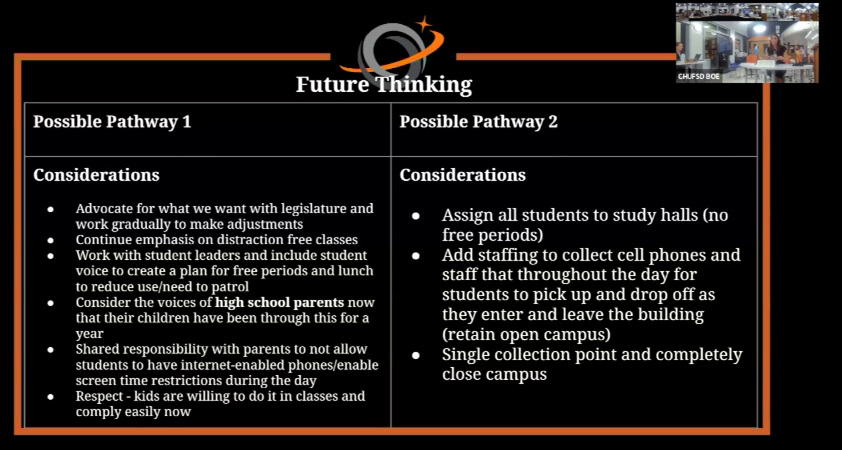
Dr. Dubak outlined two potential pathways for the policy's future. Pathway one would maintain the current approach with improvements: legislative advocacy for developmental nuance in state law, incorporating student voice, surveying high school parents, and partnering with families on parental controls. Pathway two would impose stricter enforcement: assigning study halls to all students to eliminate free periods, adding staffing for phone collection, or closing campus entirely with a single morning drop-off point.
A district slide at the June 11 meeting contrasts two possible paths for high-school phone rules; neither was adopted at this meeting. Watch this moment
Student Ex Officio Filomena DiMarco, a graduating senior, spoke strongly against stricter measures. "People are going to be a lot less willing to comply in class," Read 103:44▶ she said, warning that tighter restrictions on free periods or open campus would backfire.
Trustee Neal Haber cautioned against an absolutist approach. "What is the best for the district and for the students," Read 107:39▶ he said, should remain the focus rather than what might seem ideal in the abstract.
Trustee Allison Samuels acknowledged the complexity. "I'm really struggling with this topic," Read 110:40▶ she said, citing the addictive design of social media apps while recognizing the need for students to develop self-regulation.
Board members noted that next year's ninth graders will not have free periods or study halls — a structural change already planned — and that younger students arriving at the high school will have grown up with different family expectations around technology.
Math performance data shows upward trends
Walker presented grades 3-8 math proficiency data showing generally improving performance across the district. He reported that 2024-25 proficiency levels in both ELA and math were the highest in recent district history, "which is something again that our students should feel and faculty should feel great about." Read 27:19▶
Board members praised the presentation but requested deeper analysis. Board members asked for a more refined breakdown of proficiency versus excelling scores, a distinction relevant to resource allocation and students pursuing higher-level math or STEM pathways.
Trustees also asked whether the data could explain variations in results, including which instructional models work better and whether more instructional coaching would help.
Several trustees requested subgroup data to identify achievement gaps, curricular connections to explain performance variations, and a consolidated view spanning grades 3 through 12 including high school Regents data.
District committees complete first year
The board reviewed the first year of the district's restructured committee system, which included committees on technology, literacy, assessment and feedback, what success means in schools, athletic advisory, and school counseling. Walker thanked the administrative team and community volunteers for their work.
Trustee Allison Samuels asked for clearer expectations about committee roles — whether a committee is reviewing near-final work or collaboratively building something from scratch.
Board Vice President Anamika Bhatnagar raised concerns about the instructional technology plan, noting that language about technology being used in pursuit of specific curricular objectives had been removed from the compliance document submitted to the state.
Walker clarified that the state-mandated technology plan is a compliance document subject to state review and does not fully reflect the district's current practices. "We never live and breathe by these sorts of documents. They're valuable in terms of the conversations they elicit in the system," Read 74:41▶ he said.
Two ad hoc committees established
The board established an ad hoc committee on technology, charged with determining the scope and charge for a community advisory committee on technology. Three board members will be appointed by the board president, with recommendations due by September 3, 2026. The tight timeline reflects urgency heard from the community.
A second ad hoc committee was established to examine Policy 9230 on recruiting and hiring, with recommendations due by December 31, 2026.
Farewell to departing trustees
The meeting marked the final regular meeting for trustees Haber and Sarah Carrier, both of whom received praise from the board, administration, and community members.
Haber, who served on the policy committee, reflected on the breadth of student success. "Our success is defined by our students and what they achieve which is not necessarily measurable in numbers," Read 161:59▶ he said.
Carrier said it had been an absolute pleasure to serve on the board and the community, adding that she had learned so much from colleagues and administrators over her years of service.
Walker praised both departing members on behalf of the administrative team, describing them as "people who were smart, curious, of goodwill, and we're going to make sure that every decision was made with students at the center of it." Read 172:22▶
Board President Ana Teague also acknowledged a retiring assistant superintendent at his final board meeting.
Other business
The board approved a $67,941 salary for a newly appointed library media specialist at PVC, starting August 26, 2026 on a four-year probationary term. Professional development advisor appointments were approved for two staff members.
Five donations were accepted: $500 from the Croton River Artisans Gallery for a CHHS arts scholarship, $1,500 from Robert and Sara Mills-Cohen for three awards in music, theater, and writing, $4,800 from the Croton-Harmon Booster Club for eight athletic scholarships, $2,000 from the Booster Club for a bike shed at Carrie E. Tompkins Elementary School, and $100 from the Women's Club of Peekskill and Cortlandt for a senior scholarship.
The board's policy committee deferred action on Policy 5800 pending consultation with legal counsel. The next regular meeting is scheduled for July 16 at 5:00 p.m. at the district office, serving as the reorganization meeting for the newly constituted board.
Attachments from the meeting packet, grouped by agenda item — each links to a searchable text page and the village's original PDF.
Full meeting record with summaries →
2025-2026 Professional Development Advisor Recommendation
Experimental project: croton.news uses AI to generate articles from public records. Content may contain errors. Please report any inaccuracies and check our corrections log.AI-assisted experimental site — may contain errors. Corrections