Croton-on-Hudson, NY · Sunday, November 15, 2026· Nov 15, 2026Independent, AI-assisted local reporting from public recordsSource-linked·Corrections welcomed
Pursuant to the New York Public Officers Law Sec. 103-a and Chapter 59 of the Code of the Village of Croton-on-Hudson, the Board of Trustees will use videoconferencing and meet in a hybrid format on October 21, 2026, based upon extraordinary circumstances. Members of the Board of Trustees will meet in person at the Georgianna Grant Meeting Room of the Stanley H. Kellerhouse Municipal Building, 1 Van Wyck Street, Croton-on-Hudson, NY 10520. Trustee Matt Berger will attend the meeting remotely via Zoom. The public may attend in-person at the Municipal Building or may hear the meeting live through Zoom and provide public comment during the appropriate time. Zoom Link: https://us02web.zoom.us/j/84384739854?pwd=HG72ncOKYDhxaagLeNIefFBgl4zemp.1
Public Hearing on Local Law Introductory No. 7 of 2026 to amend Chapter 230, Zoning, of the Village Code to update the language regarding commercial and noncommercial signage.
Public Hearing on Local Law Introductory No. 13 of 2026 to amend various provisions of Chapter 230, Zoning, of the Village Code to provide clarification in the review of site development plans.
SEQRA Part II and LWRP Consistency Review for Local Law Introductory No. 7 of 2026 to amend Chapter 230, Zoning, of the Village Code to update the language regarding commercial and noncommercial signage.
SEQRA Part II and LWRP Consistency Review for Local Law Introductory No. 13 of 2026 to amend various provisions of Chapter 230, Zoning, of the Village Code to provide clarification in the review of site development plans.
Memorandum from the New York State Department of State requesting a consistency review under the Village's Local Waterfront Revitalization Program for the biennial painting of long lines on state roadways.
Consider scheduling a Public Hearing on Local Law Introductory No. 16 of 2026 to amend the provisions of Chapter 230, Zoning, of the Village Code to implement regulations for cannabis dispensaries for November 4, 2026, at 7 PM in the Georgianna Grant Meeting Room of the Stanley H. Kellerhouse Municipal Building.
Consider scheduling a Public Hearing on Local Law Introductory No. 18 of 2026 to amend Chapter 215 of the Village Code (Vehicle & Traffic) regarding season parking for November 4, 2026, at 7 PM in the Georgianna Grant Meeting Room of the Stanley H. Kellerhouse Municipal Building.
Consider authorizing the Village Manager to execute Scope Change Order 2 related to the Van Cortlandt Manor Entrance Project at Historic Hudson Valley.
Consider the Village Manager accept an agreement from Fuller D'Angelo, Architect Planners in the amount of $30,500 for design work on the Harmon Firehouse roof replacement project.
◆Review village FOIL handling and develop an AI policy; proposed changes return for board and public consideration.
◆Close sign and site-plan hearings without adopting either proposed law.
◆Set November 4 hearings on cannabis-dispensary zoning and seasonal parking.
◆Authorize a $306,155.47 Van Cortlandt Manor change order and $30,500 for Harmon Firehouse architectural services.
◆Continue leaf-blower discussion; no year-round ban was adopted.
Croton will review its public-records procedures and develop a policy on artificial intelligence after Village Manager Bryan Healy acknowledged that a response to a Freedom of Information Law request had included a private conversation that was not an IDEA Committee meeting.
New: six-minute meeting explainers. Watch selected moments from the October 21 trustees meeting in our concise, edited video summary: Watch the explainer on YouTube.
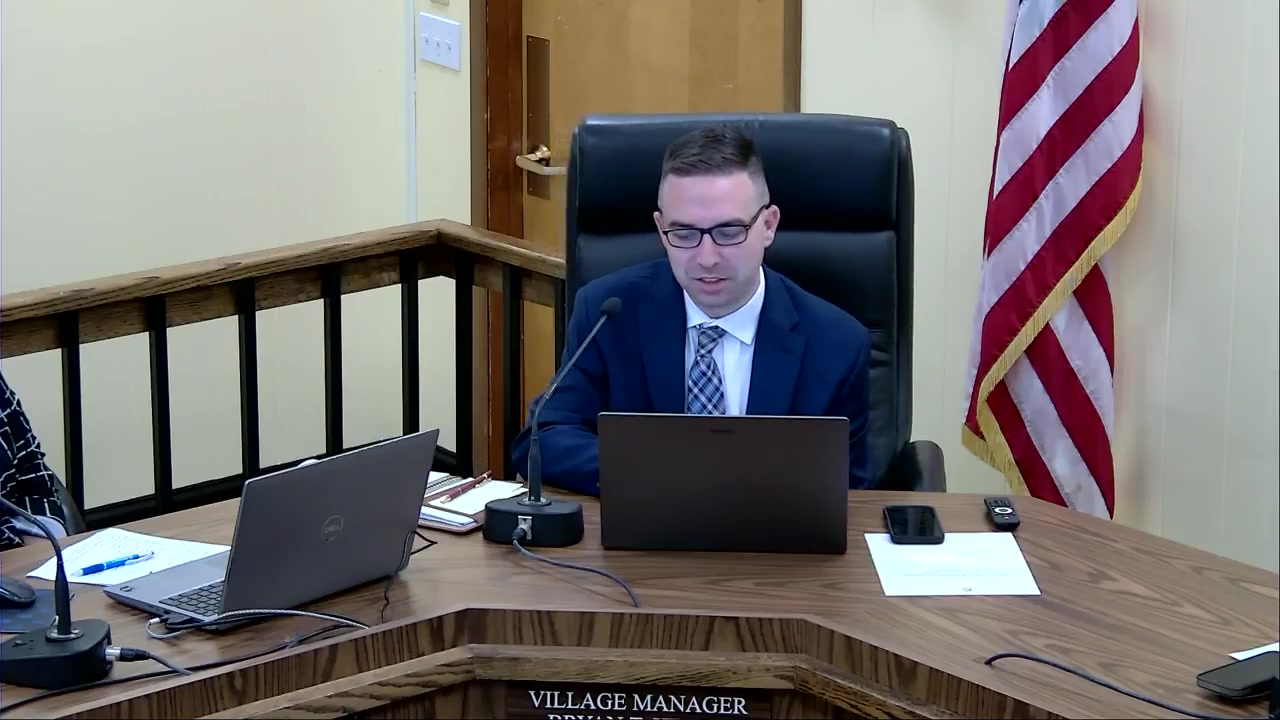
Reading a public statement at the October 21 trustees meeting, Healy said recordings supplied to the village had been released without a full understanding of their contents. The inadvertently released recording involved three individuals, he said. His complete written statement is now part of the meeting's agenda materials.
Village Manager Bryan Healy reads his public statement about the handling of an IDEA Committee records request at the October 21 trustees meeting. Watch this moment
Healy described public access and appropriate review as obligations that must work together. “These responsibilities are not mutually exclusive,”Read 43:22▶ he said.
Healy promised a review of electronic files and the technology used to create them: “Moving forward, the village will be reviewing our internal foil procedures, including how electronic files, audio recordings, and AI generated materials are identified and evaluated before release, as well as developing a policy on the use of AI in the village.”Read 43:55▶ Proposed policy changes will come to the Village Board, with an opportunity for committee members and the public to comment. Healy also distinguished staff's handling of FOIL responses from the Village Board, saying board members are not involved in that process.
Trustee Stacey Nachtaler referred to her work as an IDEA liaison, thanked the committee's volunteers and urged the village to recognize both their contributions and residents' concerns. “My hope is that this difficult experience can become an opportunity to reflect, heal, rebuild trust so IDEA can succeed while the village works toward thoughtful policies and practices with input from committees that better reflect the challenges of the world that we live in today and tomorrow,”Read 88:34▶ she said. Her response followed public comments about the release and the support and guidance provided to committee members. The board did not adopt a new FOIL or AI policy that evening.
The meeting also moved two zoning proposals through public hearings and environmental-review questions without adopting either law. The distinction matters for residents and applicants: the proposed sign rules and site-plan requirements discussed Wednesday are still proposals.
The sign-law hearing closed after residents raised questions about sign height, flagpoles, tree attachments and treatment of existing nonconforming signs. Board discussion then focused on the Visual Environment Board's role and whether illuminated signs need more detailed standards.
The revised sign draft makes the Planning Board the approval authority for signs connected to a site-plan or change-of-use application. It retains a VEB referral when the Village Engineer is the approval authority. Nachtaler asked colleagues to reconsider the VEB's role in Planning Board applications and to examine illumination more closely.
Healy defended the aim of simplifying the sequence of reviews. “We just wanna streamline it,”Read 22:46▶ he said. The discussion also considered how the VEB would receive notice so it could submit comments on its own initiative. No new illumination standard was adopted.
One board member emphasized the immediate limit: “we're not adopting tonight.”Read 26:48▶ The village attorney explained that substantive changes could require another noticed hearing. Trustees answered the environmental-assessment questions for the two laws with no or small impacts; Healy said staff would prepare the environmental determinations and waterfront-consistency statements for a later meeting, with the sign proposal still subject to possible changes.
The second proposal, Local Law Introductory No. 13, would expand information available in site-plan review. The village attorney explained that the aim is to let local reviewing boards obtain information they previously received through environmental review when a project now falls within a state exemption. The draft addresses such subjects as natural resources, drainage, traffic, public services and nearby historic resources. Its hearing closed without a recorded public comment.
Trustees did set November 4 hearings on two other proposals through the consent agenda. Both are scheduled for 7 p.m. in the Georgianna Grant Meeting Room at the Municipal Building: cannabis-dispensary zoning regulations and seasonal parking changes. Scheduling the hearings did not enact either proposal.
The parking proposal would let the manager exempt specified streets and times from the ban that takes effect after two inches of snow. Healy described an intended daytime accommodation for business districts, while the written proposal retains emergency authority. The detailed street-and-hour plan remains proposed, rather than a new permission to park during a snow event.
On capital projects, the board authorized a $306,155.47 change order for the Van Cortlandt Manor entrance project. The village acts as municipal sponsor. The resolution places costs exceeding the New York State Department of Transportation funding allocation with Historic Hudson Valley under its agreement with the village.
Trustees separately authorized $30,500 for Fuller D'Angelo's architectural services for the Harmon Firehouse roof. The approved scope includes assessing the existing roof, recommendations and cost estimates, bid documents and help evaluating bids. This was a professional-services authorization for a roof project, not the award of the roof-construction contract. Discussion of possible solar panels remained a later planning question.
Gas-powered leaf blowers drew extended, sharply divided public comment. Supporters of further restrictions described noise and effects on neighbors and urged a year-round change. One resident described the seasonal reprieve: “we have a seasonal ban, which I applaud, and the lack of gas powered leaf blowers is literally refreshing, and how nice it would be to make it year round.”Read 53:03▶
An opposing resident questioned whether a complete ban had been justified and raised equipment costs and the needs of larger properties. “Environmental decisions should be based on reliable scientific evidence, measurable results, and reasonable priorities,”Read 74:42▶ he said.
No year-round ban was adopted. Pugh reported that the Conservation Advisory Council was planning a panel on leaf-blower regulation, anticipated in early November, with details still to be announced. The next step described at the meeting was further discussion, alongside the November 4 hearings on the separate cannabis and parking proposals.
Read transcript · Play recording · Meeting documents
Meeting documents and agenda items, grouped by agenda item — each links to a searchable text page and its original source.
Full meeting record with summaries →
Consent Agenda — Correspondence to the Board — Memorandum from the New York State Department of State requesting a consistency review under the Village's Local Waterfront Revitalization Program for the biennial painting of long lines on state roadways.
Consent Agenda — Resolutions — Consider scheduling a Public Hearing on Local Law Introductory No. 16 of 2026 to amend the provisions of Chapter 230, Zoning, of the Village Code to implement regulations for cannabis dispensaries for November 4, 2026, at 7 PM in the Georgianna Grant Meeting Room of the Stanley H. Kellerhouse Municipal Building.
Consent Agenda — Resolutions — Consider scheduling a Public Hearing on Local Law Introductory No. 17 of 2026 to amend Chapter 215 of the Village code (Parking & Traffic) regarding season parking for November 4, 2026, at 7pm in the Georginna Grant Meeting Room of the Stanley H. Kellerhouse Municipal Building.
Consent Agenda — Resolutions — Consider scheduling a Public Hearing on Local Law Introductory No. 18 of 2026 to amend Chapter 215 of the Village Code (Vehicle & Traffic) regarding season parking for November 4, 2026, at 7 PM in the Georgianna Grant Meeting Room of the Stanley H. Kellerhouse Municipal Building.
Proposed Resolutions — Consider authorizing the Village Manager to execute Scope Change Order 2 related to the Van Cortlandt Manor Entrance Project at Historic Hudson Valley.
Proposed Resolutions — Consider the Village Manager accept an agreement from Fuller D'Angelo, Architect Planners in the amount of $30,500 for deign work on the Harmon Firehouse roof replacement project.
Public Hearings — Public Hearing on Local Law Introductory No. 13 of 2026 to amend various provisions of Chapter 230, Zoning, of the Village Code to provide clarification in the review of site development plans.
Public Hearings — Public Hearing on Local Law Introductory No. 7 of 2026 to amend Chapter 230, Zoning, of the Village Code to update the language regarding commercial and noncommercial signage.
SEQRA Part II and LWRP Consistency Review for Local Law Introductory No. 13 of 2026 to amend various provisions of Chapter 230, Zoning, of the Village Code to provide clarification in the review of site development plans.
SEQRA Part II and LWRP Consistency Review for Local Law Introductory No. 7 of 2026 to amend Chapter 230, Zoning, of the Village Code to update the language regarding commercial and noncommercial signage.
Experimental project: croton.news uses AI to generate articles from public records. Content may contain errors. Please report any inaccuracies and check our corrections log.AI-assisted experimental site — may contain errors. Corrections