◆Approved the Honeywell energy performance contract, subject to state education approval, and a related environmental resolution.
◆Reviewed classroom technology limits and revised high-school phone implementation procedures.
◆Approved staffing, service agreements, second-meal prices, fiscal-adviser services and a health-services budget transfer.
The Croton-Harmon school board approved an energy performance contract with Honeywell on August 27, advancing a solar and building-equipment project with a $3,175,000 price for the work. At the same work session, administrators detailed the classroom-device limits and high-school phone procedures planned for the new school year.
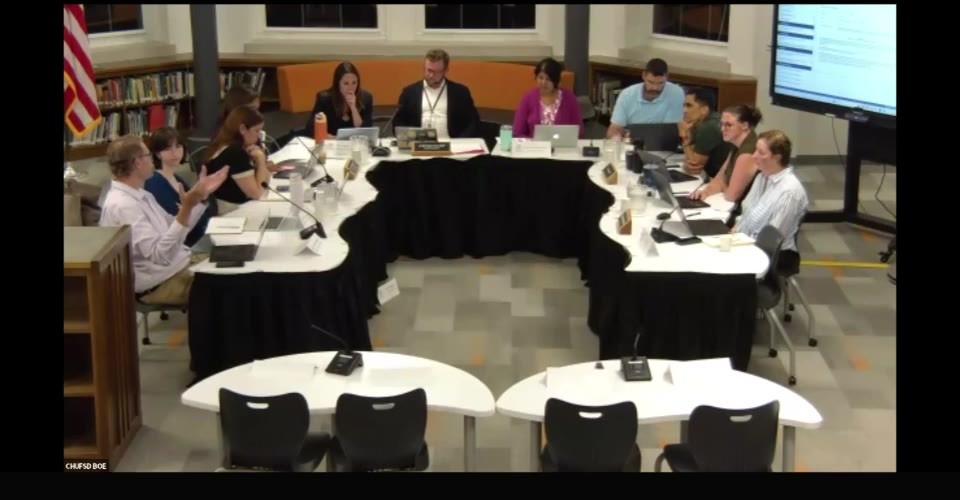
The energy contract and a related environmental resolution each passed with six yes votes. The contract covers rooftop solar at all three school campuses, carport solar canopies at the high school and middle school, and four replacement unit ventilators at Pierre Van Cortlandt Middle School. The board authorized its president to sign, subject to approval by the state education commissioner. The separate environmental resolution classified the project as a Type II action. Contract resolution and recorded voteCroton-Harmon school-board members at the August 27 meeting, where they approved a solar contract. Watch this moment
The contract lists $2,615,721 in guaranteed energy and operational savings over 18 years, subject to its measurement and adjustment terms. Honeywell's guarantee of $981,070.00 in incentive tax credits depends on the district meeting obligations including required filings and access for installation. Utility interconnection upgrades are excluded from the base scope. The district can reduce the scope to cover those costs, and the agreement permits termination without penalty if interconnection costs materially change the scope. Support services have separate charges. Work cannot begin until state approvals and financing conditions intended to avoid a net cost to the district are met. The agreement does not guarantee budget-neutral or positive cash flow. BoardDocs contract item and attached agreement
Neighbor outreach was part of the discussion before the contract vote. The facilities director described sending nearby households a postcard with a link to the earlier presentation and a form for questions; two responses came back. He described discussing lighting with a neighbor and the possibility of reducing broader parking-lot lighting after canopy lights were installed. That was a possible adjustment, not a completed change. Contract discussion
Facilities Director Brad Kennedy said: “And we potentially might be able to lessen the broader light that's there now.” Read 119:25▶
The technology presentation set out different expectations by grade. In kindergarten through second grade, classroom iPads would be limited to required STAR assessments three times a year and occasional projects specifically approved by school administrators. Third- and fourth-graders would no longer keep devices at their desks; classroom carts or other storage would hold them until a structured, teacher-led activity required digital tools. Technology presentation item and attachment
At the middle school, the plan continued practices begun in 2025-26: fifth-grade devices stay at school, sixth-grade devices remain there on weekends, and all middle-school devices stay during breaks. Lab-period use of online programs would follow individual students' intervention or enrichment needs instead of a standard time requirement. The presentation also called for classroom device storage and clear expectations for substitutes, including that technology should not be used as a reward.
Explaining the middle-school lab change, a presenter said: “So now those software programs are going to be used in accordance with individual student needs, not a particular time that you must complete as a requirement.” Read 93:56▶
For high-school instruction, the reset emphasized alternatives to starting or ending lessons with students on devices, using video for initial teaching and routinely relying on technology in substitute lesson plans. The presentation described purchases of books, math games, manipulatives, listening equipment and other hands-on materials to support the shift.
One example discussed at the meeting showed how the change could work: begin an animal-research project with a librarian's selection of nonfiction books, then use an online resource to extend a student's research or explore an animal not covered by the available books. A student representative welcomed reducing videos used in place of a day's teaching, describing that experience as lost learning time. Technology discussion
Describing videos used in place of teaching, the student representative said: “it feels like a day of learning lost within that class. So I think it's really important to try and cut back on that, and that's another change that I do appreciate.” Read 103:53▶
The high-school phone plan required students to use classroom phone storage for the whole period and keep phones off and put away during free periods and community lunch. Its consequence sequence starts with a verbal warning and parent contact. On a second offense, the phone goes in an envelope to the main office until the end of the day. A third requires parent pickup; continuing violations can lead to morning check-in at the office.
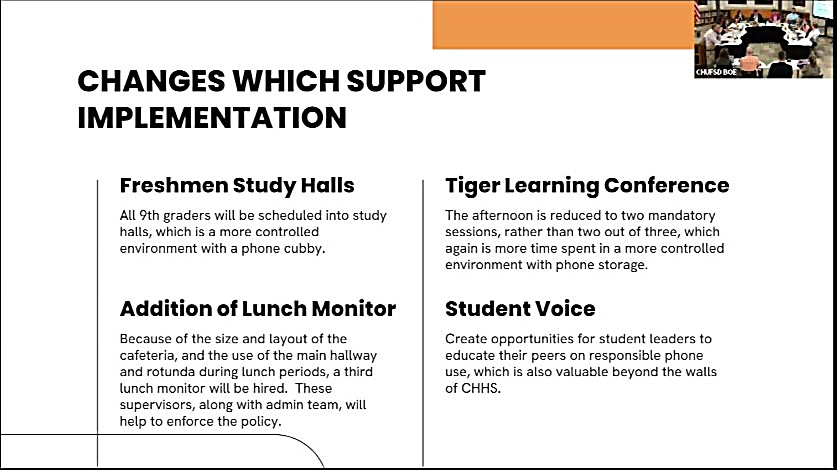
To support those procedures, the presentation proposed a third lunch monitor, study halls for all ninth-graders and two required afternoon Tiger Learning Conference sessions in place of a choice of two out of three. It also proposed opportunities for student leaders to help peers understand responsible phone use. These were implementation measures presented to the board, not a new phone policy adopted in a separate vote that evening.
A district presentation outlines study halls, lunch supervision and student input for the new high-school phone procedures. Watch this moment
During the discussion, the distinction between school devices and phones was made explicit: “that isn't changing. We're really talking very specifically about the cell phone.” Read 80:41▶
The superintendent's posted slides also addressed U.S. News & World Report's high-school rankings. They displayed Croton-Harmon's rank alongside an explanation that New York had not authorized use of the College Board's AP data, leaving schools that administered AP exams without full credit for college readiness. A separate slide highlighted Croton-Harmon High School's platinum recognition on the 2025 AP School Honor Roll. Superintendent's Report item and attachment
Several other approvals addressed the approaching school year. The board approved instructional appointments, including leave replacements, an English as a New Language position and morning mathematics intervention at the high school. The consent agenda covered support staff, fall coaches, special education service agreements, security services and a child-nutrition consultant. Trustees also approved student special education recommendations.
The board set second-meal prices at $3.35 for breakfast and $4.30 for lunch. It awarded fiscal-adviser services to Capital Markets Advisors at a $20,000 annual retainer, with specified additional work billed separately, and approved a $27,000 transfer between health-services budget lines. It also accepted a scholarship donation and a state information-technology donation amendment, and approved the August 6 meeting minutes. The August 27 minutes used for this report were subsequently approved on September 3. August 27 meeting record
Attachments from the meeting packet, grouped by agenda item — each links to a searchable text page and the village's original PDF.
Full meeting record with summaries →
2026 Summer Camp Recommendations - Carrie E. Tompkins Elementary School
Experimental project: croton.news uses AI to generate articles from public records. Content may contain errors. Please report any inaccuracies and check our corrections log.AI-assisted experimental site — may contain errors. Corrections