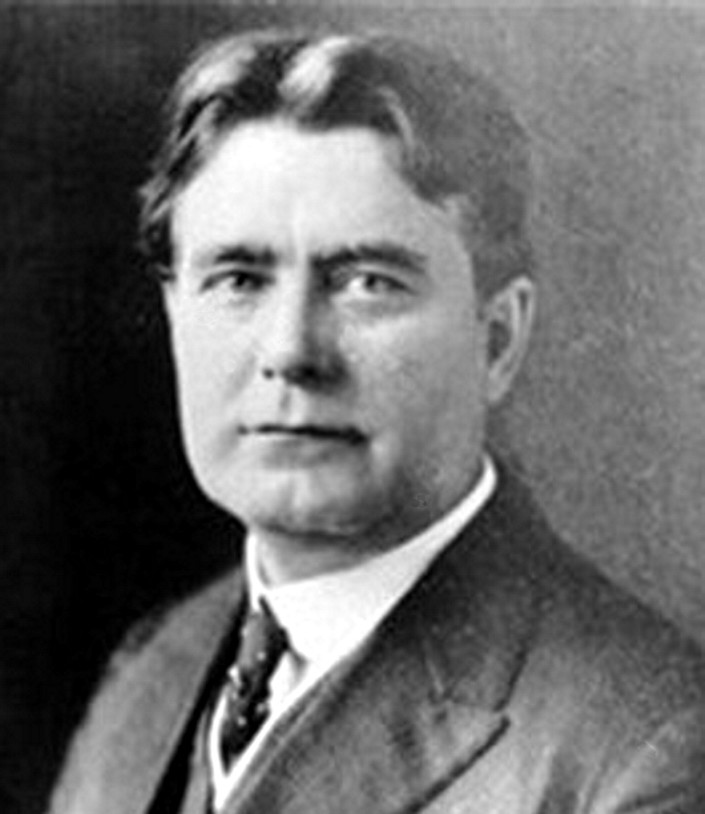
Portrait of Willard Cope Brinton, c. 1920.
In this story · 4 sections
112 + 17 + 27 = 156 acres
The name Brinton Brook connects two kinds of looking: watching a wooded landscape and learning to read a chart. Willard Cope Brinton wrote about the presentation of numerical facts. Laura and Willard Brinton also helped protect the land that became an Audubon sanctuary. Both histories are more interesting when told through what they left behind.
An engineer learns to show the numbers
In his Harvard class reports, Brinton described work at Westinghouse, the United States Motor Company and Bush Terminal. His problems were practical: machinery, freight, factories and the movement of materials. [1]
By 1913 he was preparing a book on graphic statistics and working with a group that believed diagrams could make business records easier to understand. This was not the invention of charts. It was an effort to make their use systematic and accessible to people who had decisions to make. [2]
His 1914 book, Graphic Methods for Presenting Facts, argued for visual literacy in business. In a passage near its close, he predicted that the ability to read curves would become an ordinary executive skill. His later Graphic Presentation appeared in 1939. [3] [4]
A Croton connection in his own words

The 1922 Harvard class report supplies a firmer landmark than a guessed purchase date. Brinton wrote that his recreation during the preceding year or so had largely involved putting about a hundred acres of hills at Croton-on-Hudson into shape. This establishes his involvement with the property by the early 1920s; it does not supply the exact date or terms of a deed. [5]
He also used graphics to argue about the local landscape. In his 1939 book he reproduced a map promoting a parkway route and credited its strong dashed line with making an argument words alone would have conveyed less forcefully. That is Brinton's own assessment of the map's influence, not independent proof that it determined the route. [6]
How the sanctuary grew
Saw Mill River Audubon credits Laura and Willard Brinton with the original 112-acre gift to National Audubon. The local chapter managed the sanctuary from 1958; ownership of the original lands transferred to it in 1991. Their niece Ruth Brinton Perera added seventeen acres in 1975. Another twenty-seven acres are village-owned land managed as part of the sanctuary, linked by the Coyote Trail in 1995. Sanctuary history
Those contributions explain the present 156-acre total. They also show why calling the entire sanctuary a single gift, with a single owner, obscures how conservation actually worked. The landscape depended on family gifts, local management and cooperation with the village.
A place to look closely
The sanctuary now offers more than four miles of trails through several habitats. Its entrance is off Route 9A, and its trails connect with the village's Highland Trail. The steward's current map and visitor information are the best starting point for a visit.
Brinton's books and the sanctuary need no invented connection between statistics and birds. One teaches readers to inspect evidence; the other gives visitors a place to pay attention. The surviving records let us appreciate both without imagining what he must have thought on a walk.
Updated October 16, 2026. Rewritten around Brinton’s own class reports and books, and Audubon’s account of the sanctuary. Removed unsupported descriptions of his thoughts, the brook’s destination and the circumstances of the land gift.
Citations
- Willard Cope Brinton — Harvard Class of 1907 Secretary Reports (1913, 1917, 1922)
- Willard Cope Brinton — Harvard Class of 1907 Secretary Reports (1913, 1917, 1922)
- Graphic Methods for Presenting Facts
- Graphic Presentation
- Willard Cope Brinton — Harvard Class of 1907 Secretary Reports (1913, 1917, 1922)
- Graphic Presentation
Numbered citations link to the cited passage in the archive.
Follow the evidence
Sources are linked beside the claims they support. Numbered notes open archived passages; named links open the cited record or publication.