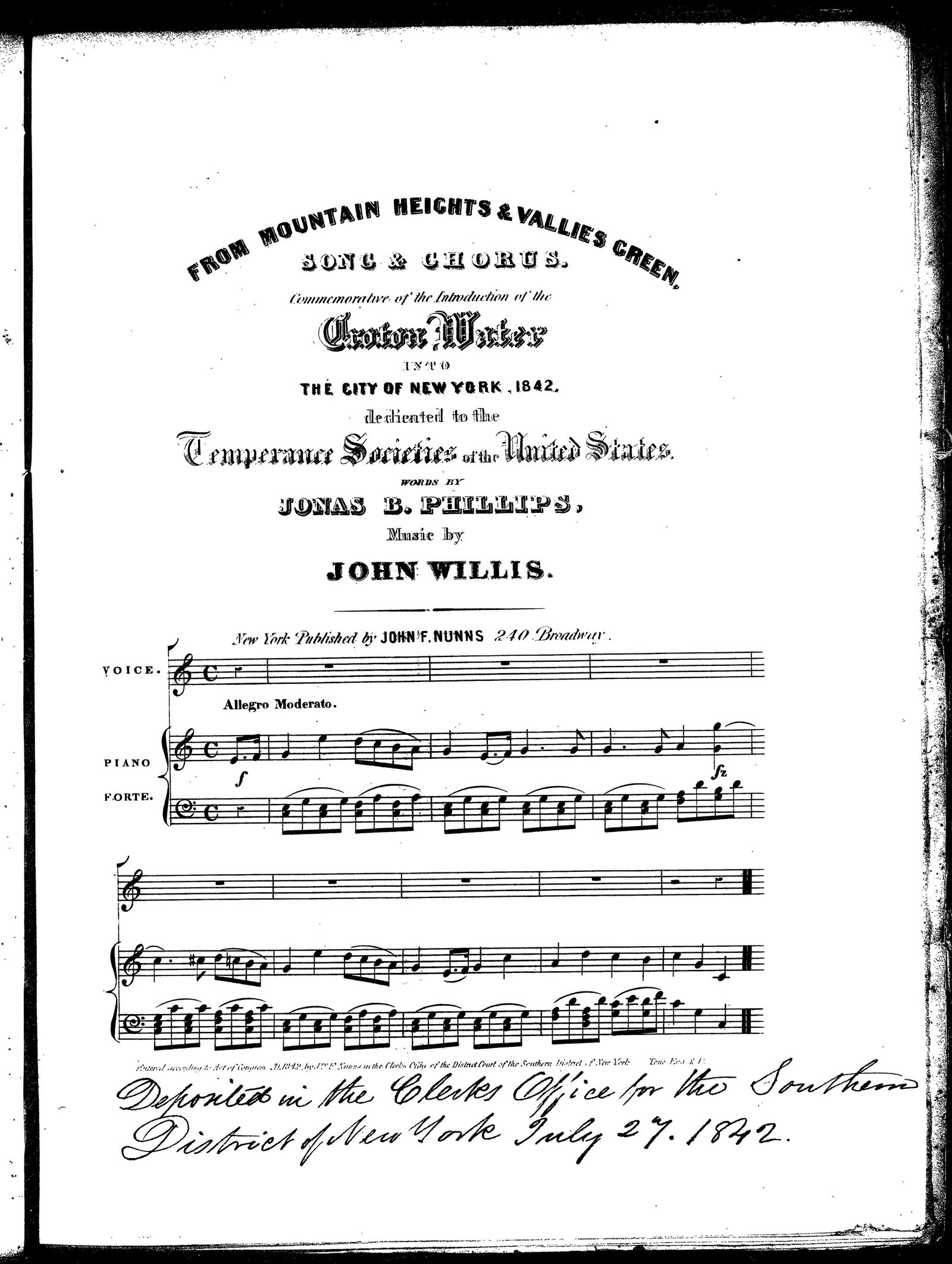
Title page of "From Mountain Heights & Vallies Green" by Jonas B. Phillips (1842). Sheet music for the Croton Water celebration, dedicated to the Temperance Societies. Library of Congress, Music Division.
In this story · 7 sections
On October 14, 1842, New York celebrated the Croton Aqueduct with a public procession and music. Charles King's account records the Sacred Music Society singing George P. Morris's commissioned ode near the Park Fountain. The celebration followed the arrival of water earlier that summer. [1]
The poems below show several ways of imagining water: a mythological visitor, relief from city heat, a resource for children and animals, and an ally of temperance. Their claims are poetic and political. They are not measurements of the aqueduct's effects on disease or drinking.
Read the verse, then explore the scores and recordings or the water celebration feature.
The Official Ode: George Pope Morris
George Pope Morris’s ode turns the arrival of water into a pageant. A mountain goddess travels toward the city with river spirits and woodland attendants. The commission was civic; the language was mythological.
For the Croton celebration, Morris wrote "The Croton Ode," set to music by Sidney Pearson on a chorus from Rossini's Armida. The ode was printed on broadsides distributed during the parade and sung in front of the fountain during the public celebration. Here is the complete poem as it appeared in Charles King's Memoir of the Construction, Cost and Capacity of the Croton Aqueduct (1843):
Gushing from this living fountain, [1]
Music pours a falling strain,
As the Goddess of the Mountain
Comes with all her sparkling train. [2]
From her grotto-springs advancing,
Glittering in her feathery spray,
Woodland fays beside her dancing,
She pursues her winding way.
Gently o'er the ripling water,
In her coral-shallop bright,
Glides the rock-king's dove-eyed daughter,
Deck'd in robes of virgin white.
Nymphs and Naiads, sweetly smiling,
Urge her back with pearly hand,
Merrily the sylph beguiling
From the nooks of fairy land.
Swimming on the snow-curled billow,
See the river spirits fair,
Lay their cheeks, as on a pillow,
With the foam beads in their hair. [3]
Thus attended, hither wending,
Floats the lovely Oread now,
Eden's arch of promise bending
Over her translucent brow.
Hail the wanderer from a far-land!
Bind her flowing tresses up!
Crown her with a fadeless garland,
And with crystal brim the cup.
From her haunts of deep seclusion,
Let Intemp'rance greet her too,
And the heat of his delusion
Sprinkle with this mountain-dew.
Water leaps as if delighted,
While her conquered foes retire!
Pale Contagion flies affrighted
With the baffled demon, Fire!
Safety dwells in her dominions,
Health and Beauty with her move,
And entwine their circling pinions
In a sisterhood of love.
Water shouts a glad hosanna!
Bubbles up the Earth to bless!
Cheers it like the precious manna,
In the barren Wilderness.
Here we wondering gaze, assembled
Like the grateful Hebrew band,
When the hidden fountain trembled,
And obeyed the Prophet's wand.
Round the Aqueducts of story,
As the mists of Lethe throng,
Croton's waves, in all their glory,
Troop in melody along.
Ever sparkling, bright and single,
Will this rock-ribbed stream appear,
When Posterity shall mingle
Like the gathered Waters here.
Morris imagined the Croton water as a classical goddess — an oread, a mountain nymph — attended by naiads and woodland fays, traveling from her "haunts of deep seclusion" to save the city. The poem is lush with mythological imagery: coral shallops, foam-beads, Eden's arch. But beneath the classical veneer lies a practical civic message. The fourth stanza addresses the temperance movement directly — "Let Intemp'rance greet her too, / And the heat of his delusion / Sprinkle with this mountain-dew" [3] — while the fifth celebrates water's defeat of the city's real enemies: disease and fire. The sixth stanza reaches for biblical grandeur, comparing the moment to Moses striking the rock. And the seventh amounts to a prophecy — that Croton's water will outlast everything else.
Morris's Summer Plea: "The Dog-Star Rages"
Morris wrote at least two other poems that reference Croton and the Hudson Valley. "The Dog-Star Rages," a comic poem about surviving summer in New York, imagines the city wilting under August heat until only one thing can save it — Croton water. The final stanza:
I'm weeping like the willow
That droops in leaf and bough — [4]
Let Croton's sparkling billow
Flow through the city now;
And, as becomes her station,
The muse will close her prayer:
God save the Corporation!
Long live the valiant Mayor!
Even in a humorous summer poem, Croton water is the answer to New York's suffering. The mock-heroic closing — "God save the Corporation!" — captures how deeply the aqueduct had become woven into the city's civic identity. Water was not just infrastructure; it was something you could pray for.
Morris's Highland Romance: "Where Hudson's Wave"
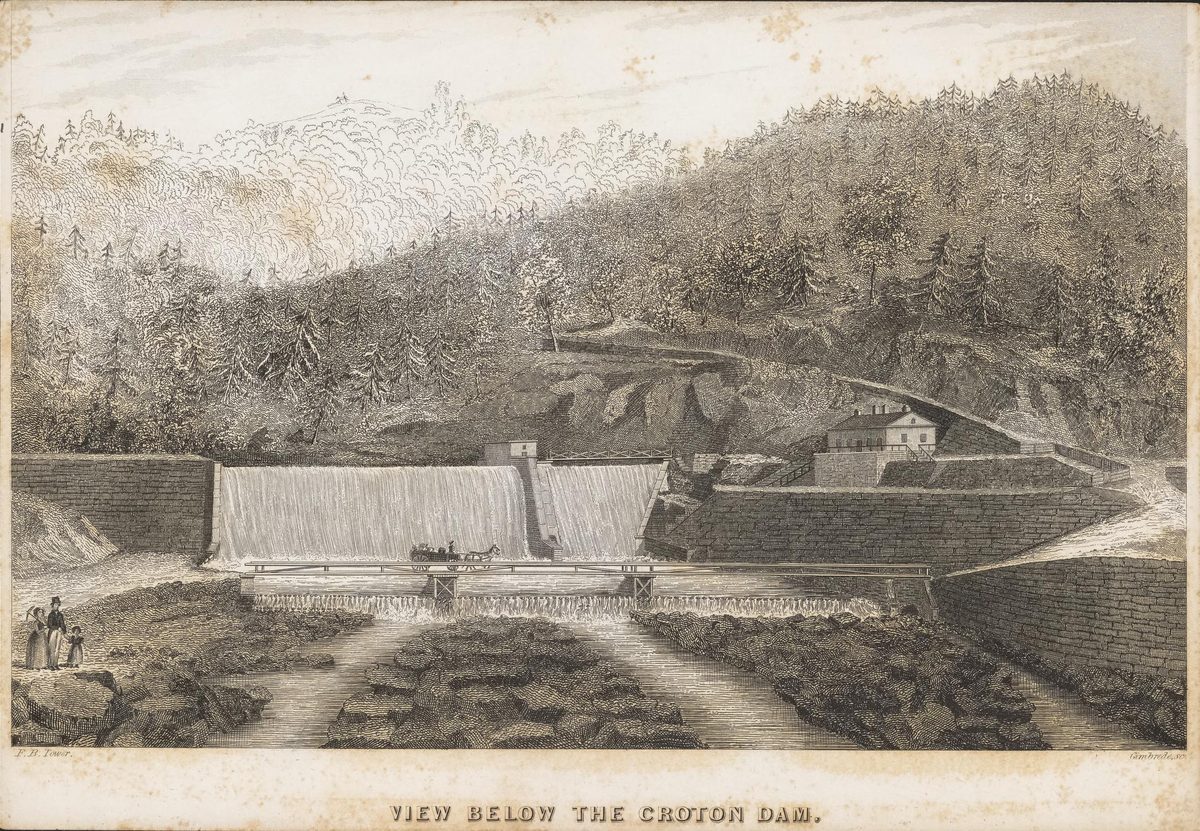
Morris’s “Where Hudson’s Wave” turns to the Hudson Highlands. Its “Old Cronest” is Crow’s Nest, and the landscape becomes the setting for a romantic address:
Where Hudson's wave o'er silvery sands [5] [6]
Winds through the hills afar,
Old Cronest like a monarch stands,
Crowned with a single star!
And there, amid the billowy swells [7]
Of rock-ribbed, cloud-capped earth,
My fair and gentle Ida dwells,
A nymph of mountain-birth.
My heart is on the hills. The shades
Of night are on my brow;
Ye pleasant haunts and quiet glades,
My soul is with you now!
I bless the star-crowned highlands where
My Ida's footsteps roam:
O for a falcon's wing to bear
Me onward to my home!
The phrase "rock-ribbed" appears in both this poem and the Croton Ode — a signature image for Morris, linking the Highlands landscape to the aqueduct that emerged from it.
The Children's Poem: Lydia Maria Child
Lydia Maria Child’s “The New-York Boy’s Song” follows water through the streets: to children, dogs, horses and drinkers offered an alternative to alcohol. Her abolitionist writing gives another context for a poem that repeatedly imagines a benefit shared by rich and poor. The verse appears in Flowers for Children. [8]
She is perhaps best remembered today as the author of "Over the River and Through the Wood" [9]. Her Croton poem has the same quality: deceptively simple, written for children, carrying a moral weight that reveals itself slowly. Here is the complete poem:
Oh, blessed be the Croton!
It floweth everywhere —
It sprinkles o'er the dusty ground,
It cooleth all the air.
It poureth by the wayside,
A constant stream of joy,
To every little ragged girl,
And chimney-sweeping boy.
Poor little ragged children,
Who sleep in wretched places,
Come out for Croton water,
To wash their dirty faces.
And if they find a big tub full, [10]
They shout aloud with glee,
And all unite to freight a chip,
And send it out to sea.
To the ever-running hydrant
The dogs delight to go,
To bathe themselves, and wet their tongues, [11]
In the silver water-flow.
The thirsty horse, he knoweth well
Where the Croton poureth down,
And thinks his fare is much improved
In the hot and dusty town.
And many a drunkard has forgot
To seek the fiery cup;
For everywhere, before his face,
Sweet water leapeth up.
Then blessings on the Croton!
It flows for man and beast,
And gives its wealth out freely, [12]
To the greatest and the least.
We city boys take great delight [13]
To watch its bubbling play,
To make it rush up in the air,
Or whirl around in spray.
It is good sport to guide a hose
Against the window-pane,
Or dash it through the dusty trees,
Like driving summer rain.
Oh, blessed be the Croton!
It gives us endless fun,
To make it jump and splash about, [14]
And sparkle in the sun.
And the Fountains in their beauty,
It glads our hearts to see —
Ever springing up to heaven,
So gracefully and free.
Fast fall their sparkling diamonds,
Beneath the sun's bright glance, [15] [8]
And like attendant fairies,
The shim'ring rainbows dance.
White and pure their feathery foam,
Under the moon's mild ray,
While twinkling stars look brightly down
Upon their ceaseless play.
And all about the crowded town, [16]
In garden, shop, or bower,
Neat little fountains scatter round
A small refreshing shower.
Perhaps some dolphin spouts it forth
To sprinkle flower or grass,
Or marble boy, with dripping urn,
Salutes you as you pass.
Then blessings on the Croton!
May it diminish never —
For its glorious beauty
Is a joy forever.
Child appended a note to the poem: "In former years, water was very scarce and very bad, in some parts of the city of New-York. But now an abundance of delicious water is brought from the river Croton, forty miles off. It runs under-ground, in big iron pipes. In every street, are conductors, called hydrants, from which small streams flow continually." [8]
Child’s poem makes a temperance argument. Clean water was not just an engineering achievement — it was a social reform. The verses move from ragged children washing their faces to dogs at hydrants to horses drinking — and then, suddenly, to "many a drunkard has forgot / To seek the fiery cup." [17] The poem's refrain — "It flows for man and beast, / And gives its wealth out freely, / To the greatest and the least" — frames water as a democratic resource, available to the poorest as equally as the richest. That reading follows the poem’s language; it should not be mistaken for proof that access to water was equal in practice.
Another celebration song: Jonas B. Phillips
There was another major poem written for the 1842 celebration — preserved in surviving sheet music. "From Mountain Heights & Vallies Green" by Jonas B. Phillips, set to music by John Willis, was a "Song & Chorus Commemorative of the Introduction of the Croton Water into the City of New York, 1842." [18] It was dedicated to the Temperance Societies of the United States and published by John F. Nunns at 240 Broadway. The copyright was deposited in the Clerk's Office for the Southern District of New York on July 27, 1842.
The original sheet music — five pages of voice and pianoforte in Allegro Moderato, with a three-part trio chorus — was digitized by the Library of Congress Music Division. The lyrics, transcribed from the scanned pages, reveal a temperance anthem that treats Croton water as divine deliverance. Here is the complete song:
From mountain heights and vallies green [19]
Rejoicing shouts ascend;
And gladsome voices on the breeze
In songs harmonious blend.
A mighty foe is overthrown,
Forever past his reign;
And all regenerated earth
Now raise this choral strain.
Chorus:
Drink! drink! the draught to cheer the soul [20]
From chrystal streamlets clear;
Away, away the madd'ning bowl
No longer tempts us here.
No more the spell of rosy wine
Enchains the human soul;
A purer draught, a gift divine,
Now mantles in the bowl;
A draught to cheer and nourish life,
To heal all earthly woes;
And free for all mankind to quaff
From nature's bosom flows.
Chorus:
Then drink the draught to cheer the soul
From chrystal streamlets clear;
Away away the madd'ning bowl
No longer tempts us here.
The fountain's in the sun's bright beams
Their dazzling gems display;
And countless are the silver streams
That wend their silent way;
Rich gifts are these of Heav'n divine
From which each blessing flows;
Imparting to the cheek of health
The bloom they give the rose.
Chorus:
Then drink the draught that cheers the soul
From chrystal streamlets clear;
Away away the madd'ning bowl
No longer tempts us here.
Phillips makes the temperance purpose explicit. His chorus turns away from the “madd’ning bowl” toward clear water. The sheet music supplies a way to perform that argument together: three vocal parts and piano accompaniment. The surviving score lets us read the words and hear how a public water supply became a subject for song.
The Nikko Tea House Verse: C.K. Nazu
A Nikko Tea House promotional postcard, dated approximately 1907–1910 in the archive, offers verse attributed to its manager, C.K. Nazu: [21]
Of Harmon on the Hudson
You surely must have heard,
But if you'll give attention
I should like a word,
About the Nikko Tea House,
On the wooded Croton's brink,
The situation picturesque;
The food is fine we think;
So get a horse or motor car,
And bring your friends along;
If you follow the road to Harmon,
You surely can't go wrong.
This is poetry doing the work of an advertisement. The wooded river, the food and the invitation to arrive by horse or motor car make Harmon a destination for an afternoon out. Its modest sales pitch contrasts with the grand civic language of the water-celebration poems.
What the Poems Tell Us
Read together, the six Croton poems trace an arc from civic grandeur to social conscience to commercial charm. Morris's ode treats water as classical mythology — nymphs and naiads, Rossini and broadsides. His "Dog-Star Rages" makes it comic salvation; his "Where Hudson's Wave" roots it in romantic landscape. Child's poem treats water as justice — clean faces for ragged children, freedom from the "fiery cup." Phillips's song treats it as divine deliverance from the "madd'ning bowl." Nazu's verse treats it as real estate — "the situation picturesque; the food is fine we think."
The poems offer different ways of imagining Croton. The water poems celebrate abundance and public benefit. Child gives that benefit an egalitarian language: water “for man and beast,” “to the greatest and the least.” The tea-house verse offers a different pleasure: a scenic river, a meal and an excursion with friends.
The Croton River still flows. The aqueduct still stands. The poems survive in archives, on postcards, and in the pages of a children's book by an abolitionist who understood that clean water was a form of freedom.
Updated October 16, 2026. Revised the introduction to distinguish the summer arrival of water from the October celebration, removed an incorrect link between yellow fever and contaminated water, and cleaned up repeated citations. Retained the verse, corrected the identification of Crow’s Nest and removed unsupported biographical and performance claims.
Citations
- A Memoir of the Construction, Cost, and Capacity of the Croton Aqueduct
- The Hudson, from the Wilderness to the Sea
- A Memoir of the Construction, Cost, and Capacity of the Croton Aqueduct
- The Dog-Star Rages (From Battery to Park) — George Pope Morris
- Where Hudson's Wave — George Pope Morris
- The Hudson River from Ocean to Source (Bacon, 1903)
- The Hudson, from the Wilderness to the Sea
- The New-York Boy's Song — Lydia Maria Child (1842)
- Clean Sweet Abundant Water
- O Blessed Be The Croton
- O Blessed Be The Croton
- O Blessed Be The Croton
- O Blessed Be The Croton
- O Blessed Be The Croton
- O Blessed Be The Croton
- O Blessed Be The Croton
- O Blessed Be The Croton
- John Quincy Adams Sends His Regrets
- From Mountain Heights & Vallies Green — Jonas B. Phillips (1842)
- Croton Water Sheet Music — Phillips/Willis (1842), Page 003
- If You Follow the Road to Harmon — C.K. Nazu (c. 1907)
- O Blessed Be The Croton
- O Blessed Be The Croton
Numbered citations link to the cited passage in the archive.
Sources Consulted
- Child, Lydia Maria. "The New-York Boy's Song." [22] Flowers for Children (1854). Internet Archive.
- King, Charles. A Memoir of the Construction, Cost and Capacity of the Croton Aqueduct (1843). Internet Archive. Full text of "The Croton Ode."
- Morris, George Pope. "The Croton Ode," "The Dog-Star Rages," "Where Hudson's Wave." Poems (1853). Project Gutenberg.
- Phillips, Jonas B. "From Mountain Heights & Vallies Green." Sheet music (1842). Library of Congress, Music Division. Lyrics transcribed from digitized pages.
- Nazu, C.K. "If You Follow the Road to Harmon." Nikko Tea House promotional postcard (c. 1907). crotonhistory.org.
- Wikipedia, "George Pope Morris" — co-founder of NY Evening Mirror, first publisher of "The Raven"
- Wikipedia, "Lydia Maria Child" — abolitionist, author of "Over the River and Through the Wood"
- crotonhistory.org, "O, blessed be the Croton!" [23] — context on the Child poem
- crotonhistory.org, "Croton's Waves in All Their Glory" — context on the Morris ode and Phillips sheet music
The source list includes the records used for this story. Explore more material in the Croton Historical Archive.