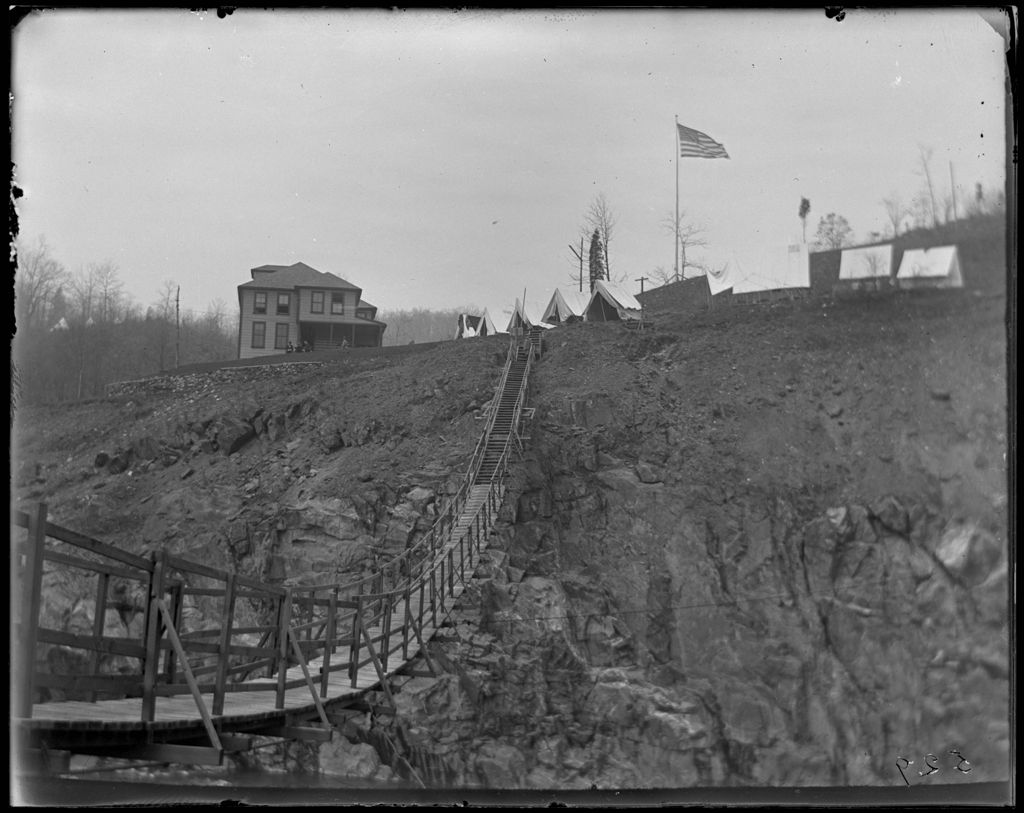
The Mount Vernon / Yonkers militia encampment in the valley below the Cornell Dam works, April 1900. Museum of the City of New York digital collections. Public domain.
In this story · 4 sections
Sergeant Robert Douglass was fatally shot while relieving guard at the Cornell Dam works on the night of April 16, 1900. The next day's Cortland Evening Standard described a dark hillside, a startled guard and a search that found no shooter. The dispatch called the killing an assassination. Its own details left the assailant unidentified. [1]
That distinction matters. Douglass's death occurred during a labor conflict involving Italian immigrant workers, contractors, deputies and state troops. The surrounding hostility does not identify who fired the shot.
A construction site under guard
The strike brought soldiers into the settlements around the unfinished New Croton Dam, also called the Cornell Dam. The April 17 report described troops entering the Bowery, where people watched from sidewalks, windows and stoops. Musicians played; a woman identified by the reporter as Bowery Kate danced. The article's vivid scene is a reporter's account, not a complete view of the community. [2]
The troops established a camp on excavated earth and stone, placed pickets around the works and controlled access at Bowery Bridge. Those details show how a workplace and residential settlement became a guarded zone.
Workers' dependence on labor brokers adds context. The later local history Water Over the Dam describes padrones managing recruitment, board and lodging, and deductions from pay. It helps explain the imbalance of power around construction labor, but it is a retrospective source and should be identified as such. [3]
What the shooting report actually says

The newspaper identifies Douglass as a member of Mount Vernon's Eleventh Separate Company. It places the shooting at 9:50 p.m., while he was speaking with Corporal McDowell and other guards. It reports that the men fired toward nearby bushes, then carried Douglass down the hill. [1]
The crucial limit follows in the same account: no one was reported to have seen the flash or heard the fatal shot. The soldiers' response therefore does not establish its direction or its author. The source supports an unidentified shooting; it does not support assigning the killing to a striker, a deputy, a labor broker or any other imagined suspect.
Twenty-six arrests
The April 20 dispatch describes Sheriff Molloy's search of the Bowery and Little Italy. Troops blocked routes out while deputies searched homes. The report announced twenty-six arrests and described weapons and ammunition being seized. It reported little resistance, apart from one man who tried to escape. [4]
The continuation reported nineteen prisoners sent to White Plains and seven, arrested without warrants, held for an appearance before the local judge. The same reporting described some militia companies breaking camp and workers leaving the area. These are observations from a particular stage of the dispute. They do not establish the later disposition of every charge or every worker's reason for leaving. [5] [6]
A record weighted toward authority
These dispatches give us names, movements and a chronology of state action. They offer much less access to workers' own explanations. Descriptions of armed Italians and official alarm should be read with that imbalance in mind. An arrest is evidence that authorities acted; it is not a verdict.
The newspaper’s perspective matters when reading its language about the strikers. Officials’ fears and the workers’ conduct are different kinds of claims.
The dam remains a public monument to engineering. The strike belongs beside that history because it concerns the terms under which people built it. Douglass's death is a documented part of the conflict. The same landscape holds the achievement of the completed dam and the conflict over the work that produced it.
Continue with the dam workers' settlement and Croton Landing's working waterfront.
Updated October 16, 2026. Rewritten around the April 17 and 20 newspaper dispatches. Removed invented shooting details, speculative suspects, unsupported “largest strike” and “first discovery” claims, and conclusions about charges or strike outcomes not established by those reports.
Citations
- SERGEANT MURDERED — First Bloodshed in Croton Landing Strike
- SERGEANT MURDERED — First Bloodshed in Croton Landing Strike
- Water Over the Dam
- TWENTY-SIX ARRESTS — Military Authorities Busy in Vicinity of Strike
- TWENTY-SIX ARRESTS — Military Authorities Busy in Vicinity of Strike
- TWENTY-SIX ARRESTS — Military Authorities Busy in Vicinity of Strike
Numbered citations link to the cited passage in the archive.
Follow the evidence
Sources are linked beside the claims they support. Numbered notes open archived passages; named links open the cited record or publication.