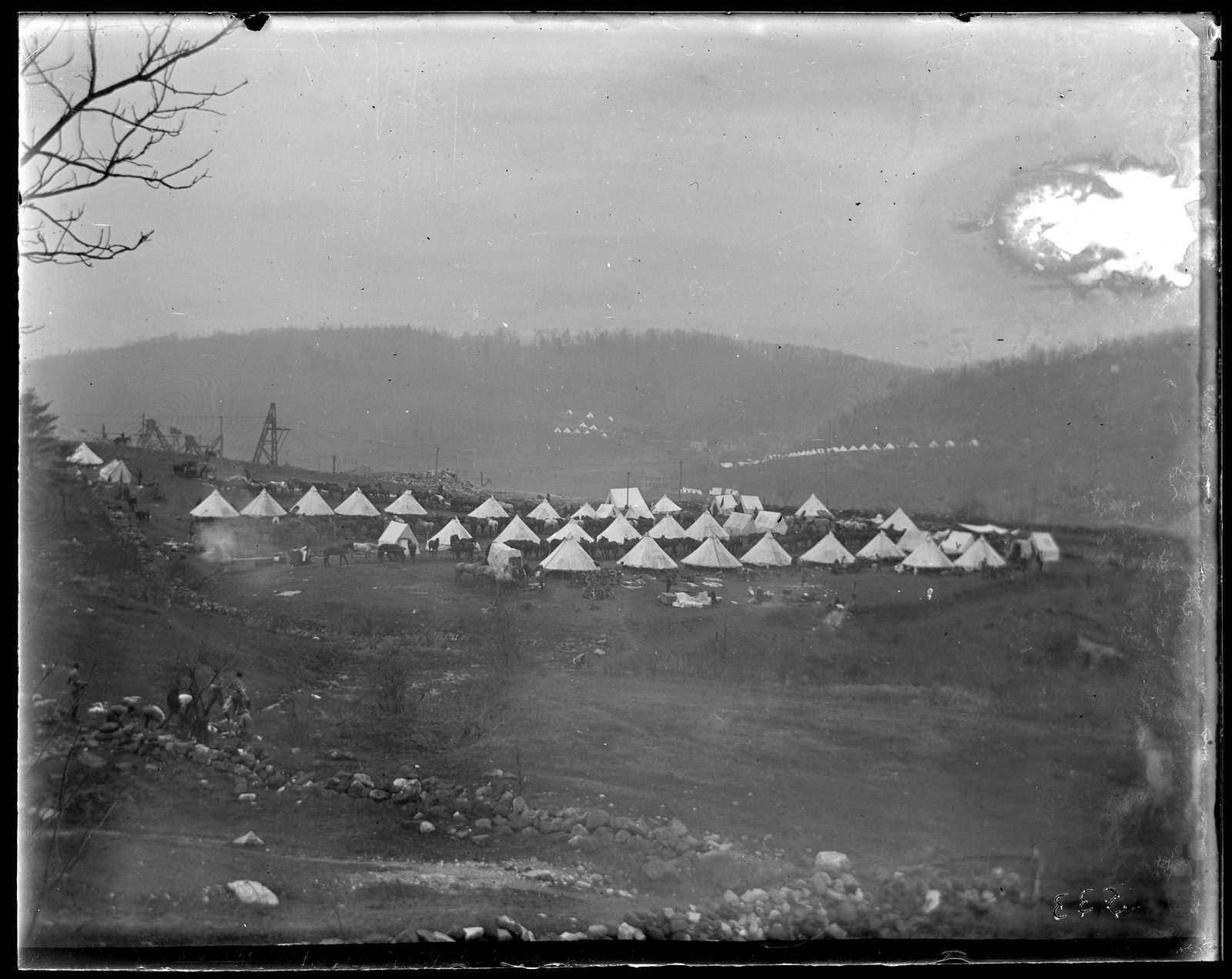
Photograph of Camp Roosevelt, the National Guard camp established at Croton Landing in April 1900 to break the Italian workers' strike at the New Croton Dam. From the George Stonebridge glass plate collection.
In this story · 4 sections
Croton Landing was a working place before it was a park name. The waterfront connected river transport, rail transport and the construction projects inland. Today's Riverwalk invites a slower encounter with that shore, but its public space also has a history of planning and construction.
A landing for materials and people
A local historical sketch published in 1940 remembered wagons and trucks carrying granite and cement from Croton Landing to the new dam. Its account connects the waterfront to the building site and recalls the Italian and American artisans who remained in the village after construction ended. It is a retrospective account, written with pride in the community, rather than a daily construction log. [1]
The same passage lists mills, furnaces, brickyards, boats and barges among industries that had become part of the community's past. It gives a useful sense of the working waterfront, but it should not be read as a parcel map. The historical community called Croton Landing covered more than today's park footprint.
The strike reaches the station
In April 1900, the landing was part of the transport network around the dam strike. Newspaper reporting recorded troops at the works and, after a raid on the workers' settlements, prisoners taken through Croton Landing on their way to jail. [2]
That connection gives the waterfront another history: not just materials arriving for a celebrated public work, but soldiers arriving and arrested workers leaving. The reporting must be read critically—it records accusations and official actions, not proof of the arrested men's guilt. The strike and Sergeant Douglass examines those dispatches.
Building the Riverwalk
The village's May 2008 newsletter describes the park project while work was still under way. It anticipated a 2,300-foot Riverwalk extension, new landscaping, parking and a multi-use field. The field was expected to remain unavailable until its turf had time to establish in 2009. The newsletter also identified county funding for the Riverwalk and a state grant toward other facilities. Village newsletter, May 2008
This contemporary planning record is more useful than an invented description of what opening day must have looked like. It shows a waterfront assembled through design, funding and phased work.
Two meanings of Croton Landing
Keep the older settlement and the present park distinct when reading photographs, newspaper datelines and maps. A report datelined Croton Landing is not necessarily describing an event within the modern park boundary. Likewise, the Croton River's mouth and the Hudson waterfront should not be collapsed into one location.
The name allows a visitor to connect the pleasant public shore with the less picturesque operations that helped make the village. The river carried trade; the railway carried workers and troops; the park now carries a different kind of public traffic.
Updated October 16, 2026. Removed unsupported claims about the village’s naming motives and corrected the conflation of the historical landing, modern park and Croton River mouth. The park-development account now uses the village’s 2008 construction report.
Citations
Numbered citations link to the cited passage in the archive.
Follow the evidence
Sources are linked beside the claims they support. Numbered notes open archived passages; named links open the cited record or publication.